AI Video Analysis That Acts on What It Sees
AI video analysis for security cameras usually means a smarter label on a clip: "person detected," "vehicle seen." PerimeterEye goes further — it is an Automatic Property Defense System: its AI writes a full plain-language analysis of every event on every camera, assigns a live threat level, and — when a threat is verified — acts on the property in seconds, commanding the hardware to respond with light, voice, and sound while you watch live.
 View photo
What PerimeterEye adds
Same camera. A different outcome.
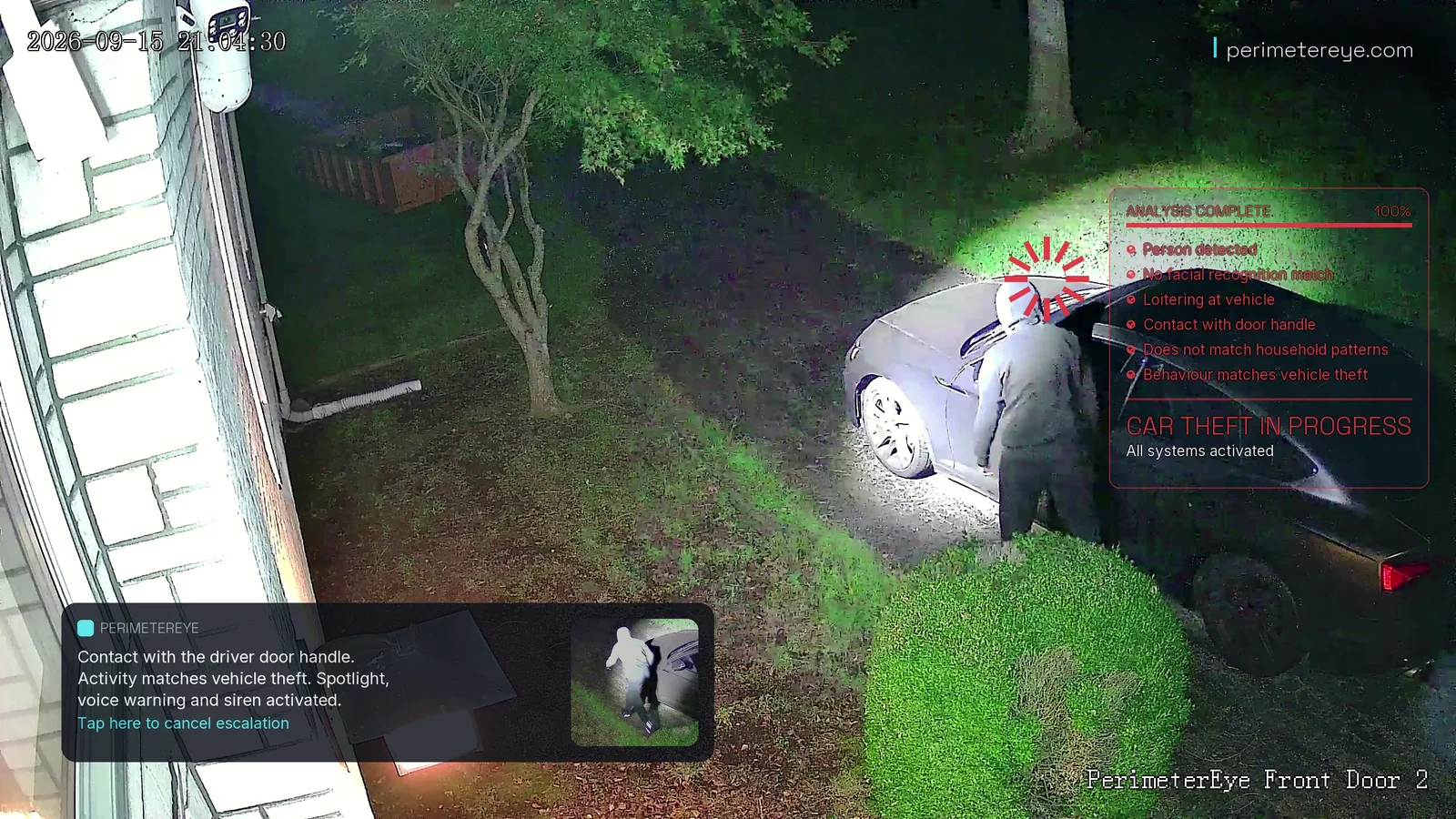
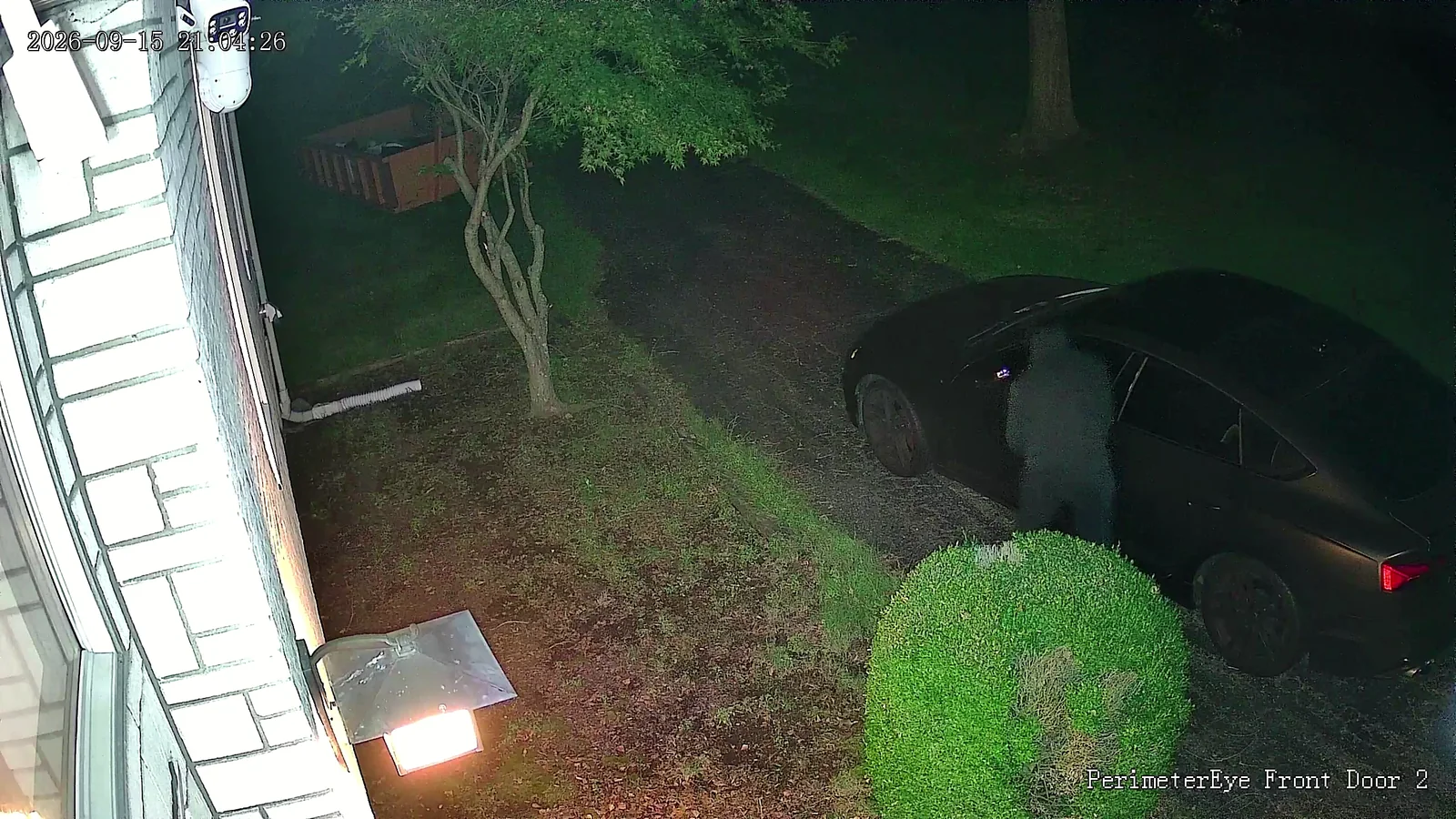
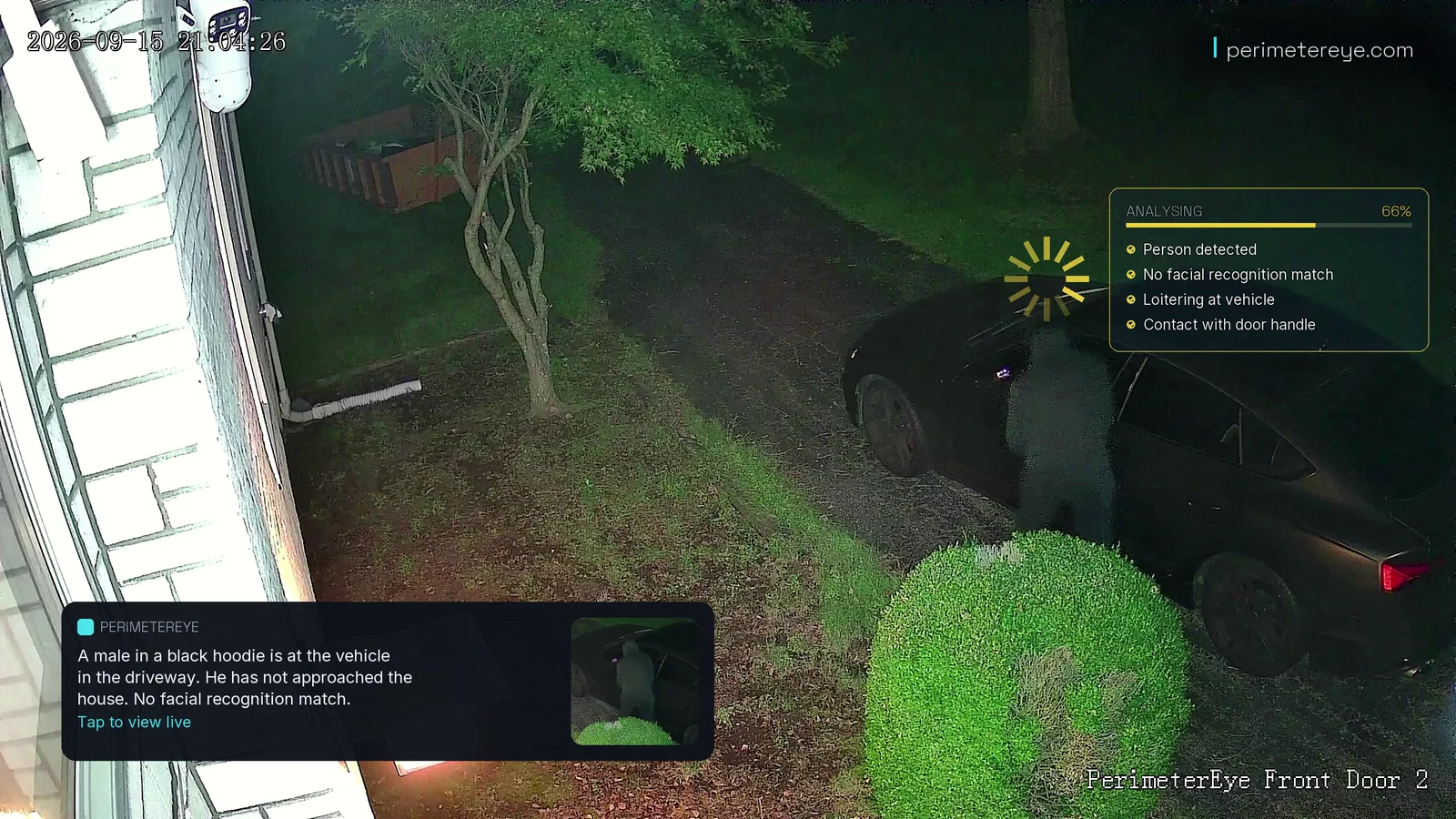
One camera and one staged break-in, shown three ways: the view on its own, with PerimeterEye’s analysis, and with its response hardware.
1 of 3 · A camera aloneView full size
It records
A person at the driver’s door, on a camera that records. Unless someone opens the clip in time, nothing else happens.
2 of 3 · UnderstoodView full size
The same view, understood
PerimeterEye reads the same moment: a person, no match to anyone it knows, loitering at the vehicle, contact with the door handle. The alert describes them in plain language.
3 of 3 · AnsweredView full size
The same view, answered
With a tracking searchlight, a siren, and AI voice warnings, the camera’s view directs a response. Four seconds later, the searchlight is on the person at the driver’s door.
Stills from a vehicle break-in staged for filming on a real property, on the Front Door 2 camera’s clock (21:04:26 and 21:04:30). The system’s response was automatic, with no operator.
What changes
Analysis That Commands Hardware
- Every event on every camera gets a full written analysis, not a one-word label.
- A live threat level decides what the hardware does next — light, voice, then siren.
- Daily briefings and plain-language search turn footage into a record you can actually read.
Most video AI ends at a notification. It can tell you a person crossed your driveway, but the telling is the whole product — you still have to open the app, judge the situation, and decide what to do about it. PerimeterEye's analysis sits at the front of a response ladder instead: verification, a tracking searchlight, a live targeted voice, and a 130 dB siren, with priority alerts and live video reaching you throughout.
The writing itself pays off daily, not just during incidents. Because every event gets a plain-language analysis, your property's history becomes something you can read and search rather than a wall of thumbnails — and the daily briefing condenses it all into the two minutes you'll actually spend.
What every system includes
- On-site edge computer (the Brain)
- 4K AI cameras
- Tracking searchlights
- Live targeted AI voice
- 130 dB siren escalation
- Doorbell video intercom
- Wall panel command center
- iOS app with live 4K video
01
A Written Analysis of Every Event
When something happens on your property, PerimeterEye's AI doesn't just tag the clip. It writes a full plain-language analysis: who or what appeared, where they went, how they behaved, and how the moment fits what the system knows about your household. A delivery reads as a delivery. A stranger circling toward a side gate reads very differently — and the write-up says so.
Each event is classified — delivery, resident, visitor, vehicle, service worker, or unknown — and carries a live threat level that updates as the situation unfolds. You get the judgment, not just the pixels. That matters at 2 a.m., when nobody wants to squint at a thumbnail and guess.
02
Alerts That Matter, Silence That's Earned
Alert fatigue is the quiet failure mode of camera ownership. When every branch and headlight pings your phone, you stop looking — which means the one alert that matters arrives pre-ignored. PerimeterEye's answer is judgment before notification: the system knows the household, so family arrivals and the regular mail carrier never trigger deterrence.
Unknown people and vehicles get scrutiny proportional to their behavior and your current mode. The result is a phone that stays quiet until quiet would be a mistake — and when an alert does arrive, it comes with the written analysis and live threat level attached, so one glance tells you whether to watch, talk, or escalate.
03
Labeling Clips Is Still Monitoring
Here's the honest line between categories. Ring, Nest, and their peers have genuinely good AI labeling — people, packages, vehicles, and on some cameras animals. But a smarter label on a notification is still monitoring: the system watches, records, and tells you. The distance between "person detected" and something actually being done about that person is the entire product gap.
PerimeterEye's analysis commands hardware. When the AI verifies a threat, a motorized searchlight locks onto the person and physically follows them, the system addresses them by description in live AI speech, and if they persist, a 130 dB siren fires alongside priority alerts with live video. The analysis is the brain; the property is the body.
04
Daily Briefings and Plain-Language Search
The AI also composes a daily briefing report: what happened, who came and went, anything worth a second look. It's the difference between owning footage and knowing your property. Most days the briefing is pleasantly boring — which is exactly what you want it to be.
And because every event has a written analysis, everything is searchable in plain language. Ask for "the white van from last Tuesday" or "anyone near the garage after midnight this month" and get the matching events with their write-ups — not a scrubbing session through hours of video.
05
You Stay in Command
PerimeterEye is not an alarm-monitoring service — alerts and control go directly to you. There is no operator between you and your property: you can watch live in 4K, speak through any camera, take manual control of a spotlight, or let the escalation ladder run automatically while you decide.
And because the intelligence lives on the on-site PerimeterEye Brain — a true edge computer, not a recording box — core defense keeps working during internet outages: live view, recording, rewind, the siren, and the spotlights all stay on the job.
What separates PerimeterEye
What the alert actually says.
Detection names an object. Analysis describes what is happening.
| Option | What the alert says | What happens next |
|---|---|---|
| Motion detection | “Motion detected.” | You decide, if you open it. |
| Person detection | “Person detected.” | You decide, if you open it. |
| PerimeterEye analysis | “A male in a black hoodie is at the vehicle in the driveway. He has not approached the house.” | When the activity warrants it, the Brain starts the response. |
Watch it at full speed
The same response, on film.
Real footage of the working system. Play it with sound to hear the voice warning and the siren.
A staged vehicle break-in on a real property. Voice warning, tracking searchlight and a 130 dB siren — automatic, on-site, no operator. The scenario was staged for filming; the system's responses were not.
Play with sound to hear the voice warning and siren.What it costs
See what a system costs for your property.
Essential system
As low as$146/mo*Essential covers a driveway and the approaches to the house. Larger properties usually suit Advanced or Estate; a specialist can size it with you before you order.
What’s included
- 5 ultra-HD 4K cameras
- 1 tracking spotlight
- 1 speaker/siren unit
- PerimeterEye Access intercom, included with every complete system
- 1 PerimeterEye control panel
- 1 PerimeterEye AI processor
*Essential system, $0 down: 36 monthly payments of $145.17 at 10% APR on the hardware price before sales tax, shown rounded up to the dollar. Affirm rates 0–36% APR; Klarna terms are shown at checkout. Subject to eligibility and lender approval; your rate, term and down payment may differ. US only; not available in all states. Software is billed separately: first 6 months included, then $99/month.
Before you choose
Common questions
What does the AI actually write about each event?
A plain-language account of what happened: who or what appeared, how they were classified — delivery, resident, visitor, vehicle, service worker, or unknown — how they behaved, and the threat level the system assigned. Every event on every camera gets one, and every analysis stays searchable in plain language afterward.
How is this different from AI detection in Ring or Nest cameras?
Those systems use AI to label clips and send smarter notifications — genuinely useful, but the response is still you. PerimeterEye's analysis drives hardware: a verified threat gets a tracking searchlight, a live targeted voice warning, and a 130 dB siren if they persist, while you watch live from the app.
Can I really search my footage in plain language?
Yes. Because the AI writes a description of every event, you can search the way you'd ask a person: "the red pickup on Thursday," "anyone at the front door after 10 p.m. last week." The system returns the matching events with their full analyses — no timeline scrubbing required.
Will I get fewer false alerts?
That's the design goal. The system knows the household, so family arrivals and regular mail carriers never trigger deterrence, and classification separates a delivery from a prowler. Alert volume drops because judgment happens before notification — you hear about what matters, with a written analysis attached, not every motion event.
What does AI analysis change about alerts?
Every event is examined, written up, and scored, so genuine threats don’t drown in noise, and everything that happens on your property is documented in plain language for later. When the activity warrants it, the analysis starts the response.
Keep exploring
Related reading
Put a response behind your property.
Tell a specialist about your property, your driveway, and where people approach. They’ll size the cameras, searchlights, and sirens with you, or book a call first if you’d rather talk it through.
Explore an upgrade for your existing camerasSystem launch offer
Your first 6 months
of service included.
First 6 months included from activation. Then $99/month.
Compare system packages