A Searchlight That Locks On and Follows
A spotlight that follows movement — a powerful light that locks onto a person and physically tracks them across a property — barely exists as a buyable product. Motion floodlights blast a fixed cone and time out. PerimeterEye's motorized tracking searchlights rotate 355 degrees, tilt 90, and follow a verified intruder wherever they move, while a live AI voice tells them exactly what it sees.
 View photo
Frame by frame, in infrared
Three seconds from the alert to the searchlight.
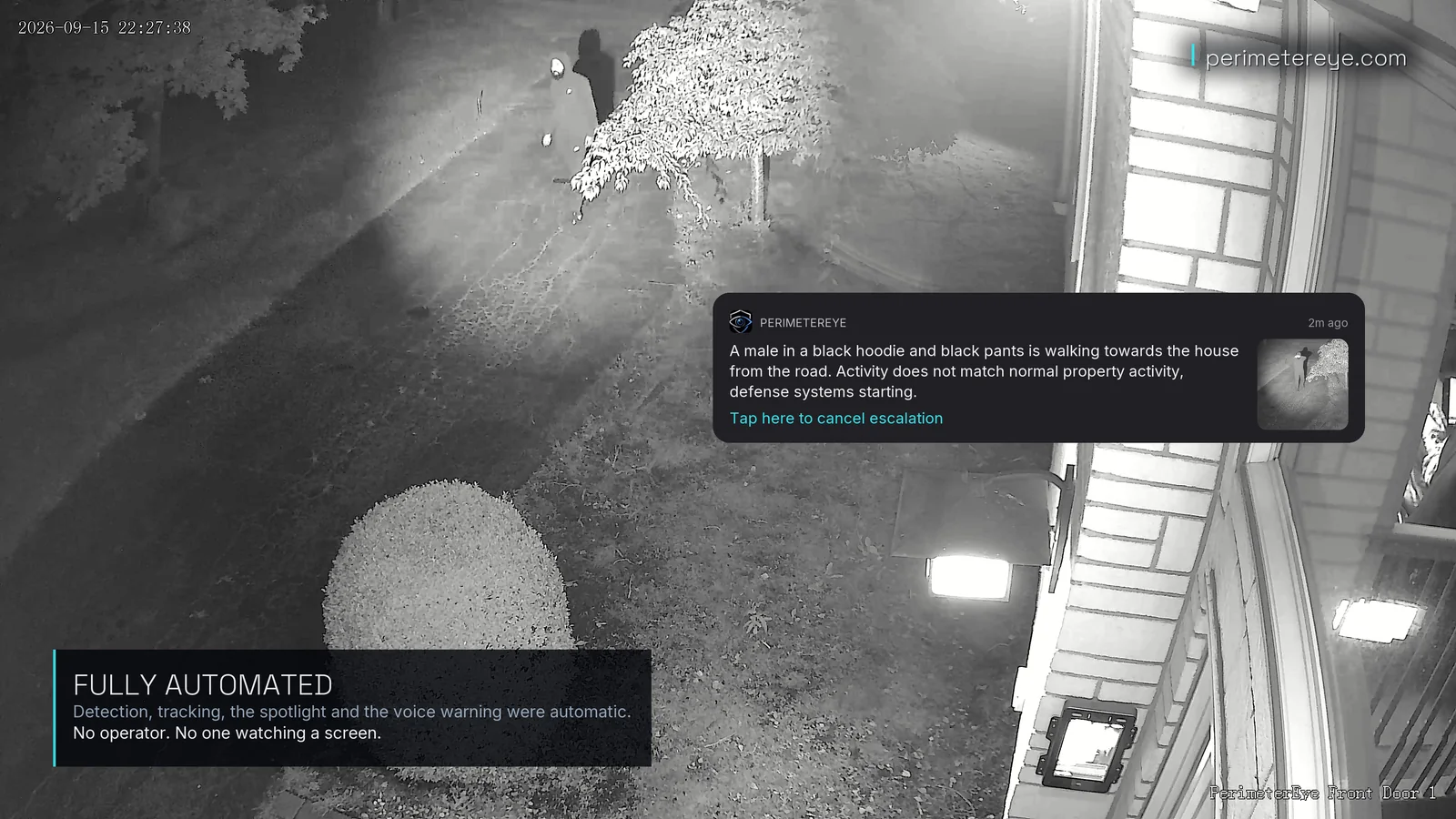
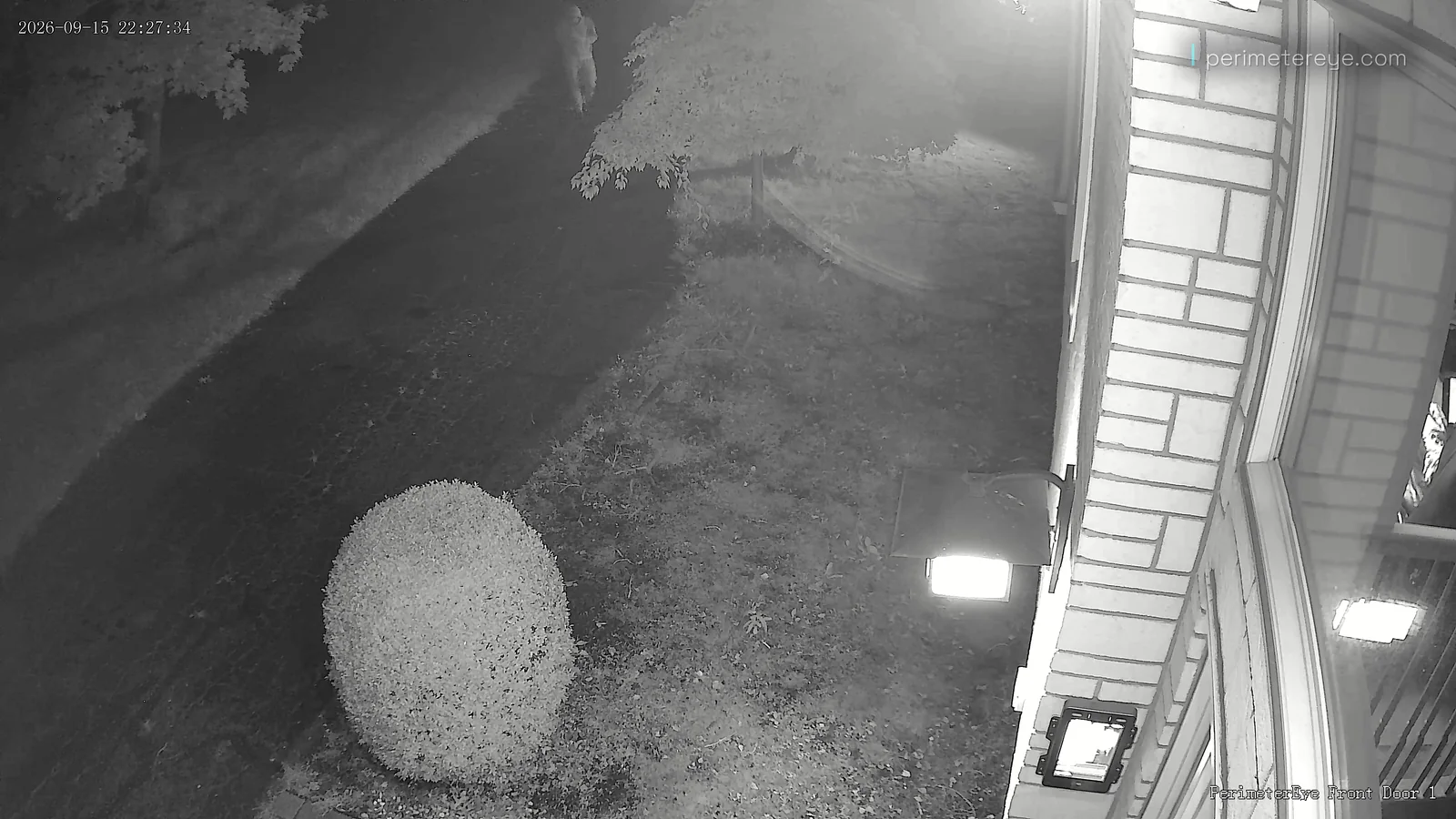
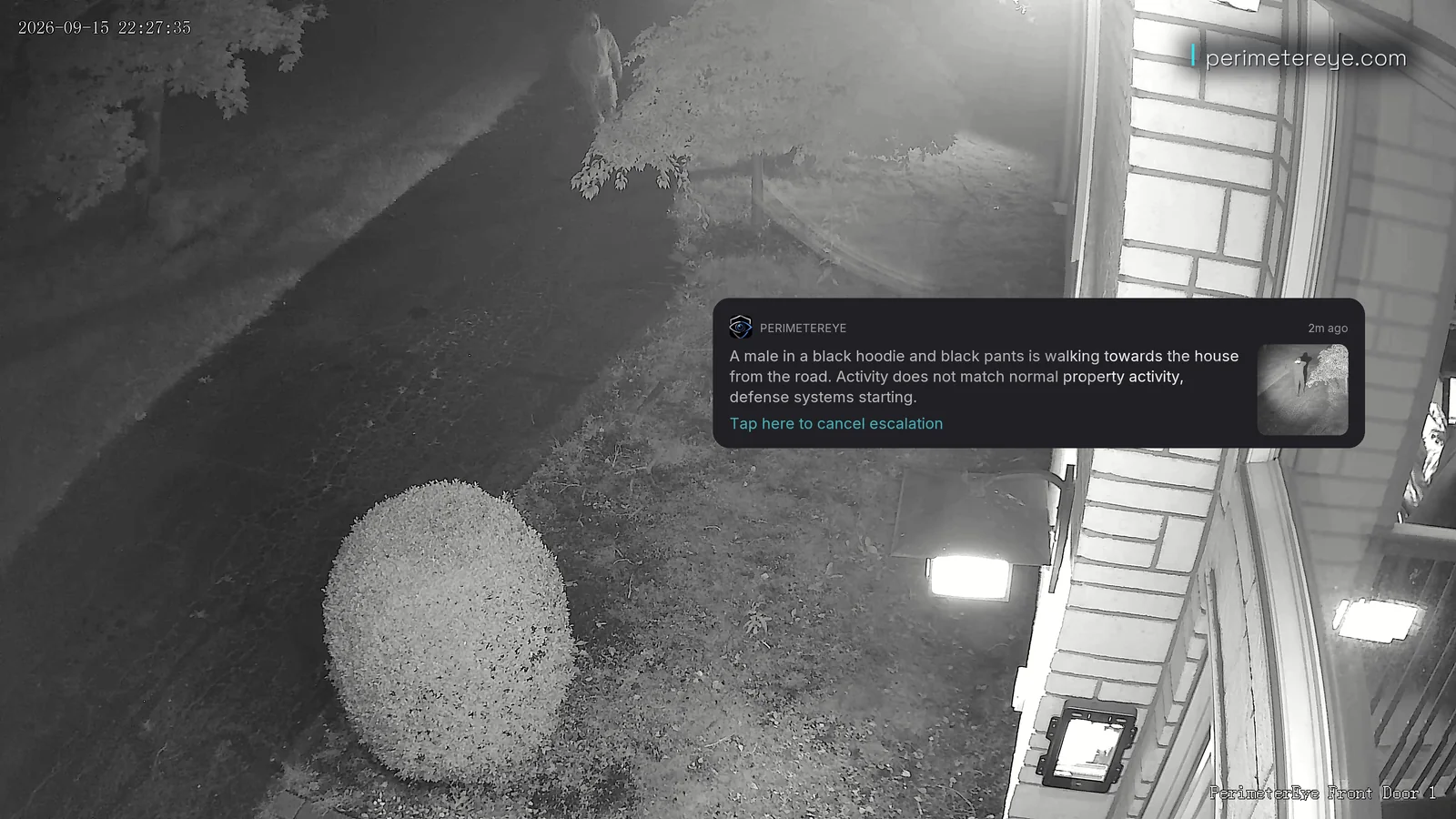
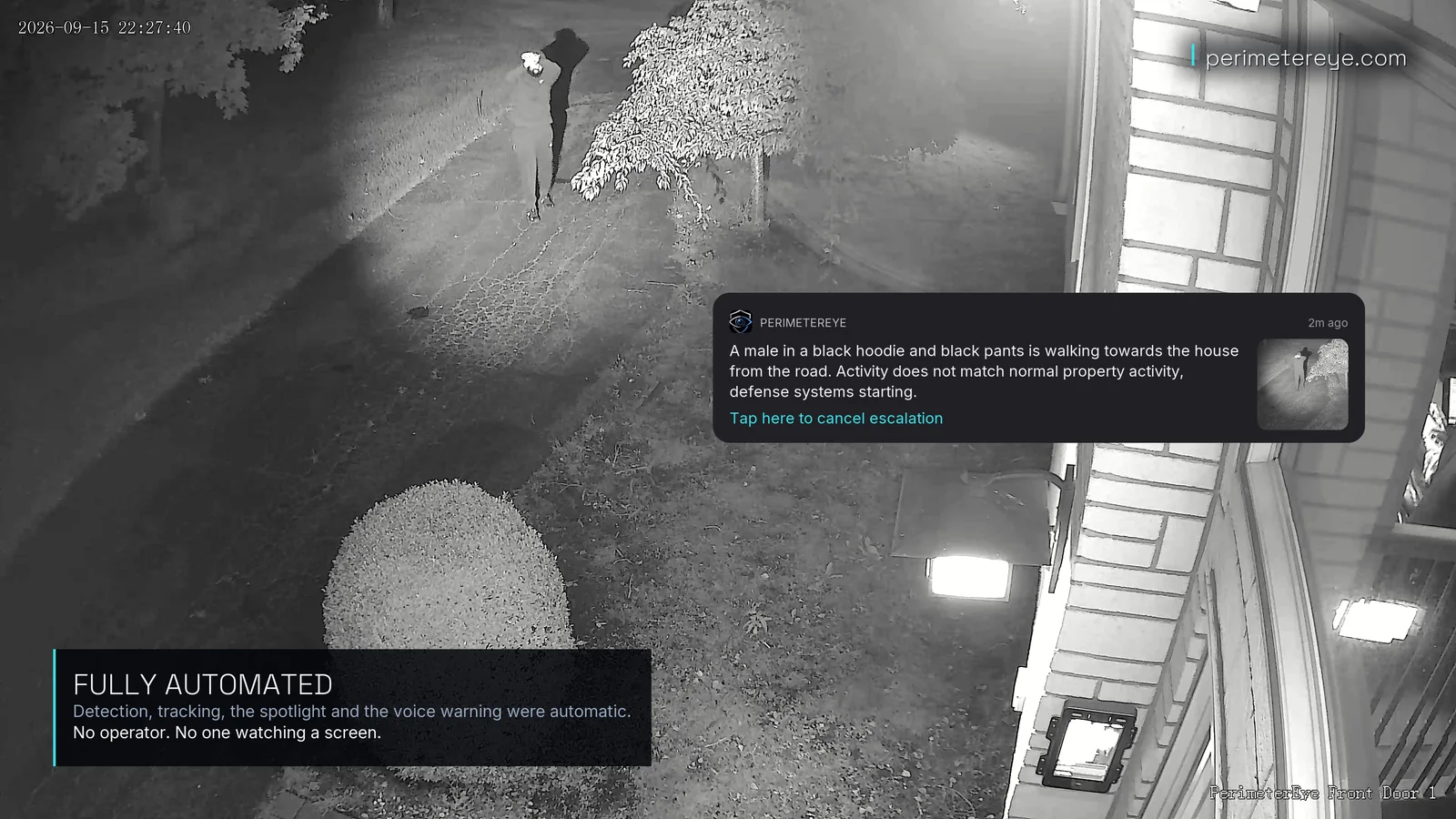
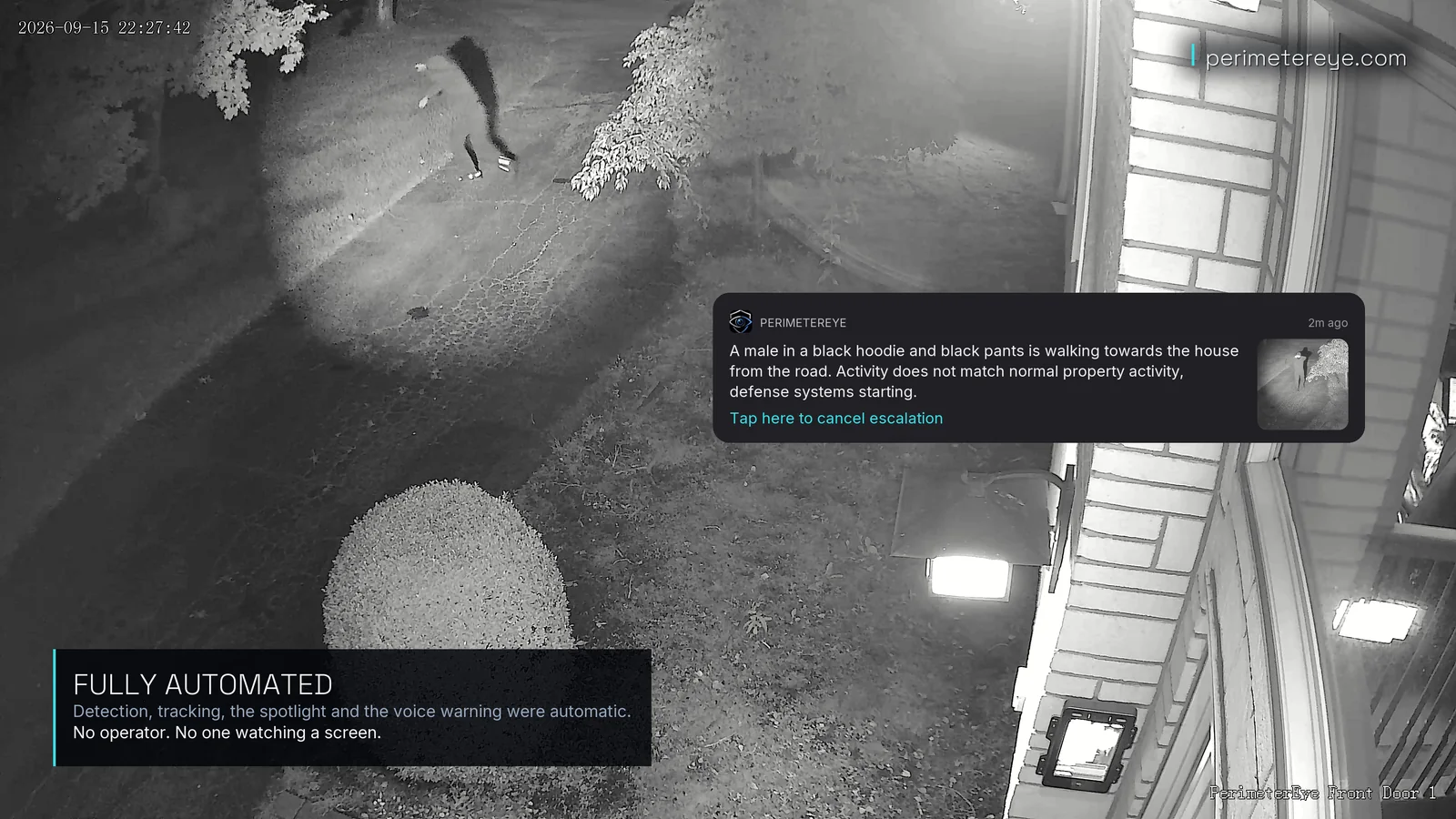
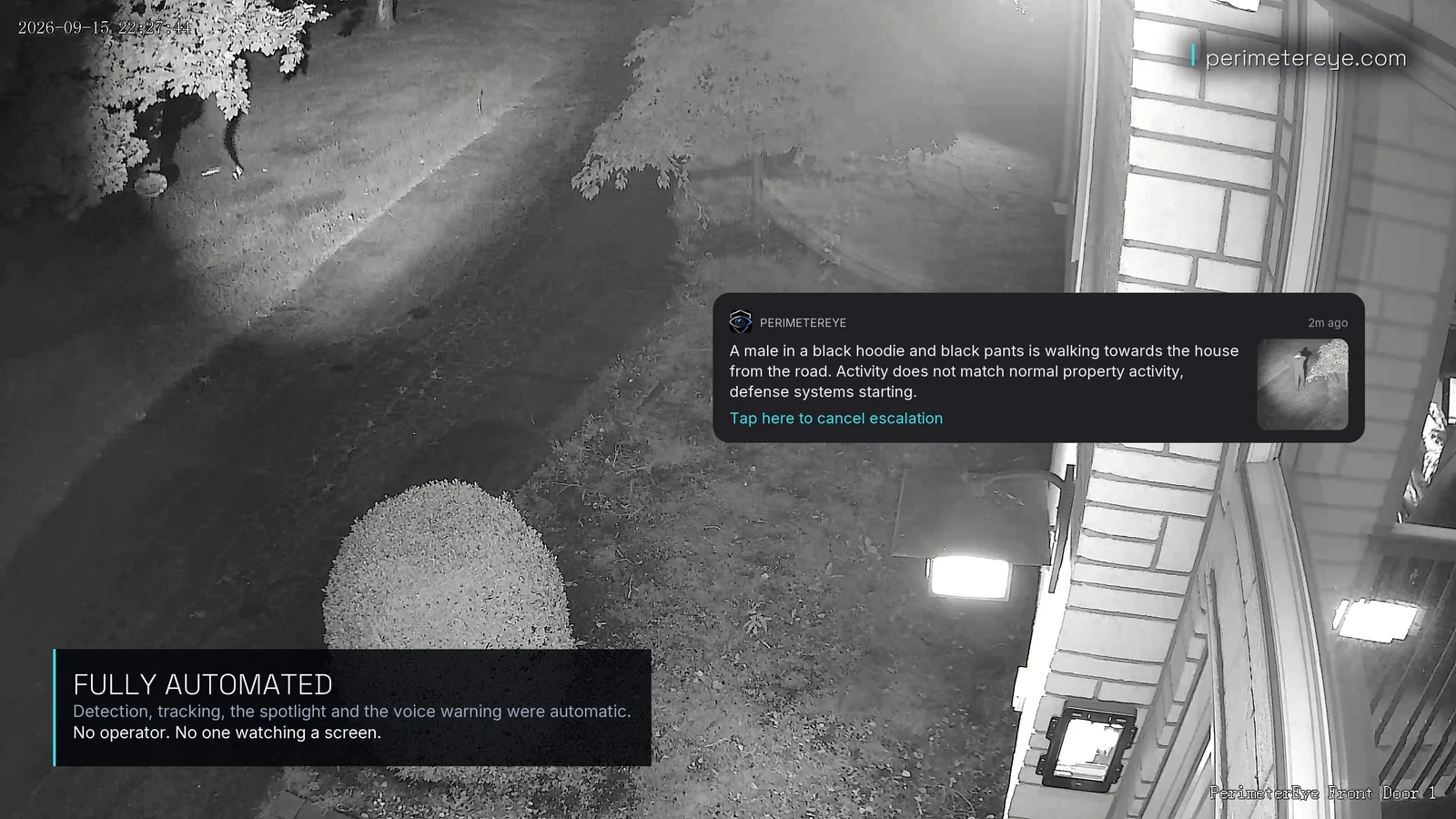
Front Door 1, on the camera’s own clock. The person is visible at the road end at 22:27:34, the alert describes them at 22:27:35, and the searchlight is on them at 22:27:38. By 22:27:42 they are turning away.
1 of 6 · 22:27:34View full size
Walking in from the road
At the far end of the driveway, in the dark, the person is already in view of the camera.
2 of 6 · 22:27:35View full size
The alert
The alert reads: walking towards the house from the road; activity does not match normal property activity; defense systems starting.
3 of 6 · 22:27:38View full size
In the searchlight
Three seconds after the alert, the searchlight is on the person by the tree. Detection, tracking, the light, and the voice warning were all automatic.
5 of 6 · 22:27:42View full size
Turning away
Four seconds in the light, and the person turns away from the house. The beam goes with them.
6 of 6 · 22:27:44View full size
Followed off the lawn
The searchlight stays on them to the edge of the camera’s view.
Filmed September 15, 2026, on a real property with PerimeterEye cameras and a searchlight. The approach was staged for filming; the system’s response was automatic, with no operator.
What changes
The Light That Answers Movement With Movement
- Every PerimeterEye spotlight tracks — 355 degrees of rotation, 90 degrees of tilt, searchlight-class output.
- It locks onto a verified person and physically follows them, like a police helicopter beam.
- Each night it runs a visible Perimeter Sweep that never crosses your property line.
PerimeterEye ships the product this search implies but the market never built: a motorized, searchlight-class beam that locks onto a verified person and follows them across the property. Every spotlight in every package tracks — there is no cheaper static tier to accidentally buy.
The searchlight is one rung of a ladder that runs by itself: verification, lock-on, a live AI voice that describes the specific person in frame, then the 130 dB siren and priority alerts with live video. You can watch, talk, or take the controls at any point, from the wall panel or the app.
What every system includes
- On-site edge computer (the Brain)
- 4K AI cameras
- Tracking searchlights
- Live targeted AI voice
- 130 dB siren escalation
- Doorbell video intercom
- Wall panel command center
- iOS app with live 4K video
01
The product you searched for mostly doesn't exist
Search for a spotlight that follows movement and you'll find two things pretending to be it. Motion floodlights: a fixed cone that snaps on when anything warm passes and snaps off ninety seconds later. And auto-tracking cameras: lenses that pan silently to keep a subject in frame while nothing on the property visibly changes.
Neither is the thing you pictured — a searchlight that finds a person and stays on them. That category is essentially empty at the residential level, which is why people describe what they want in analogies: a police helicopter beam, a prison guard tower light. PerimeterEye built exactly that, as one part of an Automatic Property Defense System.
02
Being followed by a light is categorically different
A floodlight tells an intruder something moved here. A tracking searchlight tells them we see you, and we are still watching. When the beam swings over, locks on, and then moves when they move, the ambiguity trespassers rely on — maybe it's a timer, maybe nobody noticed — is gone. They, specifically, have been seen.
Homeowners who watch it work reach for the same two comparisons: a police helicopter searchlight and a prison guard tower spotlight. That instinct is the point. Those lights changed behavior not because of raw lumens but because of what the tracking communicates — individual acknowledgment, delivered in real time.
03
How the lock-on works
Each spotlight is motorized with 355 degrees of rotation and 90 degrees of tilt, driving searchlight-class output — a different class of light from a porch floodlight. When the AI verifies a person who shouldn't be there, the nearest spotlight locks onto them and physically follows as they move across the property.
Verification comes first, always. The system knows the household, so family arrivals, registered guests, and the mail carrier never get lit up. The searchlight is reserved for people and vehicles the AI cannot account for — which is exactly what keeps the signal credible to the one person it is meant for.
The light doesn't act alone. It is step two of an escalation ladder: verify, lock on and follow, then a live targeted AI voice — "You, in the dark hoodie — you are not authorized to be on this property" — and, if they persist, a 130 dB siren with priority alerts and live video to your phone.
04
The nightly Perimeter Sweep
One hour after sunset, every night, the spotlights run a Perimeter Sweep: a slow, visible patrol of your property line. It is configurable — path, timing, behavior — and it never crosses the property boundary, so it announces the system to the street without spilling light into a neighbor's window.
The sweep exists because deterrence starts before anyone steps on the grass. A property whose lights visibly patrol reads as defended from the sidewalk, and offender interviews consistently rank visible signs of security among the top factors in choosing a target (Kuhns et al., 2013, an industry-funded survey of 422 incarcerated burglars). Anyone casing the street learns in one pass that this house notices things.
05
You hold the controls
Automation runs the ladder; you keep command. From the iOS app or the wall panel you can watch the track live in 4K, speak through the cameras with two-way audio, or take manual control of any spotlight at any moment. Modes — Off, Quiet, Visitor, Armed, High Alert, Maximum Security — set how assertive the system is, and there is nothing to arm or disarm.
And because the spotlights are driven by the on-site PerimeterEye Brain, tracking, live view, recording, instant rewind, and the siren all keep working during an internet outage. The light that follows doesn't stop following because your connection did; remote alerts simply resume when service returns.
What separates PerimeterEye
Where the light ends up.
A fixed light lights a place. A tracking searchlight lights a person.
| Option | When a person moves | Where the light ends up |
|---|---|---|
| Motion floodlight | Turns on and stays pointed where it was mounted. | Behind them, once they step out of it. |
| Floodlight camera | Turns on and records; a siren is yours to trigger from the app. | Fixed on one area. |
| PerimeterEye searchlight | The Brain aims it at the person and follows them, with 355° rotation and 90° tilt. | On them, until they leave. |
Watch it at full speed
The same response, on film.
Real footage of the working system. Play it with sound to hear the voice warning and the siren.
Night-vision camera footage as the searchlight finds and holds a person on the property.
Play with sound to hear the voice warning and siren.What it costs
See what a system costs for your property.
Essential system
As low as$146/mo*Essential covers a driveway and the approaches to the house. Larger properties usually suit Advanced or Estate; a specialist can size it with you before you order.
What’s included
- 5 ultra-HD 4K cameras
- 1 tracking spotlight
- 1 speaker/siren unit
- PerimeterEye Access intercom, included with every complete system
- 1 PerimeterEye control panel
- 1 PerimeterEye AI processor
*Essential system, $0 down: 36 monthly payments of $145.17 at 10% APR on the hardware price before sales tax, shown rounded up to the dollar. Affirm rates 0–36% APR; Klarna terms are shown at checkout. Subject to eligibility and lender approval; your rate, term and down payment may differ. US only; not available in all states. Software is billed separately: first 6 months included, then $99/month.
Before you choose
Common questions
How is a tracking searchlight different from a motion floodlight?
A floodlight throws a fixed cone at anything warm, then times out. A PerimeterEye searchlight locks onto a verified person and physically follows them — 355 degrees of rotation, 90 of tilt — while a live AI voice describes them aloud. One says motion happened; the other says you have been seen.
Will it track my kids, my dog, or the mail carrier?
No. The AI verifies before any spotlight moves, and it knows the household. Family arrivals, registered guests, deliveries, and mail carriers never trigger deterrence. The searchlight lock is reserved for people and vehicles the system cannot account for, which is exactly what keeps the signal meaningful when it fires.
What is the Perimeter Sweep, and will it bother my neighbors?
It's a configurable, visible patrol the spotlights run each night starting one hour after sunset. The beam traces your property line and never crosses the boundary, so the street sees a defended property while neighboring windows stay dark. You control the schedule, the path, and the behavior.
Can I aim the searchlight myself?
Yes. From the iOS app or the wall panel you can take manual control of any spotlight at any time — during a live event or just to check a corner of the yard. You can also talk through the nearest camera's two-way audio while the light holds on target.
Why does a tracking searchlight work on intruders?
Because being lit, followed, and spoken to is being seen, individually. The evidence supports that lighting and a visible, responsive defense change offender decisions, and PerimeterEye stacks the searchlight with a targeted live voice, a 130 dB siren, and instant alerts with live video, documenting everything in 4K. No security system can guarantee prevention of every incident.
Keep exploring
Related reading
Put a response behind your property.
Tell a specialist about your property, your driveway, and where people approach. They’ll size the cameras, searchlights, and sirens with you, or book a call first if you’d rather talk it through.
Explore an upgrade for your existing camerasSystem launch offer
Your first 6 months
of service included.
First 6 months included from activation. Then $99/month.
Compare system packages