Looking for a Perimeter Security System? You Already Have the Right Idea
A perimeter security system should stop trouble at the property line, not the front door — and that instinct is right. PerimeterEye is an Automatic Property Defense System: it identifies the person, vehicle, or animal that crossed your boundary, then responds — tracking searchlight, targeted AI voice, 130 dB siren — before anyone reaches the house.
 View photo
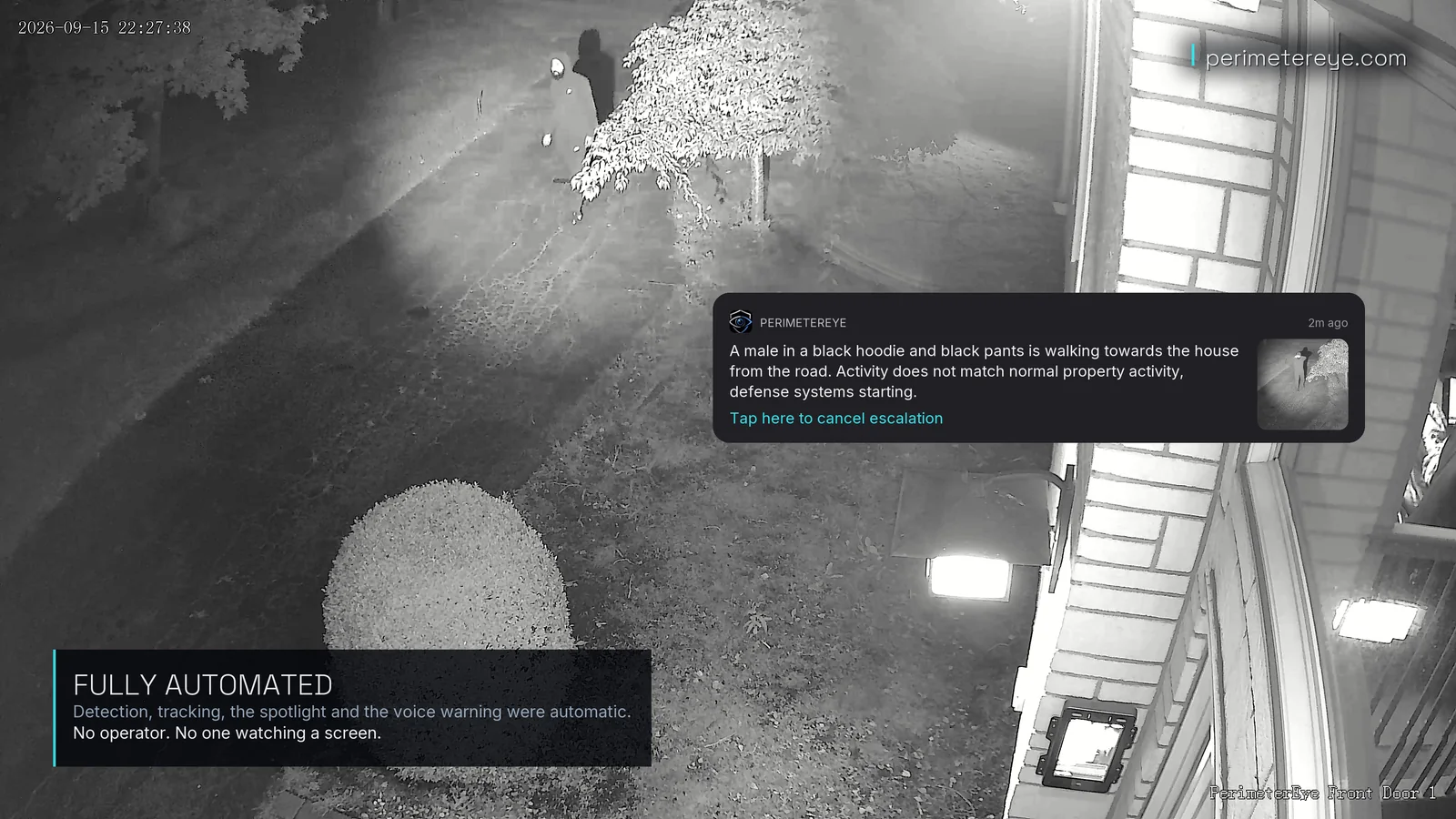
Frame by frame, in infrared
Three seconds from the alert to the searchlight.
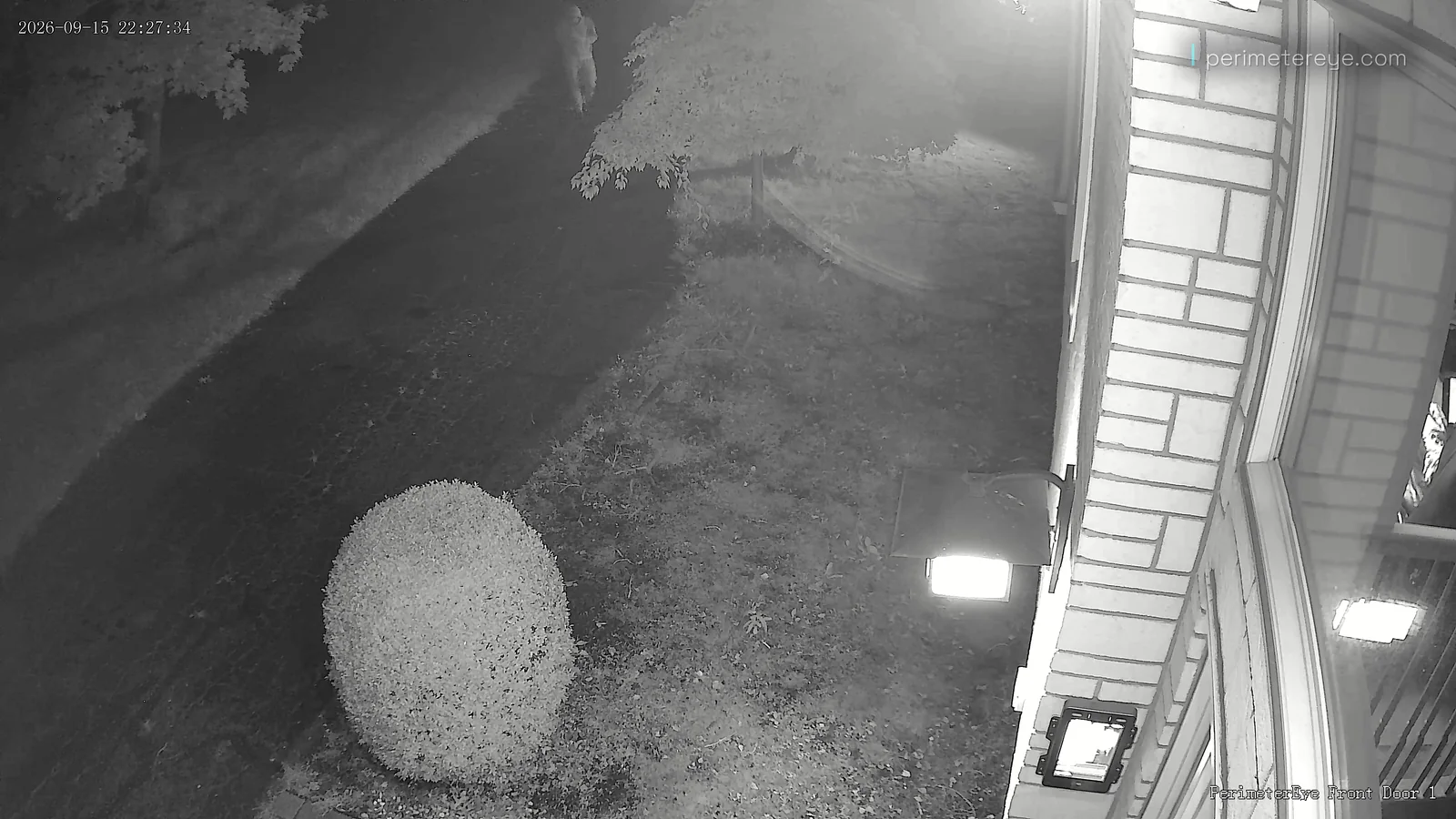
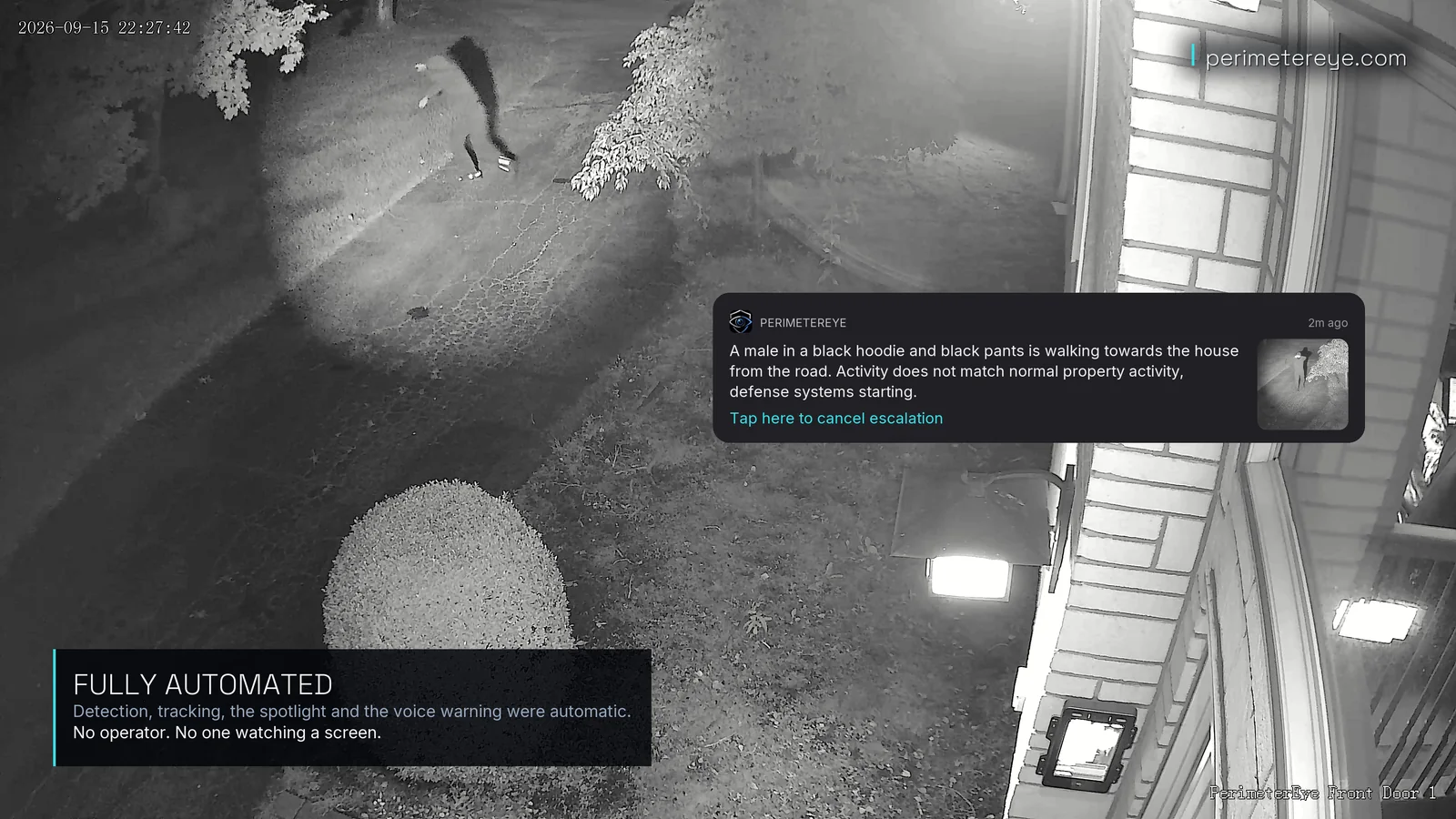
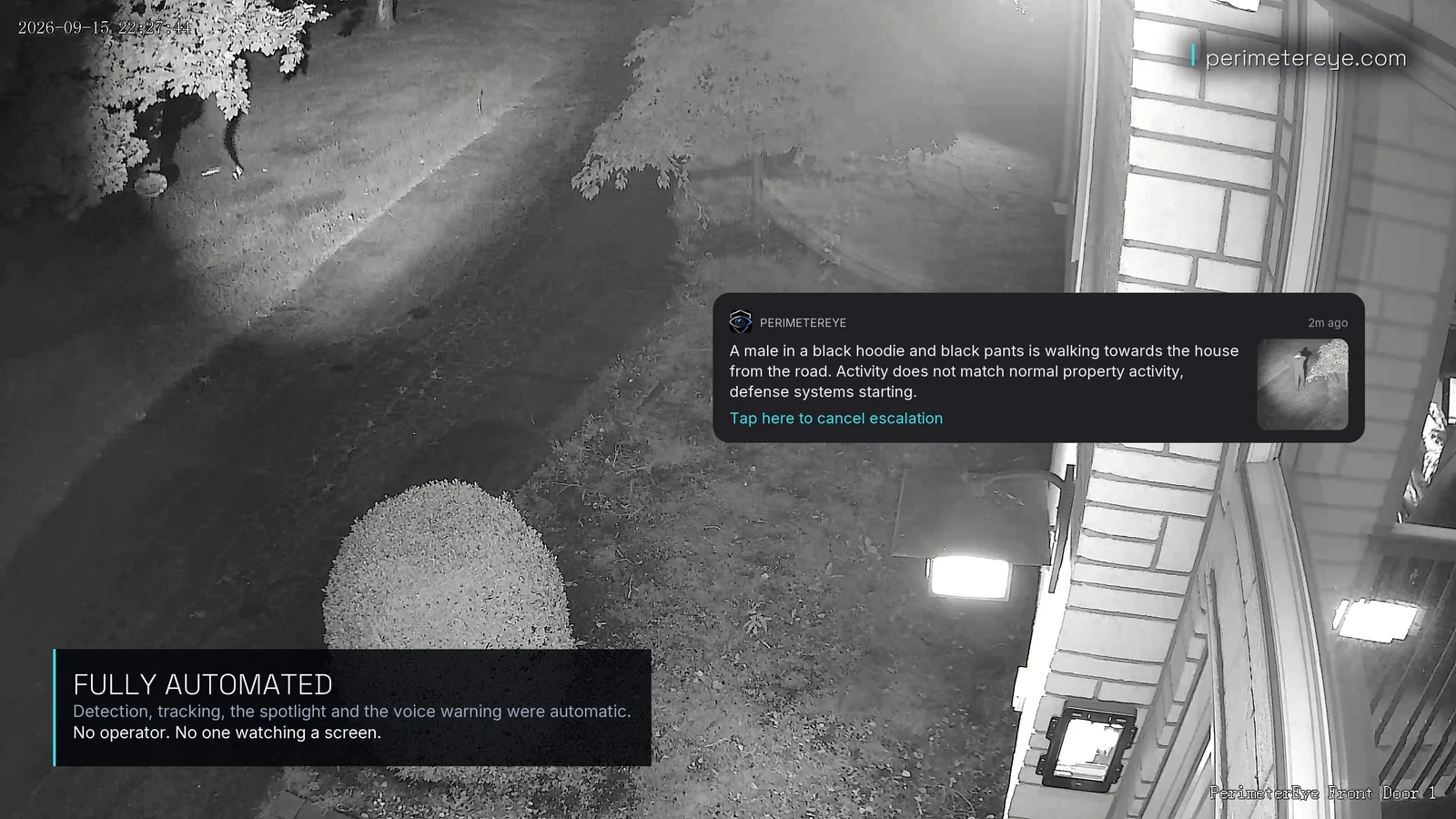
Front Door 1, on the camera’s own clock. The person is visible at the road end at 22:27:34, the alert describes them at 22:27:35, and the searchlight is on them at 22:27:38. By 22:27:42 they are turning away.
1 of 6 · 22:27:34View full size
Walking in from the road
At the far end of the driveway, in the dark, the person is already in view of the camera.
2 of 6 · 22:27:35View full size
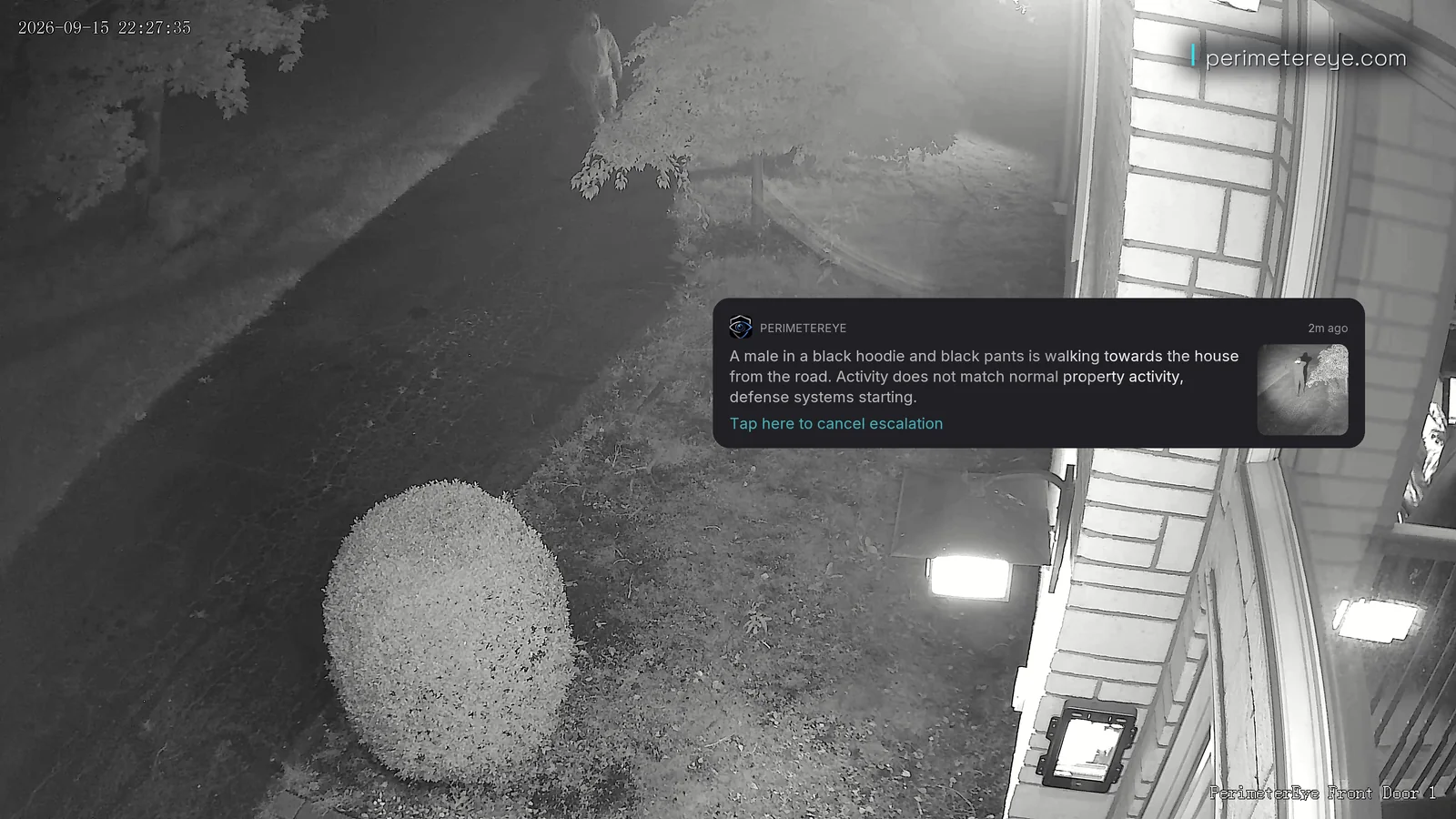
The alert
The alert reads: walking towards the house from the road; activity does not match normal property activity; defense systems starting.
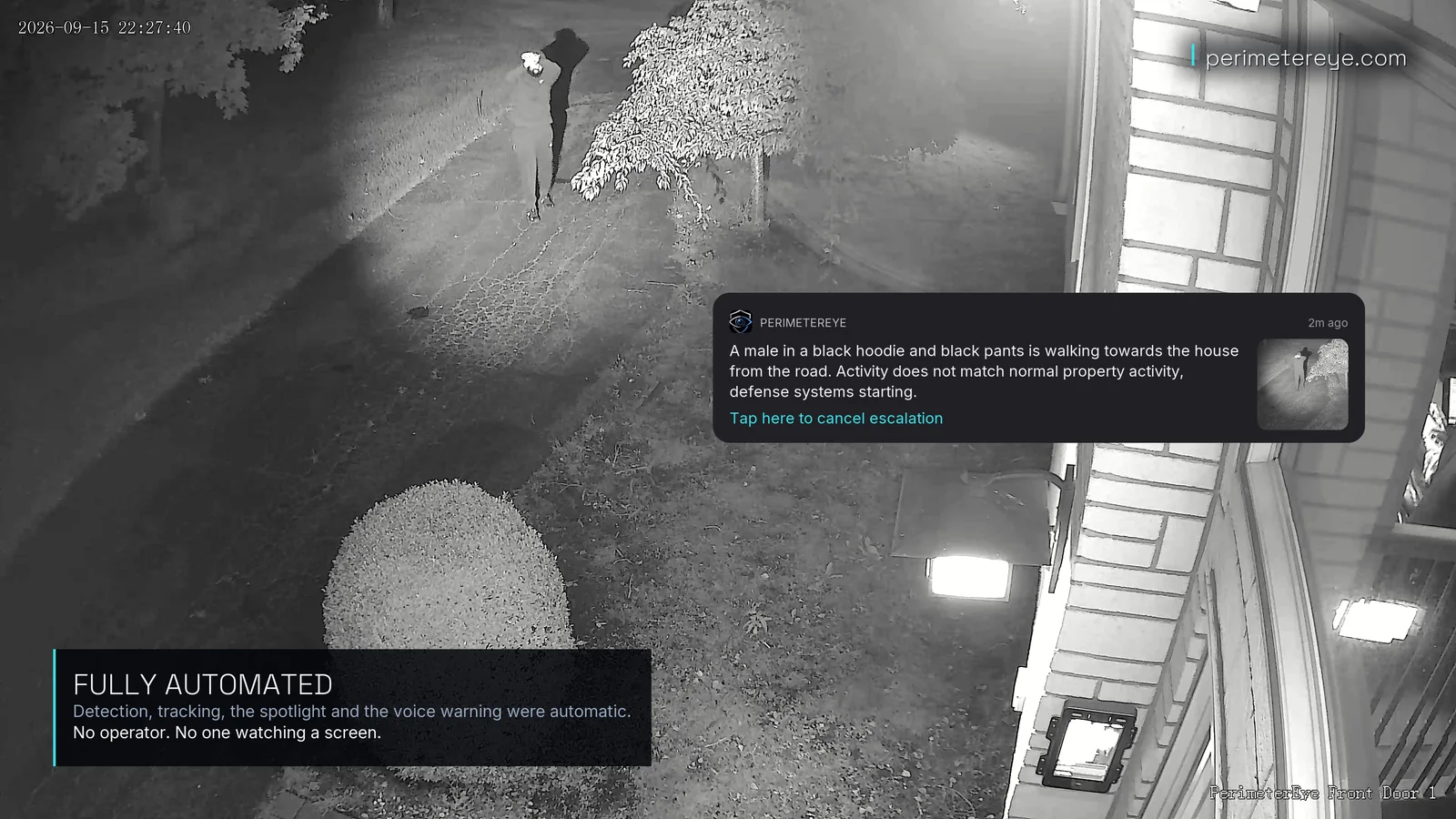
3 of 6 · 22:27:38View full size
In the searchlight
Three seconds after the alert, the searchlight is on the person by the tree. Detection, tracking, the light, and the voice warning were all automatic.
5 of 6 · 22:27:42View full size
Turning away
Four seconds in the light, and the person turns away from the house. The beam goes with them.
6 of 6 · 22:27:44View full size
Followed off the lawn
The searchlight stays on them to the edge of the camera’s view.
Filmed September 15, 2026, on a real property with PerimeterEye cameras and a searchlight. The approach was staged for filming; the system’s response was automatic, with no operator.
What changes
Defense that starts at the property line, not the door
- Identifies the person, vehicle, or animal at the boundary — beams and buried cable can only beep.
- Responds at the boundary with tracking searchlight, live targeted voice, and 130 dB siren — before anyone reaches the house.
- Runs entirely on the on-site Brain, so the perimeter holds even when the internet does not.
Monitoring systems treat the boundary as an afterthought — a camera aimed vaguely at the yard, a notification when something moves. PerimeterEye treats the boundary as the main event. The moment something crosses, the system knows what it is, decides whether it belongs, and if it does not, opens a ladder of light, voice, and sound designed to end the visit early.
You watch it all live. The searchlight follows the target so the picture never loses them, the AI narrates the event in plain language, and every second is recorded with instant rewind. By the time anyone reaches shouting distance of the house, they have been lit, described out loud, and warned — and you have the entire encounter on video.
What every system includes
- On-site edge computer (the Brain)
- 4K AI cameras
- Tracking searchlights
- Live targeted AI voice
- 130 dB siren escalation
- Doorbell video intercom
- Wall panel command center
- iOS app with live 4K video
01
Your instinct is right: win at the property line
Most systems sold as home security concentrate on doors and windows — the last possible moment. If you searched for a perimeter security system, you have already rejected that model. You want detection and response out at the boundary, where there is still time and distance to work with. That is the correct instinct, and it is the entire premise PerimeterEye is built on.
The evidence supports you. In a 2013 UNC Charlotte survey of 422 incarcerated burglars (Kuhns et al., funded by the industry-backed AIREF), respondents named proximity of other people, escape routes, and visible signs of security as their top target-selection factors. Intruders make their decision at the edge of the property. That is where the argument should happen.
02
Why beams and buried sensors end at a beep
Traditional perimeter hardware — infrared beams, microwave barriers, buried sensor cable — does one thing: it detects a crossing. Everything after that is your problem. The output is a chime, a text, maybe a floodlight on a dumb timer. It cannot tell you whether the crossing was a deer, a delivery driver cutting the corner, or a person walking your fence line at 2 a.m.
That gap has a cost. Either you treat every beep as an emergency and burn out inside a week, or you start ignoring them and the system becomes decoration. A perimeter sensor without identification and response is a doorbell for your property line.
03
PerimeterEye gives the perimeter eyes — and a response
PerimeterEye pairs the boundary with 4K AI cameras that identify what actually crossed: person, vehicle, or animal, classified further as delivery, resident, visitor, service worker, or unknown, each with a live threat level. The AI writes a plain-language analysis of every event on every camera, so "motion in zone 3" becomes an actual account of who came from where and did what.
Then it acts. A verified unknown at the boundary gets a motorized tracking searchlight that locks on and physically follows them — homeowners compare it to a police helicopter searchlight. A live, targeted AI voice addresses the specific person in frame. If they keep coming, a 130 dB siren fires with priority alerts and live video to your phone. All of it happens while they are still at the property line, not the doorstep.
04
The escalation ladder, start to finish
Every response runs the same disciplined sequence. Verification comes first, which is why family arrivals and the regular mail carrier never trigger deterrence — the system knows the household. Then the searchlight locks on and follows. Then the live voice warning, describing the actual person in frame rather than playing a canned message. Then the 130 dB siren with priority alerts and live video.
You stay in command the whole way. Watch live in 4K, talk to the person through two-way audio, or take manual control of any spotlight or siren at any point. PerimeterEye is not an alarm-monitoring service — alerts and control go directly to you.
- Verify: person, vehicle, or animal, classified with a live threat level
- Searchlight locks on and physically follows the target
- Live, targeted AI voice describes the person in frame and orders them off
- 130 dB siren plus priority alerts with live video to your phone
05
The case for lighting the boundary
Deterrence research keeps landing on the same finding: light works. A randomized street-lighting experiment across 77 New York City public-housing developments (Chalfin, Hansen, Lerner & Parker, NBER Working Paper 25798, 2019) found added lighting cut nighttime outdoor index crimes by roughly 36%, with effects persisting about three years in the 2022 Criminology & Public Policy follow-up.
PerimeterEye takes that finding and aims it. Instead of flooding the yard on a timer, the motorized searchlights run a configurable Perimeter Sweep each night, one hour after sunset — a visible patrol of your boundary that never crosses the property line — and lock onto verified targets the rest of the night. Light that moves with purpose reads very differently from a bulb on a motion sensor.
06
What a full perimeter setup costs
Packages start with Essential (5 cameras, 1 tracking spotlight, 1 siren), then Advanced for medium properties (7 cameras, 2 spotlights, 2 sirens) and Estate for estates with 12 or more cameras and 4 spotlights. Every package includes the Brain edge computer, the PerimeterEye Access doorbell intercom with AI Doorman, and the wall panel command center. You own the hardware outright, whether you pay monthly, as low as $145.17/mo for Essential (36 monthly payments at 10% APR, $0 down, through Affirm or Klarna, subject to approval), or in full at checkout.
Financing is available through Klarna or Affirm, with no contract, and a $99/mo software and AI subscription follows six included months from activation for launch system orders. Compare that to trenching sensor cable around an acre and still ending up with a system that can only beep. The full breakdown is at /pricing.
What separates PerimeterEye
Where each option starts working.
A perimeter is only useful if something happens there.
| Option | Where it starts working | What happens there |
|---|---|---|
| Door and window alarm | At the door or window, once someone opens it. | A siren inside and a call from the alarm company. |
| Motion floodlight | Wherever the light points, when anything moves. | A fixed light turns on. |
| Cameras | Wherever they point. | A recording and a notification. |
| PerimeterEye | At the property line, while the person is still walking in from the road. | An alert that describes them, a searchlight that follows them, a live AI voice, and a 130 dB siren. |
Watch it at full speed
The same response, on film.
Real footage of the working system. Play it with sound to hear the voice warning and the siren.
Night-vision camera footage as the searchlight finds and holds a person on the property.
Play with sound to hear the voice warning and siren.What it costs
See what a system costs for your property.
Essential system
As low as$146/mo*Essential covers a driveway and the approaches to the house. Larger properties usually suit Advanced or Estate; a specialist can size it with you before you order.
What’s included
- 5 ultra-HD 4K cameras
- 1 tracking spotlight
- 1 speaker/siren unit
- PerimeterEye Access intercom, included with every complete system
- 1 PerimeterEye control panel
- 1 PerimeterEye AI processor
*Essential system, $0 down: 36 monthly payments of $145.17 at 10% APR on the hardware price before sales tax, shown rounded up to the dollar. Affirm rates 0–36% APR; Klarna terms are shown at checkout. Subject to eligibility and lender approval; your rate, term and down payment may differ. US only; not available in all states. Software is billed separately: first 6 months included, then $99/month.
Before you choose
Common questions
How is PerimeterEye different from driveway alarms or beam sensors?
Beam and driveway sensors detect a crossing and stop there — you get a chime with no idea what caused it. PerimeterEye identifies the person, vehicle, or animal, writes a plain-language account of the event, and responds automatically with tracking light, live targeted voice, and siren while you watch from the app.
Will animals set off the deterrence at night?
No. The system verifies before it responds and classifies what it sees — person, vehicle, or animal. A deer crossing the yard is logged and searchable, not sirened. Verification is also why family arrivals and regular mail carriers never trigger the searchlight or voice: the system knows the household.
Does the perimeter still work if my internet goes out?
Yes. Everything runs on the on-site Brain, a true edge computer on your property. Live view, recording, instant rewind, the siren, and the tracking searchlights all keep working during an internet outage. Remote alerts to your phone resume as soon as your connection comes back.
What happens when someone crosses the perimeter?
PerimeterEye detects them at the boundary, verifies that the activity doesn’t fit the property, lights them with a tracking searchlight, warns them with a live AI voice, sounds a 130 dB siren, and documents everything in plain language. In the infrared footage on this page, the alert went out at 22:27:35, while the person was still at the road end. No security system can guarantee prevention of every incident.
Is someone at a monitoring center watching my perimeter?
No. PerimeterEye is not an alarm-monitoring service — alerts and control go directly to you. When the system escalates, you get priority alerts with live video and can watch, talk to the person through two-way audio, or take manual control of the spotlights and siren from the app or wall panel.
How large a property can it cover?
Packages scale from 4 cameras and one tracking spotlight for smaller lots up to 12 or more cameras and four spotlights for estates. Each spotlight rotates 355 degrees and tilts 90 degrees, so a handful of units covers long fence lines and driveways. Package details are at /pricing.
Keep exploring
Related reading
Put a response behind your property.
Tell a specialist about your property, your driveway, and where people approach. They’ll size the cameras, searchlights, and sirens with you, or book a call first if you’d rather talk it through.
Explore an upgrade for your existing camerasSystem launch offer
Your first 6 months
of service included.
First 6 months included from activation. Then $99/month.
Compare system packages