A Driveway Camera Should Defend the Approach, Not Narrate the Aftermath
A driveway security camera system records vehicles as they approach — and that's where most of the category stops. PerimeterEye is an Automatic Property Defense System: it reads the plate at your entrance, recognizes household vehicles, announces family arrivals — and when an unknown vehicle rolls in at 2 AM, a motorized searchlight locks onto it and a live AI voice challenges the driver before they reach your house.
 View photo
Your view and PerimeterEye’s view
You don’t see anyone. PerimeterEye does.
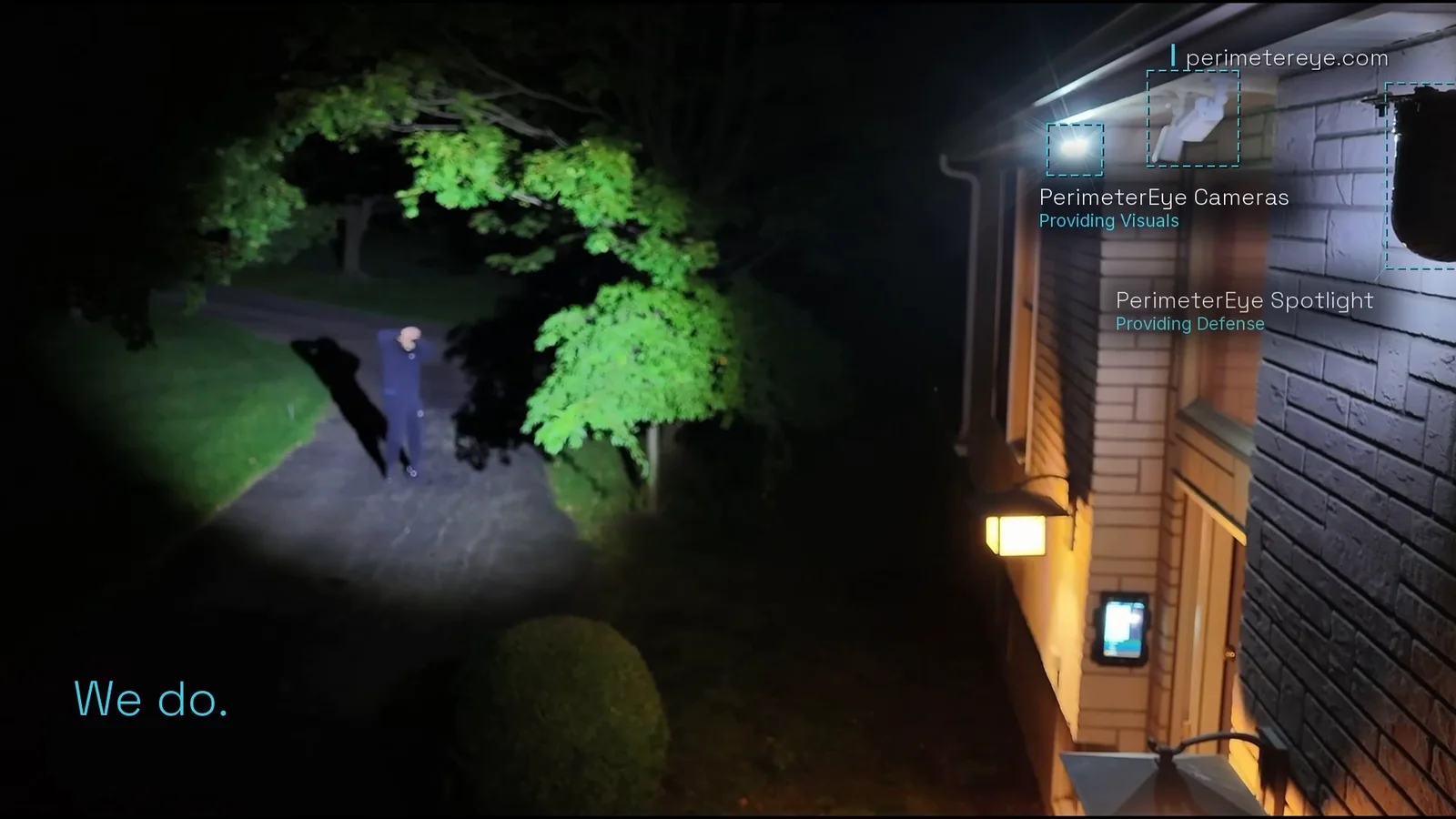
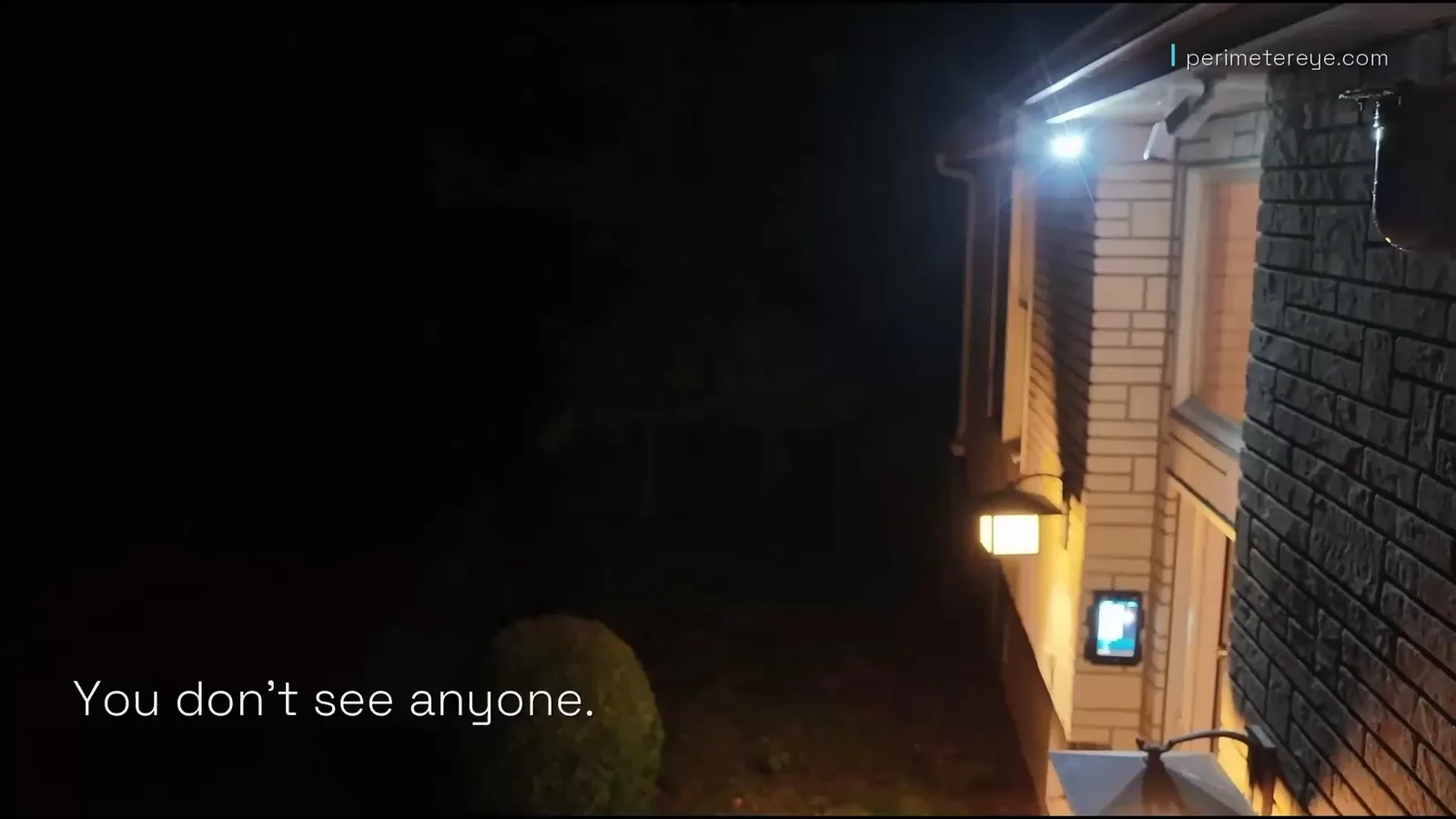
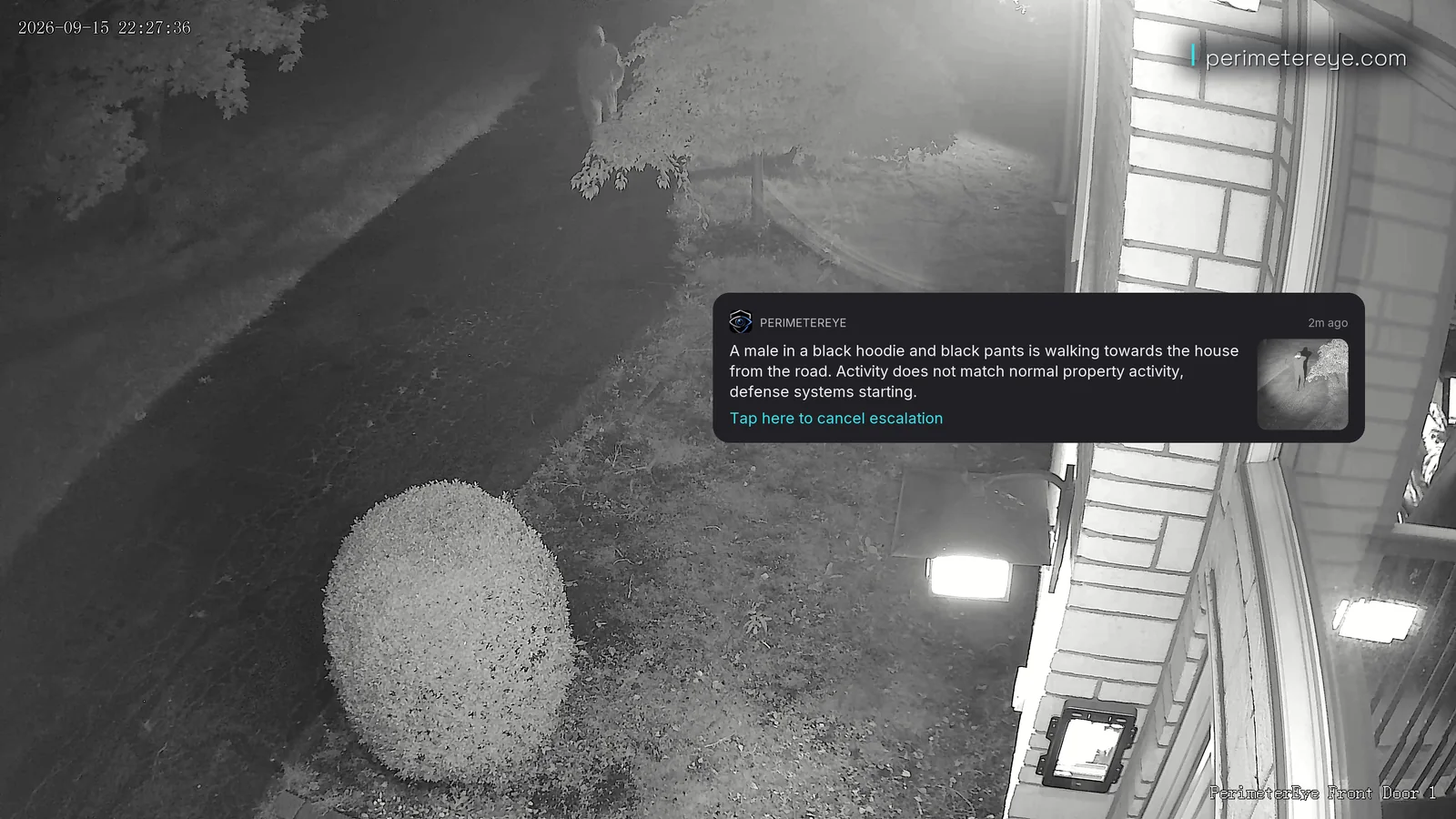
The same approach three ways: what you see from the house at night, what the camera sees in infrared, and the moment the searchlight catches the person.
1 of 3 · Your viewView full size
You don’t see anyone.
From the house, the driveway is dark. Whoever is out there is invisible to you.
2 of 3 · PerimeterEye’s viewView full size
The camera sees them in infrared
In infrared the person is in plain view, and the alert is already describing them: walking toward the house from the road, not normal activity for the property.
3 of 3 · The searchlightView full size
We do.
The searchlight catches the person on the driveway, and their hands go up against the light. The cameras provide the view; the searchlight provides the defense.
Filmed on a real property with PerimeterEye cameras and a searchlight. The approach was staged for filming; the system’s response was automatic, with no operator.
What changes
Defense That Starts at the Curb, Not the Doorstep
- Reads the plate at the entrance and recognizes household vehicles before anyone reaches the door.
- An unknown vehicle at 2 AM gets a searchlight lock and a live, targeted voice challenge — not a clip in the morning.
- Family arrivals are announced, never challenged — the system knows the household.
Most driveway cameras are aftermath tools: they hand you a clean clip of the vehicle that already left. PerimeterEye treats the driveway as the property's first decision point — reading plates at the entrance, recognizing the household, and putting a searchlight and a live voice on anything it can't account for, before it reaches the house.
It gives up nothing you like about a camera — 4K recording, instant rewind, and clip export are all there — it just refuses to stop at watching. The full escalation ladder, from verification to searchlight to voice to siren, runs automatically on the on-site Brain while you watch live.
What every system includes
- On-site edge computer (the Brain)
- 4K AI cameras
- Tracking searchlights
- Live targeted AI voice
- 130 dB siren escalation
- Doorbell video intercom
- Wall panel command center
- iOS app with live 4K video
01
The driveway is a decision point, not a camera angle
Everything meaningful about an intrusion happens on the approach. A vehicle slows, turns in, sits for a moment with the lights off. By the time someone is standing at your door, the decision was made ninety feet earlier — and a conventional driveway camera spent those ninety feet quietly recording for later.
That is the real gap in this category. Ring, Nest, and most of their peers are monitoring products: they watch, record, and send you a notification to deal with. PerimeterEye acts on the property itself, in seconds, automatically, while you watch live from the app or the wall panel. The driveway stops being a camera angle and becomes the first line of response.
The approach is also where deterrence research points. When Oregon journalists interviewed 86 convicted burglars in 2017 (KGW-TV — journalistic, not peer-reviewed), nearly all said they knocked or rang first to test whether anyone was home, and a car in the driveway was one of the strongest signals to move on. A driveway that visibly responds sends the same message before anyone knocks.
02
It reads the plate at the entrance
PerimeterEye reads license plates at the entrance to your property. Your own vehicles are recognized on approach, and confirmed regular visitors are logged as visitors. A vehicle the system has never seen is classified as unknown and assigned a live threat level — all before it reaches the house.
Recognition is the difference between defense and noise. When your spouse gets home, the system announces a family arrival — no spotlight, no challenge, no alert storm. The AI knows the household, so the deterrence ladder is reserved for vehicles and people it cannot account for.
Every event, routine or not, gets a full plain-language analysis you can read and search later: what arrived, when it arrived, what it did, and how the system classified it. Your driveway history becomes something you can query in plain English instead of a scrub bar you have to drag through.
03
The 2 AM unknown vehicle
Here is the sequence when an unregistered vehicle rolls up your driveway at 2 AM. First, the AI verifies what it is seeing. Then a motorized tracking searchlight locks onto the vehicle and physically follows it — 355 degrees of rotation, 90 degrees of tilt, searchlight-class output that homeowners compare to a police helicopter beam.
Next comes the voice. Not a canned chime — a live, targeted AI announcement describing exactly what it sees: the vehicle, the driver who steps out, what they are wearing. Someone sitting in a car with the headlights off learns, specifically and personally, that they have been seen.
If they press on, the ladder continues: a 130 dB siren and priority alerts to your phone with live video. You can watch, speak through the cameras yourself, or take manual control at any point. The system escalates on its own; you stay in command.
04
Deliveries, guests, and daylight — without the noise
Most driveway traffic is legitimate, and most residential burglary is not a midnight event: FBI data for 2024 (FBI Crime Data Explorer) counted 216,601 daytime residential burglaries against 174,053 at night. A driveway system that only thinks about darkness misses more than half the problem.
PerimeterEye runs on modes — Off, Quiet, Visitor, Armed, High Alert, Maximum Security — so daytime behavior fits your actual life. There is nothing to arm or disarm. Package detection and delivery guidance work in every mode except Off and Quiet: couriers are recognized as deliveries, guided, and logged, never challenged.
Each morning the AI composes a daily briefing that reads like a report from a sharp night-shift colleague: the day's vehicles, visitors, and classifications, summarized in plain language. No scrubbing through hours of driveway footage to find out what that gray sedan was doing at 3:40.
05
What arrives in the box
Every PerimeterEye package is a complete system: the PerimeterEye Brain — a true edge computer with dedicated CPU, GPU, RAM, and SSD running PerimeterEye OS — plus 4K AI cameras with two-way audio, motorized tracking searchlights, a 130 dB siren, the PerimeterEye Access doorbell intercom with AI Doorman, a wall panel command center, and the iOS app.
Because everything runs on the on-site Brain, core defense — live view, recording, instant rewind, spotlights, siren — keeps working if your internet goes down. Pay monthly, as low as $145.17/mo for Essential (36 monthly payments at 10% APR, $0 down, through Affirm or Klarna, subject to approval), or in full at checkout; you own the hardware, and there is no contract. The full breakdown is at /pricing.
- 4, 7, or 12+ 4K AI cameras with two-way audio
- Motorized tracking searchlights included in every package
- 130 dB safe-start, policy-gated siren
- PerimeterEye Access doorbell intercom with AI Doorman, included
- Wall panel command center plus iOS app with live 4K and instant DVR rewind
What separates PerimeterEye
A motion light turns on. PerimeterEye turns toward them.
Most driveway products tell you that something happened. PerimeterEye tells you who is there and puts them in the light while it is happening.
| Option | When someone walks up the drive at night | What you know |
|---|---|---|
| Motion floodlight | Switches on a fixed light when anything moves: a person, a car, a cat, a branch. A person can step out of it or wait for it to switch off. | That something moved. |
| Driveway alarm or chime | Beeps inside when something crosses the sensor at the entrance. | That something crossed. Not who, or what they did next. |
| Camera with motion alerts | Records and sends a notification. The response is up to whoever opens it in time. | Whatever you can make out on your phone. |
| PerimeterEye | Sees the person in infrared, lights them with a searchlight that follows them, speaks to them about what they’re doing, and escalates to a 130 dB siren, automatically. | Who is there, what they’re doing, and where they went, in plain language. |
Watch it at full speed
The same response, on film.
Real footage of the working system. Play it with sound to hear the voice warning and the siren.
Detection, tracking searchlight, spoken warning and siren escalation, end to end — all recorded output from a working system.
Play with sound to hear the voice warning and siren.What it costs
See what a system costs for your property.
Essential system
As low as$146/mo*Essential covers a driveway and the approaches to the house. Larger properties usually suit Advanced or Estate; a specialist can size it with you before you order.
What’s included
- 5 ultra-HD 4K cameras
- 1 tracking spotlight
- 1 speaker/siren unit
- PerimeterEye Access intercom, included with every complete system
- 1 PerimeterEye control panel
- 1 PerimeterEye AI processor
*Essential system, $0 down: 36 monthly payments of $145.17 at 10% APR on the hardware price before sales tax, shown rounded up to the dollar. Affirm rates 0–36% APR; Klarna terms are shown at checkout. Subject to eligibility and lender approval; your rate, term and down payment may differ. US only; not available in all states. Software is billed separately: first 6 months included, then $99/month.
Before you choose
Common questions
Can PerimeterEye recognize my family's vehicles?
Yes. The system reads plates at the entrance and knows the household, so your own vehicles are recognized as they turn in and arrivals are announced rather than challenged. The deterrence ladder — searchlight, voice, siren — is reserved for vehicles and people the system cannot account for.
What happens when an unknown vehicle pulls in at night?
The AI verifies it, then a tracking searchlight locks on and physically follows it up the driveway. A live AI voice describes the vehicle and driver aloud. If they continue, a 130 dB siren fires and you get priority alerts with live video. You can talk or take control at any point.
Does the driveway coverage work if my internet goes out?
Yes. Everything runs on the PerimeterEye Brain, an on-site edge computer, so core defense — live view, recording, instant rewind, the spotlights, and the siren — continues through an internet outage. Remote alerts to your phone resume the moment your connection comes back.
Do I need a monitoring contract or call center?
No. PerimeterEye is not an alarm-monitoring service — alerts and control go directly to you. There is a $99/mo software and AI subscription after six included months from activation for launch system orders, you own the hardware outright, and there is no long-term contract. The system acts on the property automatically while you stay in command.
Why does a driveway system that responds deter better than a camera?
Because it acts while the person is still on the driveway. PerimeterEye detects, verifies, lights, speaks, sounds the siren, alerts you, and documents it all, and offender interviews (Kuhns et al., 2013, an industry-funded survey of 422 incarcerated burglars) rank visible signs of security among the top reasons to pick a different target. No security system can guarantee prevention of every incident.
Can I install it on a long or gated driveway myself?
Yes — every system is designed for easy self-installation, with full in-depth instructions provided after purchase. If you'd rather hire a pro, PerimeterEye supplies a list of independent installers plus a pre-filled job spec; you hire and pay the installer directly. Long-entrance layouts are covered on the gated-driveways use-case page.
Keep exploring
Related reading
Put a response behind your property.
Tell a specialist about your property, your driveway, and where people approach. They’ll size the cameras, searchlights, and sirens with you, or book a call first if you’d rather talk it through.
Explore an upgrade for your existing camerasSystem launch offer
Your first 6 months
of service included.
First 6 months included from activation. Then $99/month.
Compare system packages