The License Plate Recognition Camera That Ships as an Outcome, Not a Project
Most license plate recognition camera guides read like installer coursework: mounting height, capture angle, one dedicated camera per lane. PerimeterEye ships plate reading as a built-in outcome instead. Vehicles entering your property are identified and checked against the vehicles you have confirmed, unknown vehicles at odd hours climb an escalation ladder of light, voice, and siren, and "whose car is in my driveway" gets answered by name in the app.
 View photo
Frame by frame, in infrared
Three seconds from the alert to the searchlight.
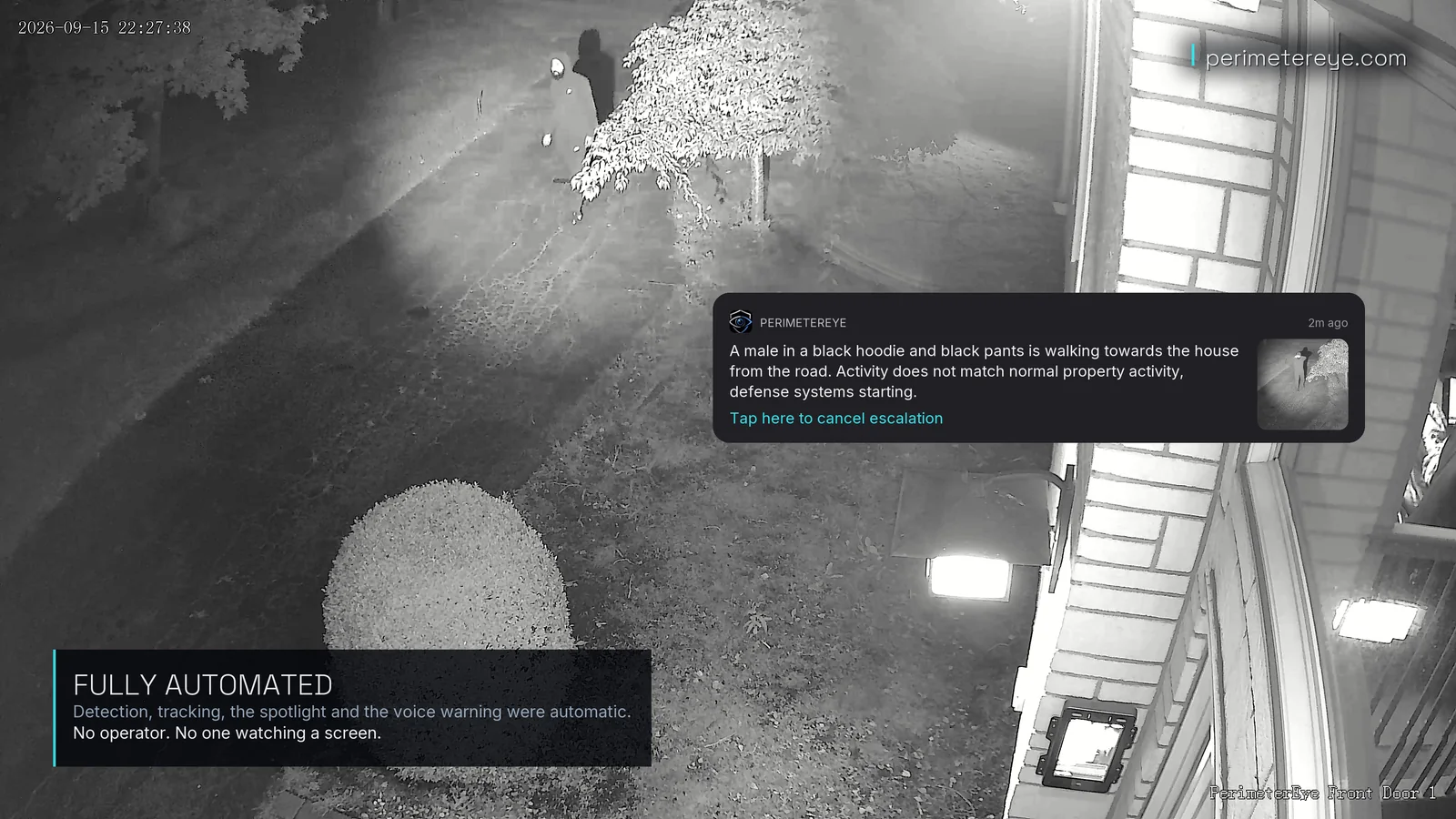
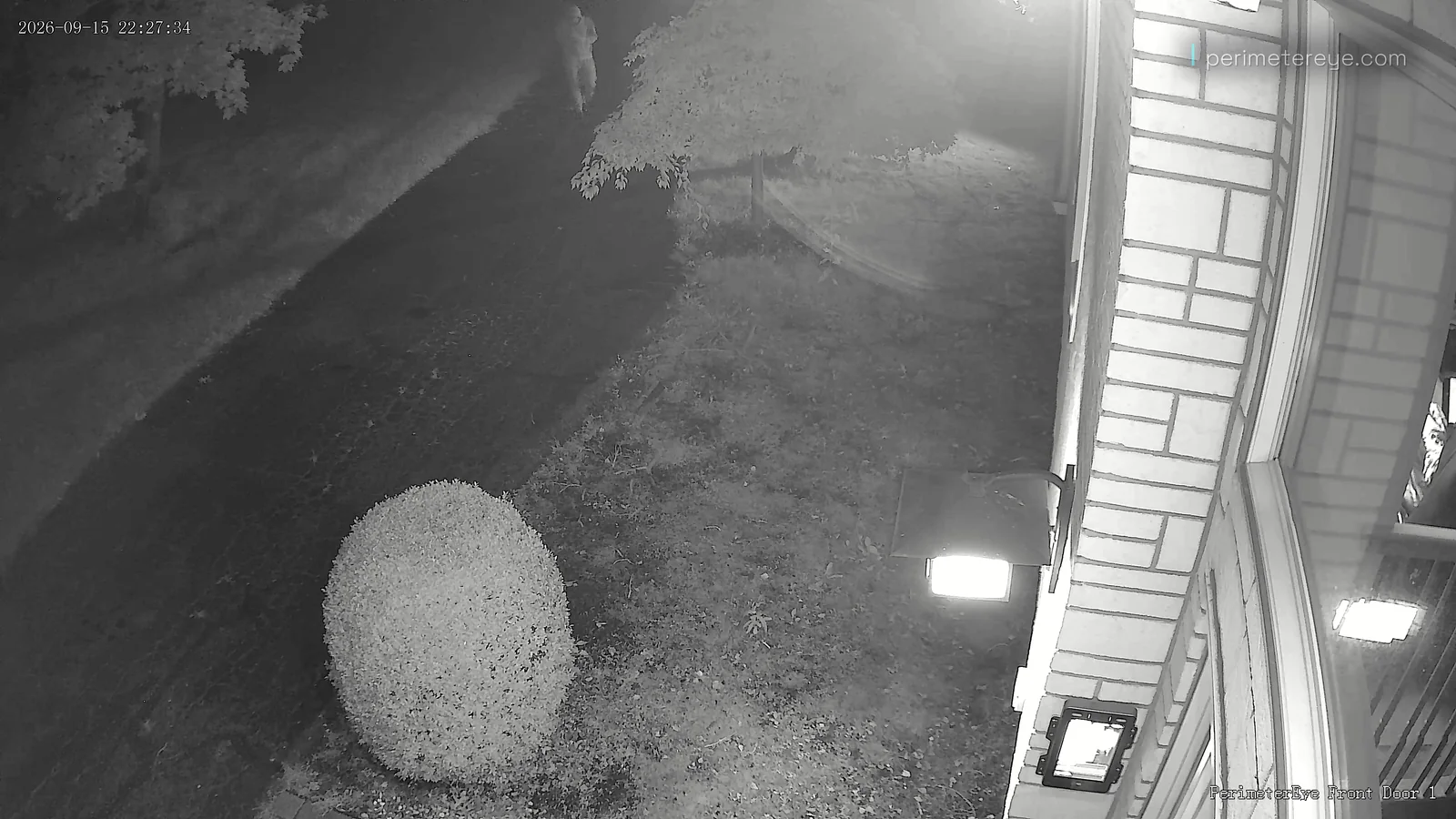
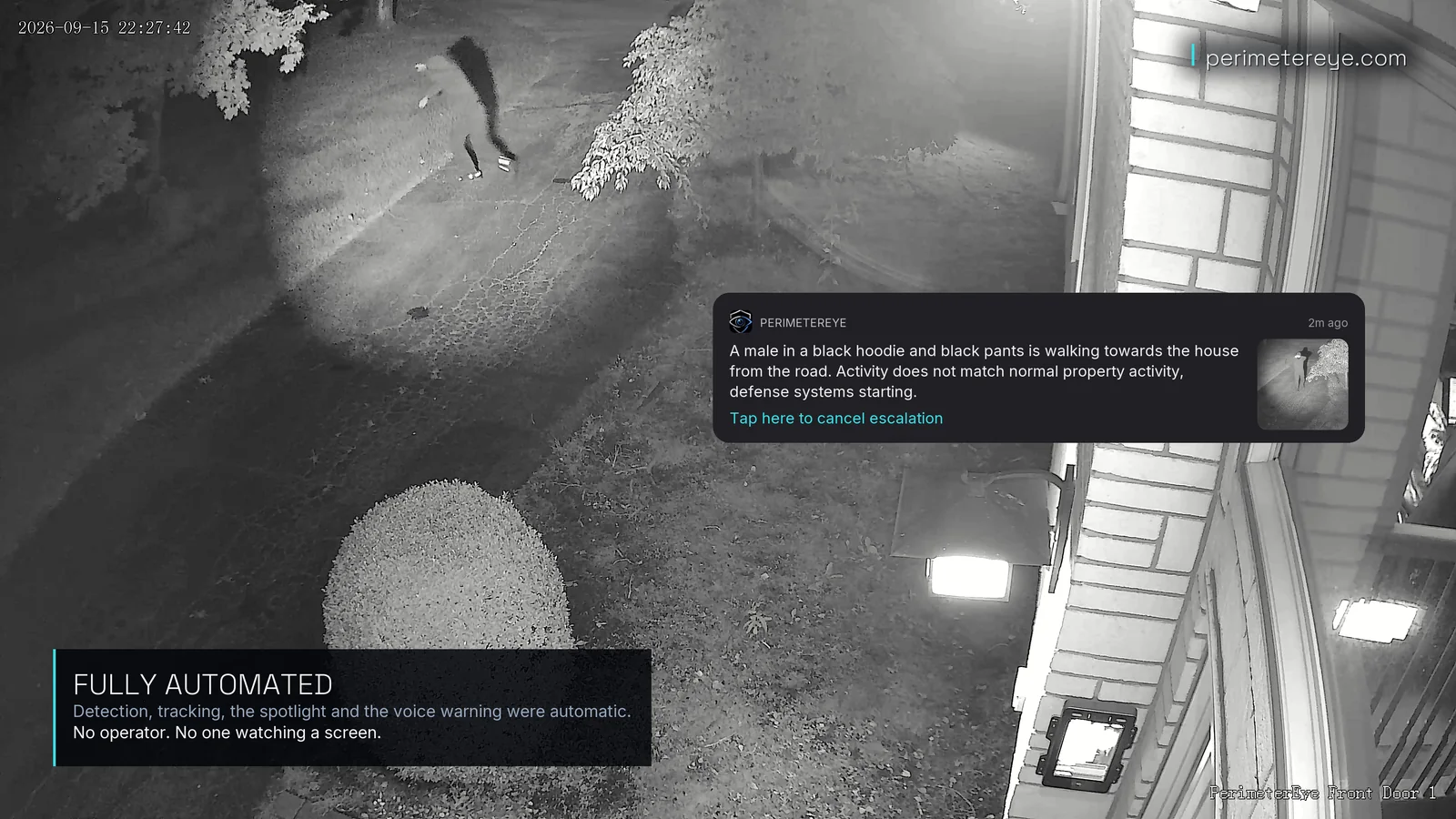
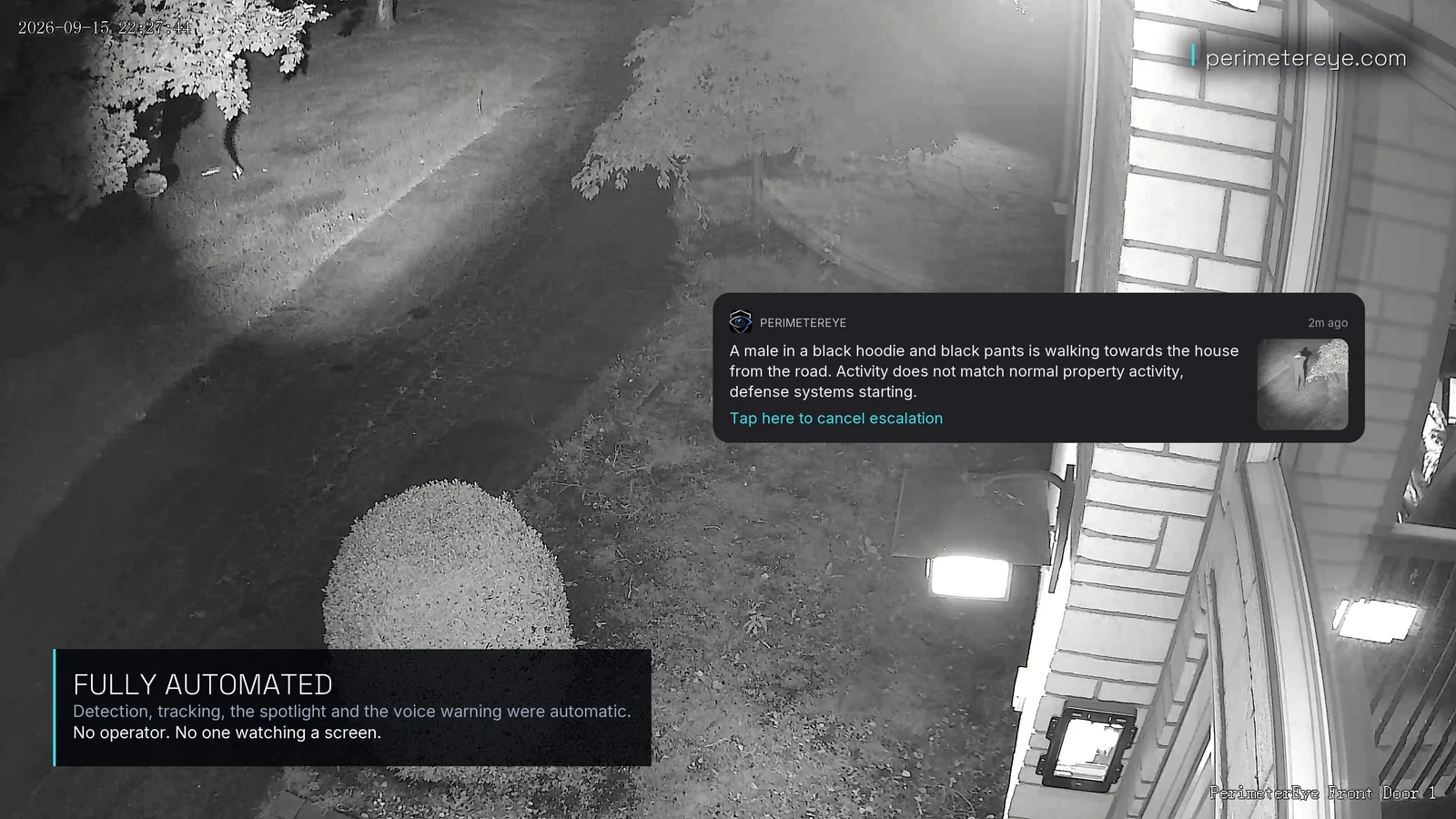
Front Door 1, on the camera’s own clock. The person is visible at the road end at 22:27:34, the alert describes them at 22:27:35, and the searchlight is on them at 22:27:38. By 22:27:42 they are turning away.
1 of 6 · 22:27:34View full size
Walking in from the road
At the far end of the driveway, in the dark, the person is already in view of the camera.
2 of 6 · 22:27:35View full size
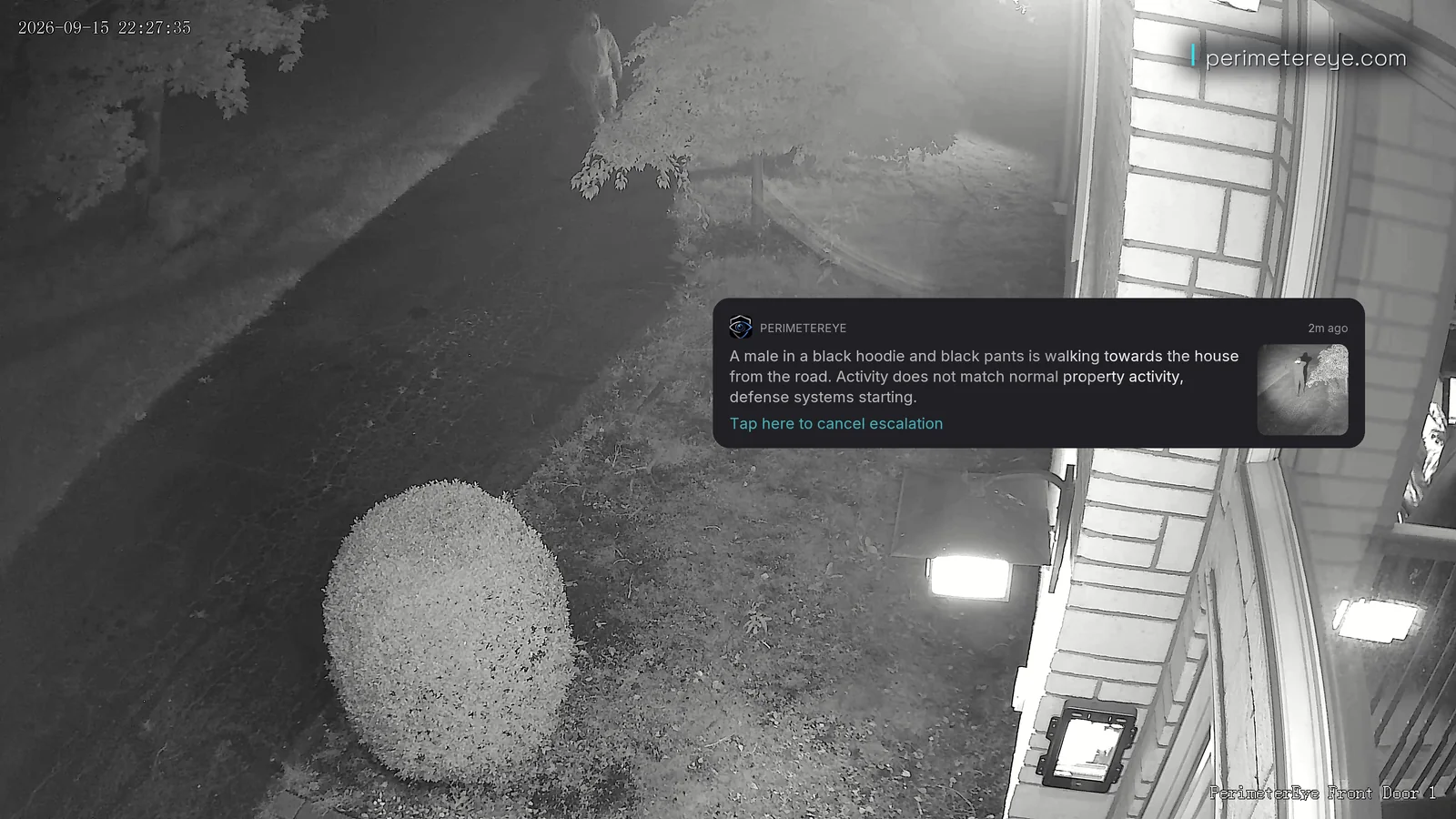
The alert
The alert reads: walking towards the house from the road; activity does not match normal property activity; defense systems starting.
3 of 6 · 22:27:38View full size
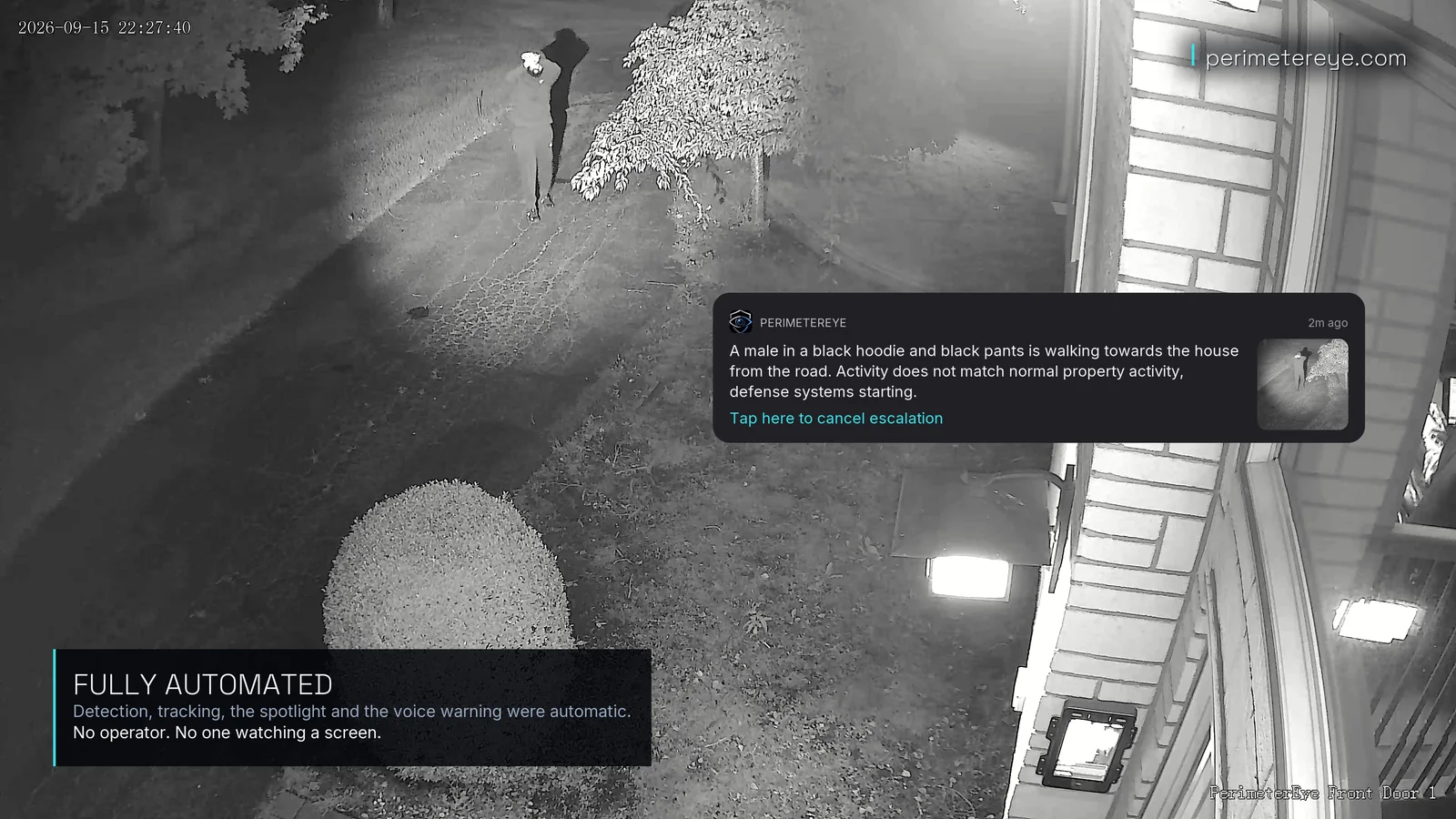
In the searchlight
Three seconds after the alert, the searchlight is on the person by the tree. Detection, tracking, the light, and the voice warning were all automatic.
5 of 6 · 22:27:42View full size
Turning away
Four seconds in the light, and the person turns away from the house. The beam goes with them.
6 of 6 · 22:27:44View full size
Followed off the lawn
The searchlight stays on them to the edge of the camera’s view.
Filmed September 15, 2026, on a real property with PerimeterEye cameras and a searchlight. The approach was staged for filming; the system’s response was automatic, with no operator.
What changes
Plate reading that comes with a response attached
- Entering vehicles identified and checked against your known-vehicle registry — no geometry homework.
- "Whose car is in my driveway" answered by name in the app, in plain language.
- Unknown vehicles at odd hours meet the ladder: tracking searchlight, live voice, 130 dB siren.
Standalone plate cameras make you the integrator: one device reads plates, another watches the yard, a third rings when someone reaches the door, and nothing talks to anything. PerimeterEye reads plates inside one system that also identifies people, writes up every event in plain language, and commands searchlights and sirens when something does not belong.
The registry does the remembering. Family vehicles and regular visitors are recognized by name on arrival; unknown vehicles get scrutiny proportional to the hour and their behavior. When your phone buzzes about a car in the driveway, the alert tells you whose it is — or that nobody knows, and that the property is already responding.
What every system includes
- On-site edge computer (the Brain)
- 4K AI cameras
- Tracking searchlights
- Live targeted AI voice
- 130 dB siren escalation
- Doorbell video intercom
- Wall panel command center
- iOS app with live 4K video
01
Why DIY plate reading reads like coursework
Spend an hour researching license plate recognition cameras and you will find installer geometry guides: mount between this height and that, keep the capture angle shallow, dedicate one camera to one lane of travel, mind your lighting, and accept that a camera positioned to read plates usually sees little else. All of it is true — for cameras that make plate reading your project.
The result is a hobby with homework. Get the geometry slightly wrong and you collect a hard drive of unreadable smears. Get it right and you have exactly one camera doing exactly one job, feeding a log of plate strings that only you will ever read.
02
PerimeterEye ships the outcome, not the project
With PerimeterEye, plate reading is a built-in outcome of the system, not a separate discipline. Vehicles entering the property are identified and checked against your known-vehicle registry by the same intelligence that classifies people, writes a plain-language account of every event, and runs the response ladder. Plate reads depend on camera placement, angle, and conditions — no recognition system reads every plate.
Your job is confirming names, not calibrating optics. When a new vehicle starts appearing, the system proposes it for the registry; you confirm it once — that is Dad's truck, that is the landscaper — and from then on it is recognized on arrival. Family vehicles never trigger deterrence, because the system knows the household.
03
"Whose car is in my driveway?" — answered by name
This is the question the entire category exists to answer, and most products answer it with a plate string and a timestamp. PerimeterEye answers it the way a sharp employee would: by name, in the app, in plain language — a known vehicle identified as itself, an unknown one flagged as unknown, each with a live threat level attached.
Vehicle events are also searchable in ordinary English. The white pickup from last Tuesday, or the sedan that sat outside the gate, pulls up the event, the written analysis, and the video. Your driveway keeps a diary you can actually interrogate.
04
Unknown plate, wrong hour: the ladder climbs
A known vehicle arriving is a non-event — that is the point of the registry. An unknown vehicle at an odd hour is something else, and PerimeterEye treats it that way. The system verifies, assigns a live threat level, and starts the response ladder: a motorized searchlight locks onto the target and physically follows it, live targeted AI voice addresses whoever steps out, and if the situation escalates, a 130 dB siren fires with priority alerts and live video to your phone.
You watch the entire time in live 4K, with two-way talk and manual control one tap away, and instant DVR rewind lets you scrub back to the moment the vehicle first appeared. PerimeterEye is not an alarm-monitoring service — alerts and control go directly to you.
05
One system, not one gadget
A standalone LPR camera guards a chokepoint. PerimeterEye's plate reading arrives inside a full Automatic Property Defense System: 4 to 12+ 4K AI cameras, motorized tracking searchlights, sirens, the PerimeterEye Access doorbell intercom with AI Doorman, a wall panel command center, and the on-site Brain — a true edge computer that keeps core defense running even when the internet is out.
So the vehicle that enters is also the person who steps out of it, followed as one story: the read at the entrance, the walk to the door, the delivery or the loitering — each written up, classified, and kept in one searchable history instead of scattered across gadgets that do not talk to each other.
What separates PerimeterEye
A plate read that leads somewhere.
A plate log tells you who drove in. PerimeterEye decides what happens next.
| Option | What it reads | What happens next |
|---|---|---|
| Driveway alarm | Nothing. It senses that something crossed. | A chime. |
| Standalone plate camera | Plates, into a log or a separate app. | Nothing, unless someone reviews the log. |
| PerimeterEye | Plates at the entrance, checked against the vehicles you approve. | Your cars are announced as arrivals. An unknown vehicle after dark gets the searchlight, the voice, and the siren. |
Watch it at full speed
The same response, on film.
Real footage of the working system. Play it with sound to hear the voice warning and the siren.
Night-vision camera footage as the searchlight finds and holds a person on the property.
Play with sound to hear the voice warning and siren.What it costs
See what a system costs for your property.
Essential system
As low as$146/mo*Essential covers a driveway and the approaches to the house. Larger properties usually suit Advanced or Estate; a specialist can size it with you before you order.
What’s included
- 5 ultra-HD 4K cameras
- 1 tracking spotlight
- 1 speaker/siren unit
- PerimeterEye Access intercom, included with every complete system
- 1 PerimeterEye control panel
- 1 PerimeterEye AI processor
*Essential system, $0 down: 36 monthly payments of $145.17 at 10% APR on the hardware price before sales tax, shown rounded up to the dollar. Affirm rates 0–36% APR; Klarna terms are shown at checkout. Subject to eligibility and lender approval; your rate, term and down payment may differ. US only; not available in all states. Software is billed separately: first 6 months included, then $99/month.
Before you choose
Common questions
Do I need to position a special camera just to read plates?
No. Plate reading is built into the system rather than delegated to one fussy, dedicated device. During setup you follow full self-installation instructions for covering your entrance and driveway, and vehicle reading comes as an outcome of that coverage — no capture-angle math, no single-lane dedication, no calibration hobby.
How does the known-vehicle registry get built?
Mostly by confirmation. Vehicles that belong — family cars, the regular landscaper — are proposed by the system and confirmed by you, and from then on they are recognized by name on arrival. Family arrivals never trigger deterrence, because the system knows the household and the vehicles that come with it.
What happens when an unknown vehicle pulls in at 2 a.m.?
The system verifies it, assigns a live threat level, and climbs the ladder: a tracking searchlight locks onto the vehicle, live targeted AI voice addresses whoever steps out, and a 130 dB siren with priority alerts follows if things escalate. You get live video and full manual control from your phone throughout.
Can it tell delivery drivers from strangers?
Yes. Every event is classified — delivery, resident, visitor, service worker, vehicle, or unknown — with a live threat level, and package detection with delivery guidance works in every mode except Off and Quiet. A courier gets treated like a courier; an unfamiliar car idling at midnight does not.
Will plate reading stop vehicle break-ins on my property?
No technology can promise that — no security system can guarantee prevention of every incident. What plate reading changes is the speed and quality of the response: unknown vehicles are identified and confronted with light and live voice in seconds, and every visit is documented in searchable plain language and 4K video.
What does it cost compared to a standalone LPR camera?
PerimeterEye packages are sized to the property, each including cameras, tracking searchlights, siren, doorbell intercom, wall panel, and the Brain — with plate reading built in. You own the hardware, paid monthly, as low as $145.17/mo for Essential (36 monthly payments at 10% APR, $0 down, through Affirm or Klarna, subject to approval), or in full at checkout, and a $99/mo software subscription follows six included months from activation for launch system orders. Details at /pricing.
Keep exploring
Related reading
Put a response behind your property.
Tell a specialist about your property, your driveway, and where people approach. They’ll size the cameras, searchlights, and sirens with you, or book a call first if you’d rather talk it through.
Explore an upgrade for your existing camerasSystem launch offer
Your first 6 months
of service included.
First 6 months included from activation. Then $99/month.
Compare system packages