Do fake security cameras work?
Fake security cameras deter only the least experienced intruders, and only briefly. In a 2013 survey of 422 incarcerated burglars, most said they checked for an alarm before a break-in, and over half would abort one on discovering an alarm — meaning props get probed. Decoys cost little and may nudge an opportunist elsewhere, but they collapse the moment anyone tests them, because there is nothing behind the bluff.
The decoy market is built on a single assumption: an intruder glances up, believes, and leaves. The two best surveys of convicted burglars — one academic, one journalistic — describe a different animal. Burglars investigate. They knock, they watch, they read the small details of a property, and they treat visible security as evidence to be examined rather than a verdict to be accepted.
This article ranks the options honestly — props, recording, and response — using only research you can trace to a named source. Then it walks through the day that decides everything: the day somebody calls the bluff.
What this looks like on a real property
Same camera. A different outcome.
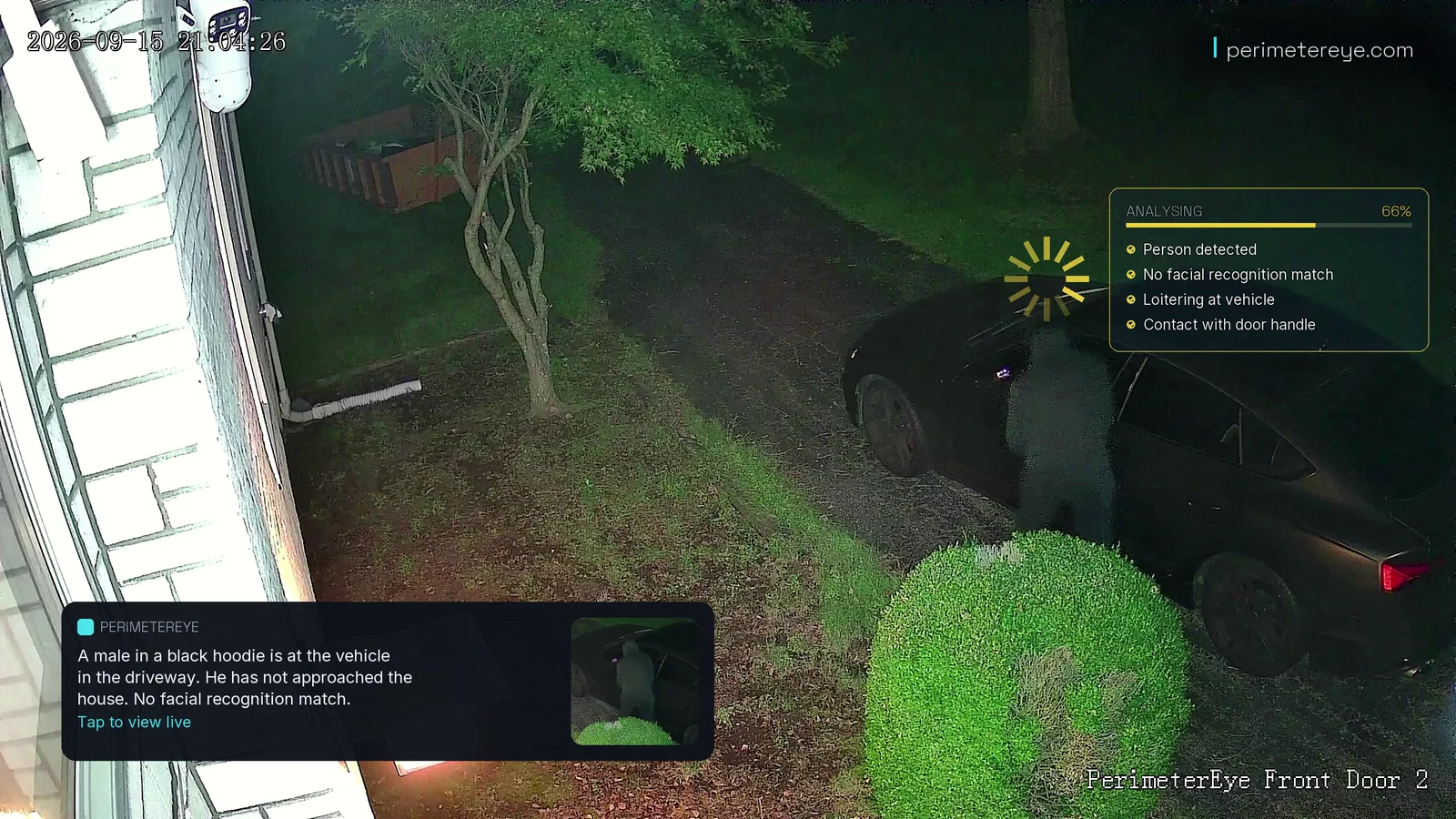
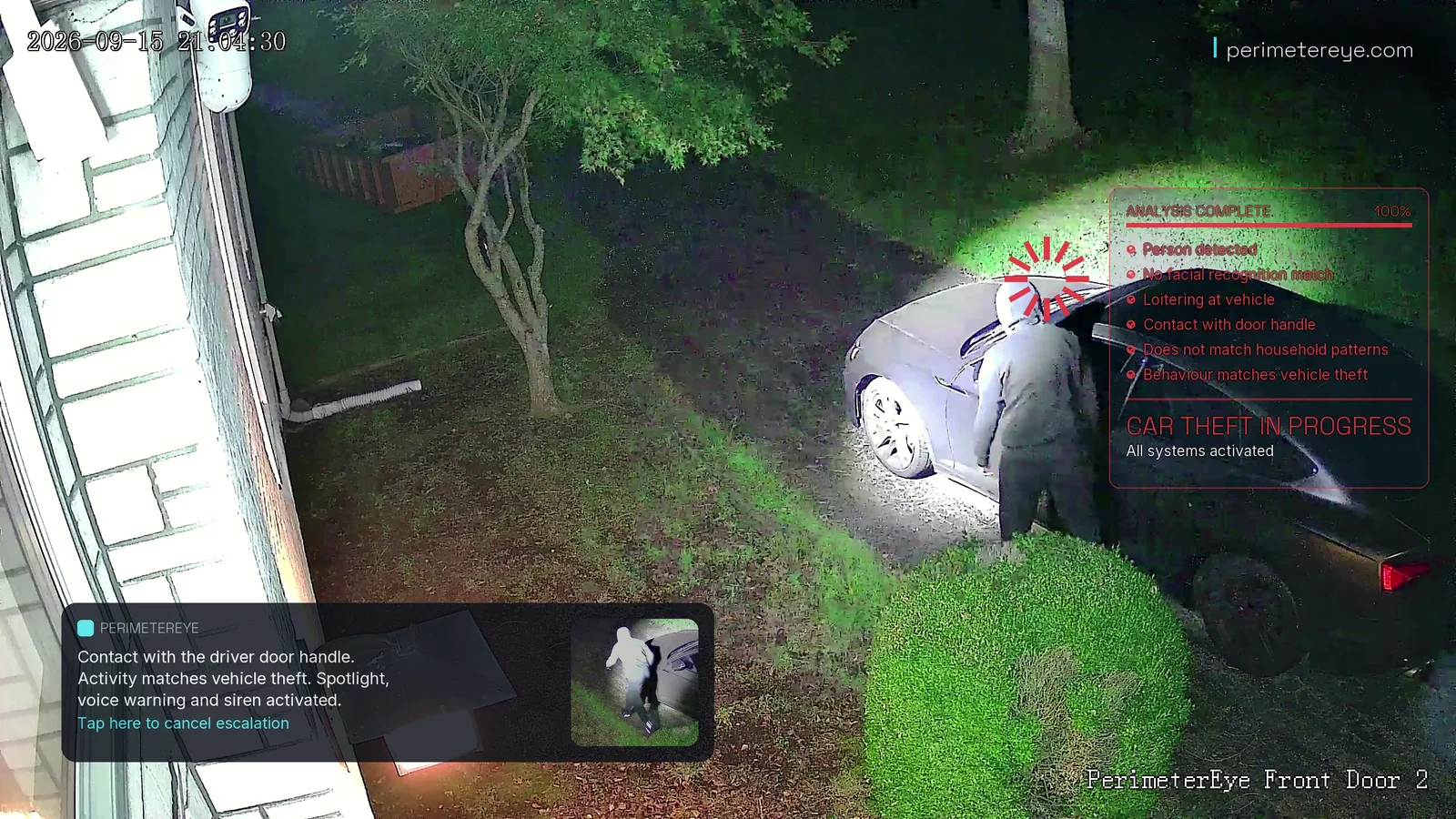
One camera and one staged break-in, shown three ways: the view on its own, with PerimeterEye’s analysis, and with its response hardware.
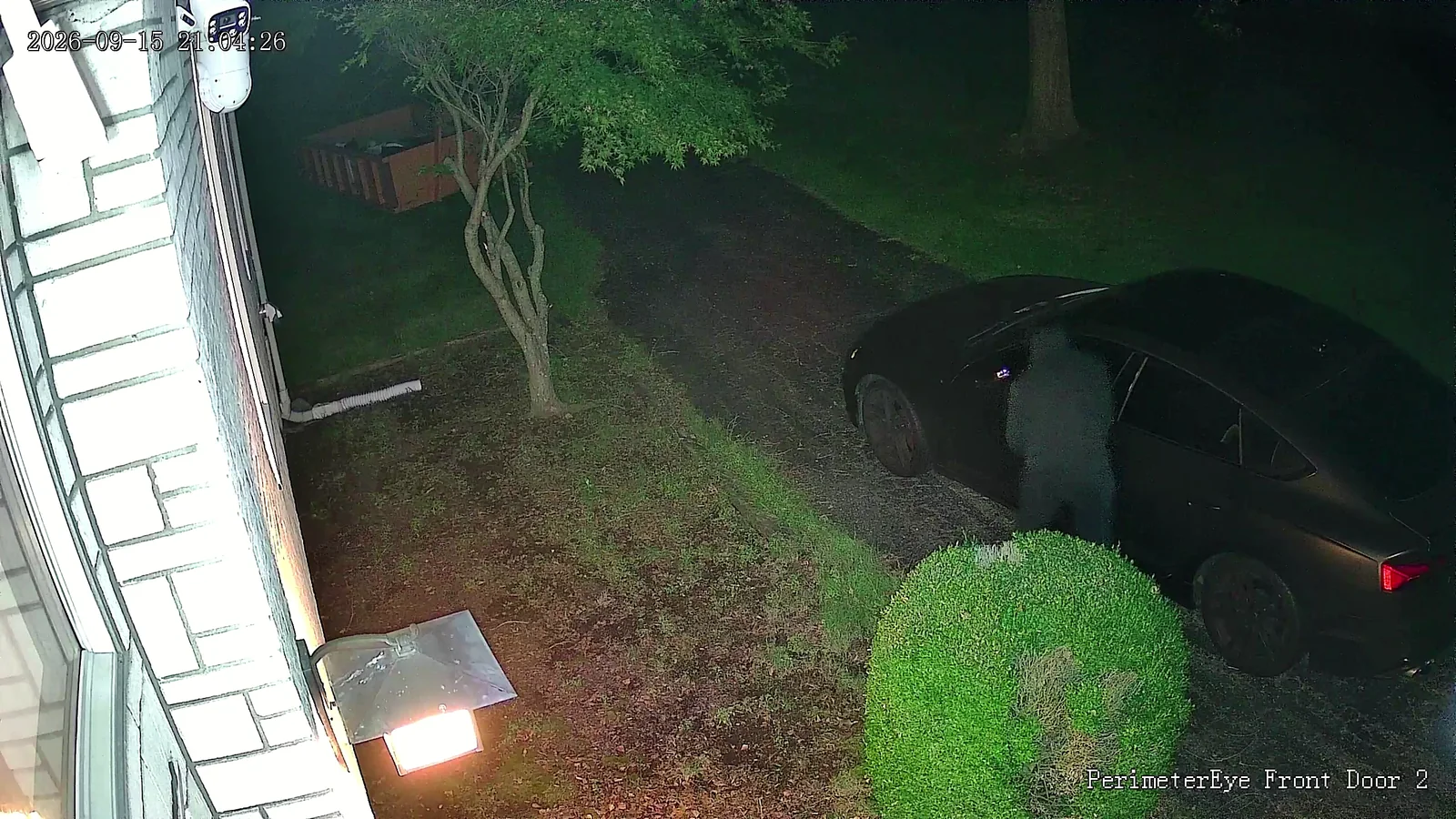
1 of 3 · A camera aloneView full size
It records
A person at the driver’s door, on a camera that records. Unless someone opens the clip in time, nothing else happens.
2 of 3 · UnderstoodView full size
The same view, understood
PerimeterEye reads the same moment: a person, no match to anyone it knows, loitering at the vehicle, contact with the door handle. The alert describes them in plain language.
3 of 3 · AnsweredView full size
The same view, answered
With a tracking searchlight, a siren, and AI voice warnings, the camera’s view directs a response. Four seconds later, the searchlight is on the person at the driver’s door.
Stills from a vehicle break-in staged for filming on a real property, on the Front Door 2 camera’s clock (21:04:26 and 21:04:30). The system’s response was automatic, with no operator.
What a fake camera is actually selling
A decoy camera makes one bet: that whoever looks at it will believe it is real, assume the property records everything, and decide the risk is not worth the reward. That is deterrence theater — a prop standing in for a capability. Theater sometimes works. The useful questions are on whom, and for how long.
The same bet underwrites most visible security. A yard sign claims an alarm exists. A decoy claims recording exists. Even a genuine camera, if nothing ever acts on what it sees, is a claim that the footage will someday matter to the person standing in frame. Each layer is a bluff about a response that may or may not exist behind it.
That framing sounds cynical, but it is exactly how the people you are trying to deter evaluate it. The evidence below is consistent on the core point: burglars do not take security at face value. They check.
Burglars check first — the survey evidence
The strongest data comes from Kuhns and colleagues at UNC Charlotte, who surveyed 422 incarcerated burglars for the 2013 study "Understanding Decisions to Burglarize from the Offender's Perspective." Roughly 83% said they would try to determine whether an alarm was present before attempting a burglary, and about 60% would seek another target if one was. More striking: over half said discovering an alarm mid-burglary would make them abort. One disclosure — the study was funded by AIREF, an alarm-industry research foundation, so weigh it accordingly. It remains the largest structured offender survey on the question.
In 2017, KGW-TV journalist Kyle Iboshi put similar questions to 86 incarcerated burglars in Oregon. The reporting is journalistic rather than peer-reviewed, but it rhymes with the academic work: most entered through unlocked doors and windows, and essentially all knocked or rang the doorbell first to test whether anyone was home. Cameras registered as a deterrent — though several inmates added that cameras can also signal a home worth robbing.
Put the two together and a picture forms. The burglar is running a fast investigation. In the UNC study, the top target-selection factors were the proximity of other people, escape routes, and signs of security — alarm signs, dogs inside, outdoor cameras. A decoy enters that investigation as one piece of evidence, and evidence gets examined.
Why bluffs fail inspection
Knocking is a probe. So is a slow drive past, a walk up the path with a flyer, or a long look at how your camera is mounted. Decoys tend to fail these inspections in predictable ways:
Not every intruder is a professional. Plenty of burglaries are opportunistic, and a convincing prop may push a purely casual thief toward an easier street. But the intruders worth worrying about — the ones who case, probe, and choose — are precisely the population most likely to spot a fake.
There is also a subtler cost, straight from the Oregon interviews: cameras can read as a hint that a house holds valuables. A prop buys you that downside without buying you the recording.
- Decoys ship in a handful of mass-produced shell designs, and repeat offenders have seen them all
- No infrared glow after dark, where most real cameras show a faint ring of light
- No reaction to anything, ever — no repositioning, no status change, no response to a wave or a knock
- Fake wires that run to nothing, or no cable at all where one would have to be
The honest hierarchy: props, recording, response
Rank visible security by what it does when someone decides to ignore it. Props do nothing; they are pure signal. Recording does something after the fact — it produces evidence that can support a police report or an insurance claim, and it may deter the subset of intruders who notice it and care. Response does something during the event: it changes the scene while the person is standing in it.
The strongest causal evidence in this whole space concerns response-tier conditions, not signals. A randomized experiment by Chalfin, Hansen, Lerner, and Parker (NBER Working Paper 25798) placed intensive lighting across 77 New York City public-housing developments and measured a roughly 36% drop in nighttime outdoor index crimes, with follow-up work in Criminology & Public Policy finding the effect persisted about three years. Light is not a claim about what might happen later. It changes what is true at the scene right now.
The UNC abort finding points the same direction: over half of burglars said that discovering an alarm during a burglary would make them quit. Real-time discovery interrupts. Nothing about a decoy — or a silently recording camera — manufactures that moment.
The day someone calls the bluff
Walk it through. Someone crosses your fence at 2 p.m. — and afternoon is the right test, because FBI data for 2024 shows daytime residential burglaries (216,601) outnumbering nighttime ones (174,053). The decoy on the eave stares. Nothing lights, nothing sounds, nobody is told. The burglary proceeds exactly as it would at a house with bare walls, except you paid for the plastic.
Now give the house a real recording camera. The event is documented — genuinely valuable afterward — but during those minutes the difference is nil. And the stakes of "during" are not abstract: Bureau of Justice Statistics data found a household member was present in roughly 28% of burglaries.
A prop also has no day two. Once one person has tested it — knocked, waited, walked past it and drawn no reaction — the bluff is spent. National context softens none of this. The FBI's 2024 figures put burglary at a record-low 229.2 per 100,000 nationally, but roughly 52% of burglaries were residential. Lower odds are not zero odds, and a decoy does not move them.
If you still want decoys, use them like decoys
There are defensible uses. A decoy costs a few dollars, and as one thread in a real layered setup it can add a sliver of doubt over a shed or a back gate. The mistake is promotion: treating a prop as the plan rather than a garnish on one.
A few rules keep the purchase honest:
- Never let a decoy be the only visible measure — pair it with real lighting, real locks, and something that actually reacts
- Mount it high and out of casual reach so its tells are harder to inspect
- Skip models with obvious fake wires or blinking red LEDs, which read as props to anyone who has seen a real camera
- Spend your next dollar on function, not another prop — the evidence rewards conditions that change at the scene
When the bluff has to be real
Everything above points to one design principle: deterrence that survives a probe must be backed by action. That is the premise of an Automatic Property Defense System. Monitoring products — cameras, alarms, video doorbells — watch, record, and notify. A property defense system acts on the property itself, in seconds, automatically, while you watch live.
PerimeterEye is built as that response tier. When it verifies a person on the property, a motorized searchlight locks onto them and physically follows them. The system speaks — live, targeted words describing the specific person in frame, not a canned announcement. If they stay, a 130 dB siren sounds and priority alerts with live video reach your phone, where you can watch, talk, or take manual control. There is no bluff to call, because every escalation an intruder tests produces a real reaction.
No security system can guarantee prevention of every incident. But the offender research is clear about what interrupts: being detected, confronted, and escalated on, in real time. That is the thing a prop imitates and a defense system does.
Common questions
Do fake security cameras deter burglars?
Only unreliably, and mostly against impulsive opportunists. In the 2013 UNC Charlotte survey of 422 incarcerated burglars, most said they checked for security before or during a break-in, which means props get inspected. A decoy may shift a casual thief next door, but anyone who probes it finds nothing behind the bluff.
Can burglars tell a camera is fake?
Often, yes. Decoys ship in a handful of recognizable shell designs, show no infrared glow at night, never move or react, and sometimes trail a wire to nowhere. Burglars who scout — the ones cameras are meant to worry — are exactly the ones most likely to notice those tells.
Are fake cameras better than nothing?
Marginally, and only as one cheap layer. They cost a few dollars and might redirect a purely opportunistic thief. But they do nothing during an actual break-in, they erode once tested, and money spent on them buys more deterrence as lighting, locks, or equipment that genuinely reacts.
Do real security cameras deter burglars?
Partially. Incarcerated burglars in the UNC Charlotte survey listed outdoor cameras among the signs of security they weighed, but Oregon inmates in KGW's 2017 reporting also read cameras as a hint that a home holds valuables. A camera that only records documents a crime; it does not interrupt one.
What deters burglars more than a fake camera?
Signals that are hard to fake: someone appearing to be home, a big loud dog, a discovered alarm, and bright active lighting. In the UNC survey, about 60% of burglars said they would seek another target if an alarm was present, and over half would abort mid-burglary after discovering one.
Sources
- Kuhns et al., Understanding Decisions to Burglarize from the Offender's Perspective (UNC Charlotte, 2013, AIREF-funded)
- KGW-TV, "We asked 86 burglars" (Kyle Iboshi, 2017)
- Chalfin, Hansen, Lerner & Parker, NBER Working Paper 25798 (2019)
- FBI Crime in the Nation 2024, FBI Crime Data Explorer
- BJS, Victimization During Household Burglary (2010)
What it costs
See what a system costs for your property.
Essential system
As low as$146/mo*Essential covers a driveway and the approaches to the house. Larger properties usually suit Advanced or Estate; a specialist can size it with you before you order.
What’s included
- 5 ultra-HD 4K cameras
- 1 tracking spotlight
- 1 speaker/siren unit
- PerimeterEye Access intercom, included with every complete system
- 1 PerimeterEye control panel
- 1 PerimeterEye AI processor
*Essential system, $0 down: 36 monthly payments of $145.17 at 10% APR on the hardware price before sales tax, shown rounded up to the dollar. Affirm rates 0–36% APR; Klarna terms are shown at checkout. Subject to eligibility and lender approval; your rate, term and down payment may differ. US only; not available in all states. Software is billed separately: first 6 months included, then $99/month.
Deterrence that answers the probe
PerimeterEye lights intruders up, calls them out by description, and runs them off with light, voice, and sound — automatically, while you watch live. See what a real response tier looks like.