Do security signs deter burglars?
Security yard signs are a weak-to-moderate deterrent at best. In the best available offender survey — 422 incarcerated burglars interviewed for a 2013 UNC Charlotte study — signs registered only inside a broader "signs of security" bundle, well behind occupancy cues and escape routes as reasons to skip a house. The dramatic sign statistics that dominate search results cannot be traced to any primary source.
That last sentence is the part most articles on this topic omit. The web's favorite numbers about yard signs are quoted, requoted, and rounded — but never linked to a paper anyone can read. So this article does two jobs: it audits the folklore, and then it answers every practical sign question using only research that traces to a named study, with funding disclosed.
The short version: a sign is a claim about a response. The evidence supports the response. The sign borrows credibility it has to keep earning.
What this looks like on a real property
Voice first. Then the light. Then the siren.
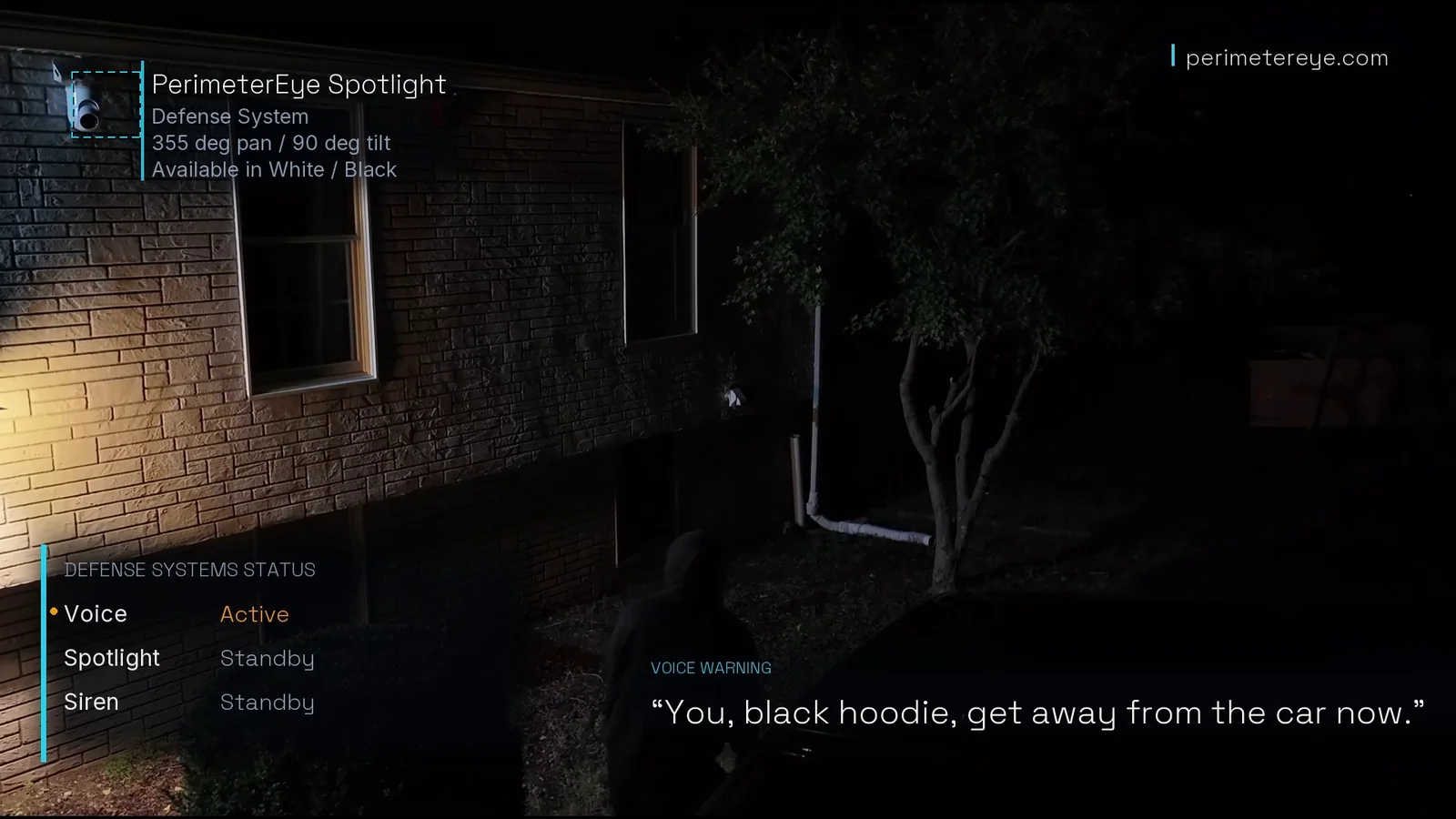
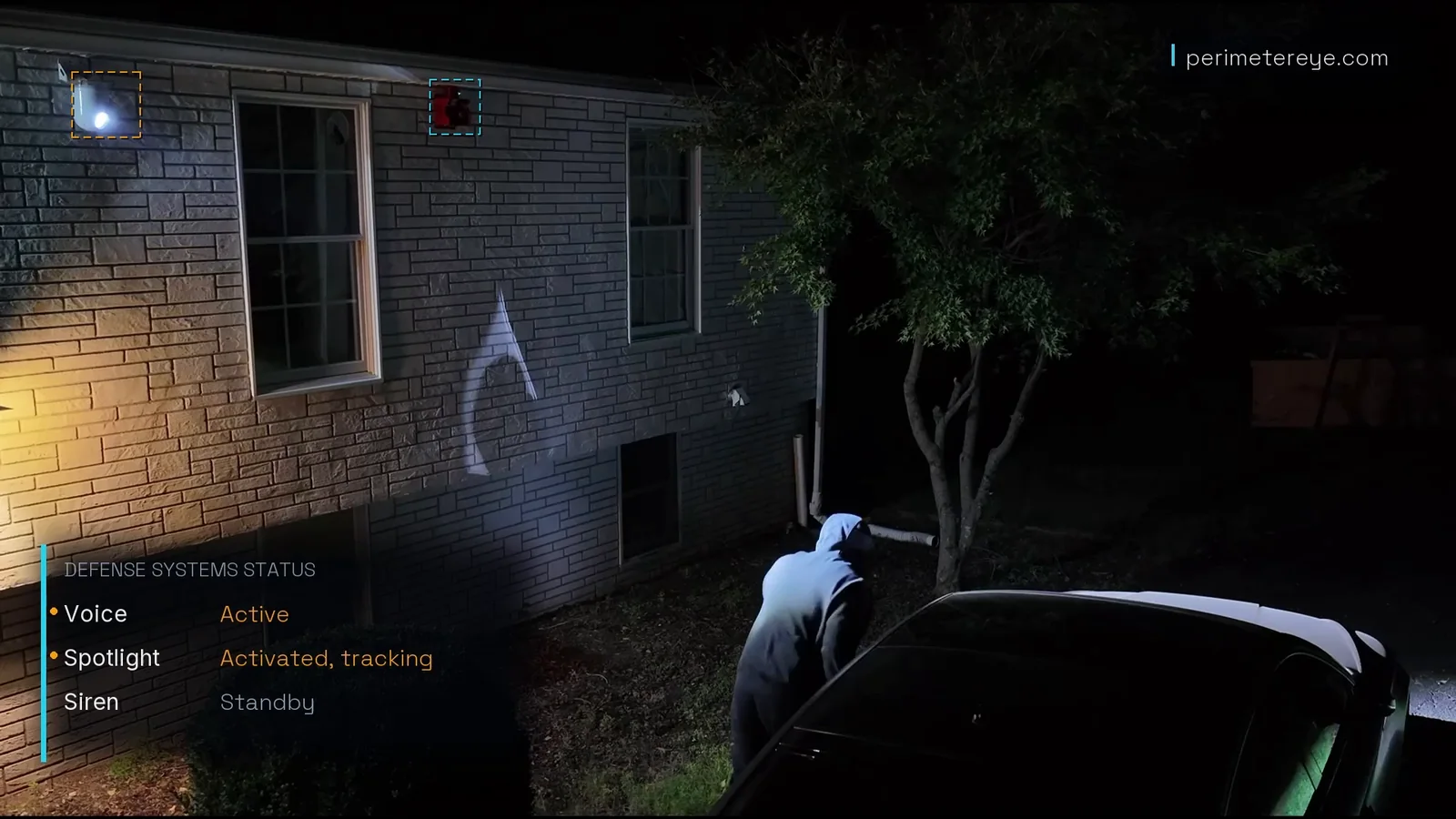
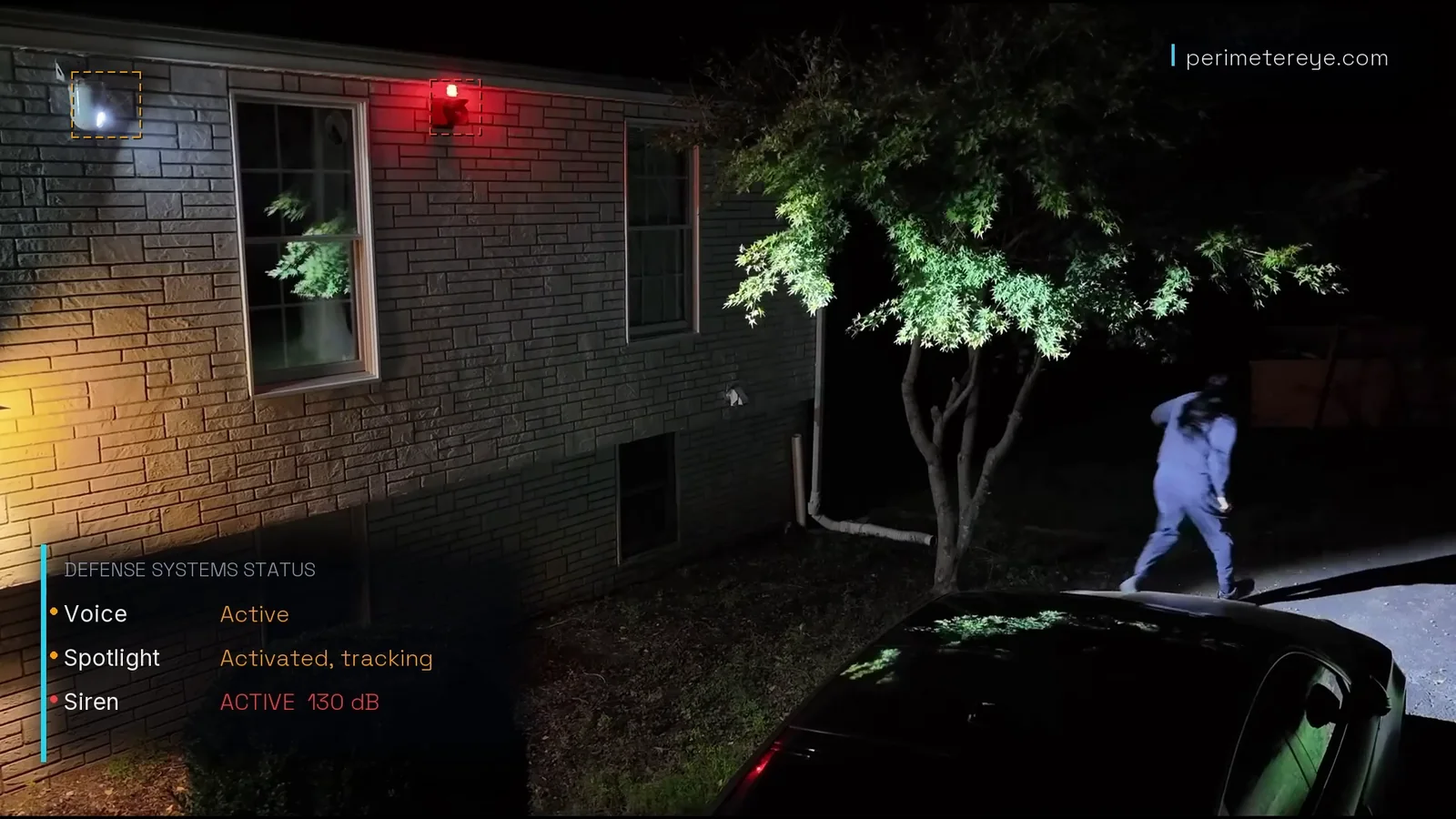
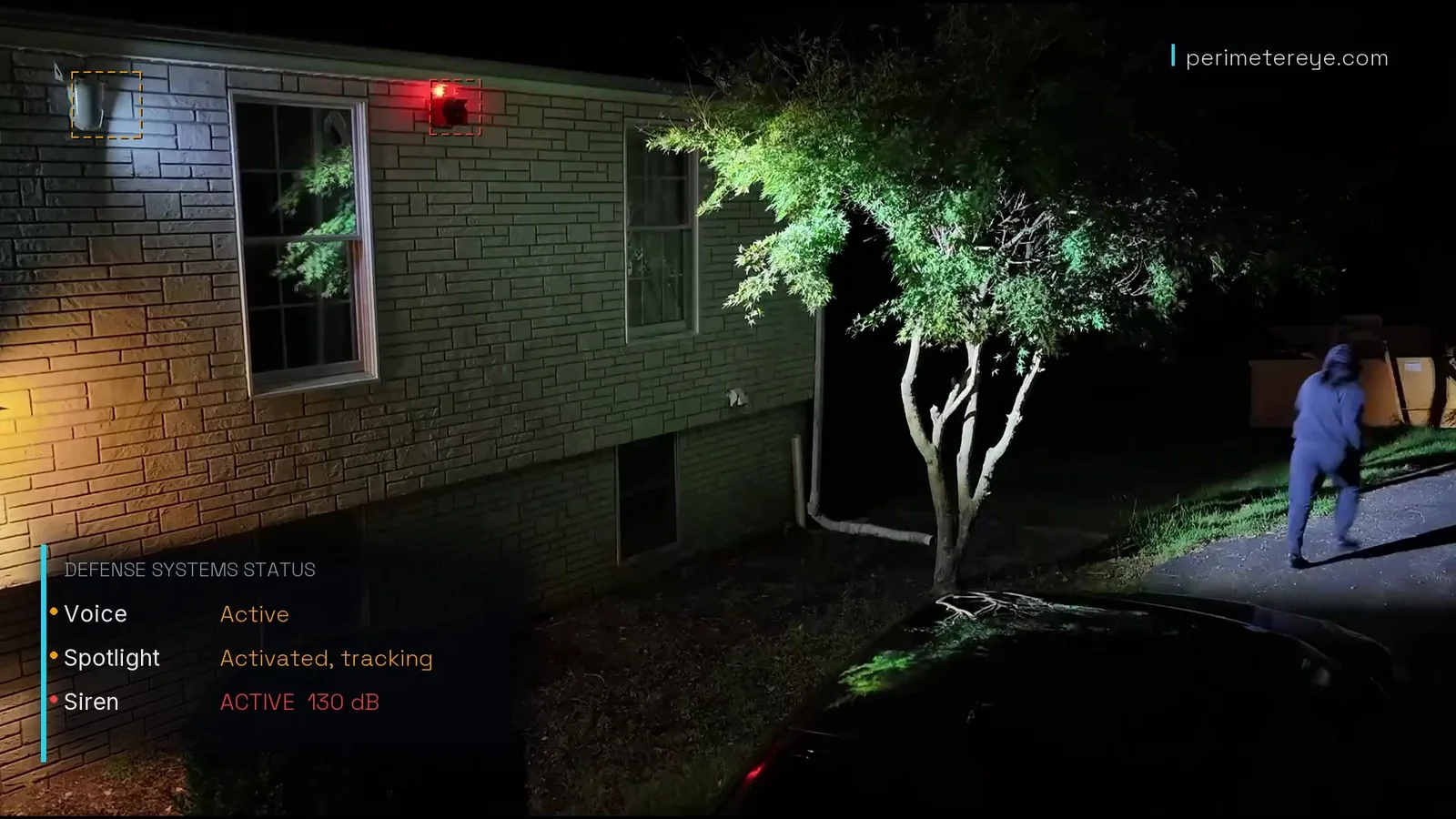
Stills from the demonstration with the system’s status on screen. Each part of the response switches on as the person keeps going, automatically.
1 of 4 · VoiceView full size
A warning with their description
The first response is spoken, and it is about them: “You, black hoodie, get away from the car now.” The searchlight and siren are on standby.
2 of 4 · SearchlightView full size
Then the light finds them
The person stays at the car, so the searchlight activates and tracks. They are lit up where they stand.
3 of 4 · SirenView full size
Then the 130 dB siren
The siren joins the voice and the light, and the person runs from the car.
4 of 4 · FollowedView full size
Followed as they go
The beam stays on them as they run past the tree, with every part of the response still active.
Filmed on a real property. The attempt was staged for filming; the system’s response was automatic, with no operator.
Why the top results for this question fail basic sourcing
Search this question and the highest-ranking pages lean on a familiar set of numbers: a University of Texas at San Antonio study said to show yard signs deter burglars; a claim that "46% of burglars avoid homes with alarm signs"; the evergreen "homes without security are 300% more likely to be burglarized." Try to follow any of them to a paper, a dataset, or a named author with a locatable publication, and the trail dies in a loop of blogs citing blogs citing a press release nobody archived.
This is not pedantry. Untraceable statistics are how an eight-dollar sign gets marketed as a security strategy. If a number cannot be checked, it cannot be weighed — you cannot know the sample, the question wording, the funding, or whether the figure was about signs at all. A common corruption: the real UNC finding that about 60% of burglars would avoid a home with an alarm quietly becomes "60% avoid homes with alarm signs." The alarm and the sign are not the same thing, and the difference is the entire question.
The rule for everything below: every number traces to a study you can locate, and industry funding is disclosed where it exists.
What the verified evidence actually says about signs
The central source is Kuhns and colleagues' 2013 UNC Charlotte survey of 422 incarcerated burglars, funded by AIREF, an alarm-industry research foundation — a conflict worth knowing, though the work remains the largest structured offender survey available. Its headline findings concern alarms, not signs: roughly 83% of burglars said they would try to determine whether an alarm was present before a burglary, about 60% would seek another target if one was, and over half would abort a burglary in progress on discovering one.
Signs appear in the study as part of a broader category. The top target-selection factors were the proximity of other people, escape routes, and "signs of security" — a bundle that includes alarm signs, dogs inside, and outdoor cameras. So a sign does register. But read carefully and its role is specific: it is one input into the burglar's judgment about whether an alarm actually exists, weighed alongside stickers, visible keypads, wiring, and the look of the property. It is also the cheapest of those inputs to fake, and burglars price that in.
Nothing in the study supports a standalone percentage for yard signs alone. That is precisely why the honest summary is a range — weak to moderate, as a contributing cue — rather than the crisp fake numbers the top results prefer.
Signs are claims; alarms are the substance
Independent-ish support for the thing signs advertise comes from Lee's 2009 Rutgers School of Criminal Justice study of Newark, also AIREF-sponsored: neighborhoods with higher residential alarm density experienced fewer burglaries, with no measurable displacement of crime to neighboring homes. Industry funding, again disclosed — but note what the study is about. The alarm itself. Nobody has produced comparable evidence for vinyl.
The KGW-TV survey of 86 Oregon inmates (2017, journalistic rather than peer-reviewed) explains why the sign can never be the main event: occupancy dominates everything. Most burglars entered through unlocked doors and windows, essentially all knocked or rang first to test whether anyone was home, and a car in the driveway, sound inside, or a big loud dog were the strongest reasons to walk away. A sign does not answer a knock.
Then there is the economics. Signs cost a few dollars, no purchase verification required, and every burglar knows sign-only houses exist in quantity. A sign backed by nothing is the fake-camera problem printed on aluminum: a bluff that works until the first probe, and not a minute after.
Every sign subquestion, answered
The practical questions people actually type into search boxes, each answered from the evidence above:
- Do signs work with no system behind them? Sometimes, on opportunists, unreliably — and the first probe that meets silence spends the bluff for good
- Does the brand on the sign matter? A recognizable alarm brand reads more credible than a generic "protected by" shield, but any sign can be bought, so the credibility ceiling is low either way
- How many signs, and where? Cover each approach a stranger would actually use — front walk, driveway entrance, gates, rear alley — and place them where nighttime lighting reaches them
- Do signs advertise valuables? Unproven for signs specifically; KGW's inmates said it about cameras, and the logic transfers, so treat it as a real possibility rather than a myth
- Do old, faded signs still work? A weathered sign for a defunct alarm company signals bluff more than protection — replace it or remove it
The signal hierarchy the surveys support
Rank the cues by how consistently the two offender surveys treat them: people present or plausibly present comes first, big loud dogs close behind, then a discovered alarm, then visible cameras, and signs last — a supporting witness for the alarm, never the star. The pattern underneath is simple: the harder a signal is to fake, the more a burglar respects it.
One more entry belongs in the ranking even though it makes no claim at all. The randomized NBER lighting experiment (Working Paper 25798) — intensive lighting across 77 New York City public-housing developments — cut nighttime outdoor index crimes by roughly 36%, an effect that follow-up work found persisted about three years. Lighting does not assert that something will happen later. It changes the scene now, which is a different and better category of deterrent.
Honesty about the limits: both offender surveys are self-reports from burglars who were caught, the UNC study is industry-funded, and the KGW piece is journalism with a sample of 86. This is the best evidence available, and it is thinner than the confidence of the average listicle.
A property that demonstrates instead of claims
Every sign shares one structural weakness: it asserts a capability it cannot demonstrate. The interesting inversion is a system whose visible behavior is the advertisement — where what a passerby sees is not a claim about a response but the response itself, idling.
That is how an Automatic Property Defense System like PerimeterEye handles the signaling problem. Each night, an hour after sunset, its motorized tracking searchlights run a configurable Perimeter Sweep — a visible patrol of light that never crosses the property boundary. Someone sizing up the street is not reading vinyl; they are watching a property demonstrate that it sees and reacts. And if a verified intruder steps onto the property, the demonstration stops being ambient: a searchlight locks on and physically follows them, a live targeted voice describes them out loud, and a 130 dB siren with priority alerts and live video sits behind it.
No security system can guarantee prevention of every incident — and after the sourcing audit above, you should distrust anyone who implies otherwise. But there is a real difference between a sign that says something will happen and a property where something visibly does.
Common questions
Do security signs deter burglars?
Weakly to moderately, as one cue among several. In the 2013 UNC Charlotte survey of 422 incarcerated burglars, signs of security — alarm signs, dogs, visible cameras — factored into target selection, but occupancy and escape routes mattered more, and the alarm itself carried more weight than the sign advertising it.
Is there a study proving signs stop burglars?
No traceable one. The statistics that dominate search results — a supposed yard-sign study, "46% avoid alarm signs," "300% more likely without security" — cannot be followed back to any locatable primary source. The verified offender research treats signs as a minor input into a burglar's judgment, not a standalone deterrent.
Do security signs work without an alarm system?
They work worse, and they carry risk. A sign is a claim about a response; the verified evidence — like Lee's 2009 Newark study linking alarm density to fewer burglaries — supports the alarm, not the vinyl. A burglar who probes a sign-only house and gets silence learns the claim was empty.
Where should security signs go?
At the points where someone sizing up the property would look: the front walkway, the driveway entrance, gates, and any secondary approach like an alley. Visibility at night matters, so place signs where exterior lighting reaches them. Signs facing the street do nothing for a burglar already probing the back.
What deters burglars more than signs?
Occupancy above everything. Oregon inmates in KGW's 2017 reporting said a car in the driveway, sound inside, and big loud dogs were the strongest reasons to walk away, and nearly all knocked first to test whether anyone was home. Signals that respond in real time beat signals that just sit there.
Sources
- Kuhns et al., Understanding Decisions to Burglarize from the Offender's Perspective (UNC Charlotte, 2013, AIREF-funded)
- KGW-TV, "We asked 86 burglars" (Kyle Iboshi, 2017)
- Lee, Rutgers School of Criminal Justice, Newark alarm-density study (2009, AIREF-sponsored)
- Chalfin, Hansen, Lerner & Parker, NBER Working Paper 25798 (2019)
What it costs
See what a system costs for your property.
Essential system
As low as$146/mo*Essential covers a driveway and the approaches to the house. Larger properties usually suit Advanced or Estate; a specialist can size it with you before you order.
What’s included
- 5 ultra-HD 4K cameras
- 1 tracking spotlight
- 1 speaker/siren unit
- PerimeterEye Access intercom, included with every complete system
- 1 PerimeterEye control panel
- 1 PerimeterEye AI processor
*Essential system, $0 down: 36 monthly payments of $145.17 at 10% APR on the hardware price before sales tax, shown rounded up to the dollar. Affirm rates 0–36% APR; Klarna terms are shown at checkout. Subject to eligibility and lender approval; your rate, term and down payment may differ. US only; not available in all states. Software is billed separately: first 6 months included, then $99/month.
Advertise something real
PerimeterEye's nightly Perimeter Sweep and tracking searchlights make the deterrence visible — and back it with live voice, siren, and alerts the moment someone tests it.