What scares burglars away? People, mostly
What scares burglars away most is people. In two separate interview studies of convicted burglars, the top avoid signals were occupancy — a car in the driveway, sound inside a home, neighbors nearby — plus loud dogs and the risk of being seen and confronted. Hardware mattered mainly as a hint that a person might respond.
That finding comes from the two best windows we have into burglar decision-making: a UNC Charlotte survey of 422 incarcerated burglars, funded by an alarm-industry research foundation, and a KGW-TV journalist's questionnaire answered by 86 Oregon inmates. Different methods, different years, different incentives — the same answer. Burglars are managing one risk above all others: a face-to-face encounter.
Understanding that reframes every security purchase. The question is not "which gadget scares burglars?" It is "does this make a burglar believe a person will notice and respond, right now?"
What this looks like on a real property
Voice first. Then the light. Then the siren.
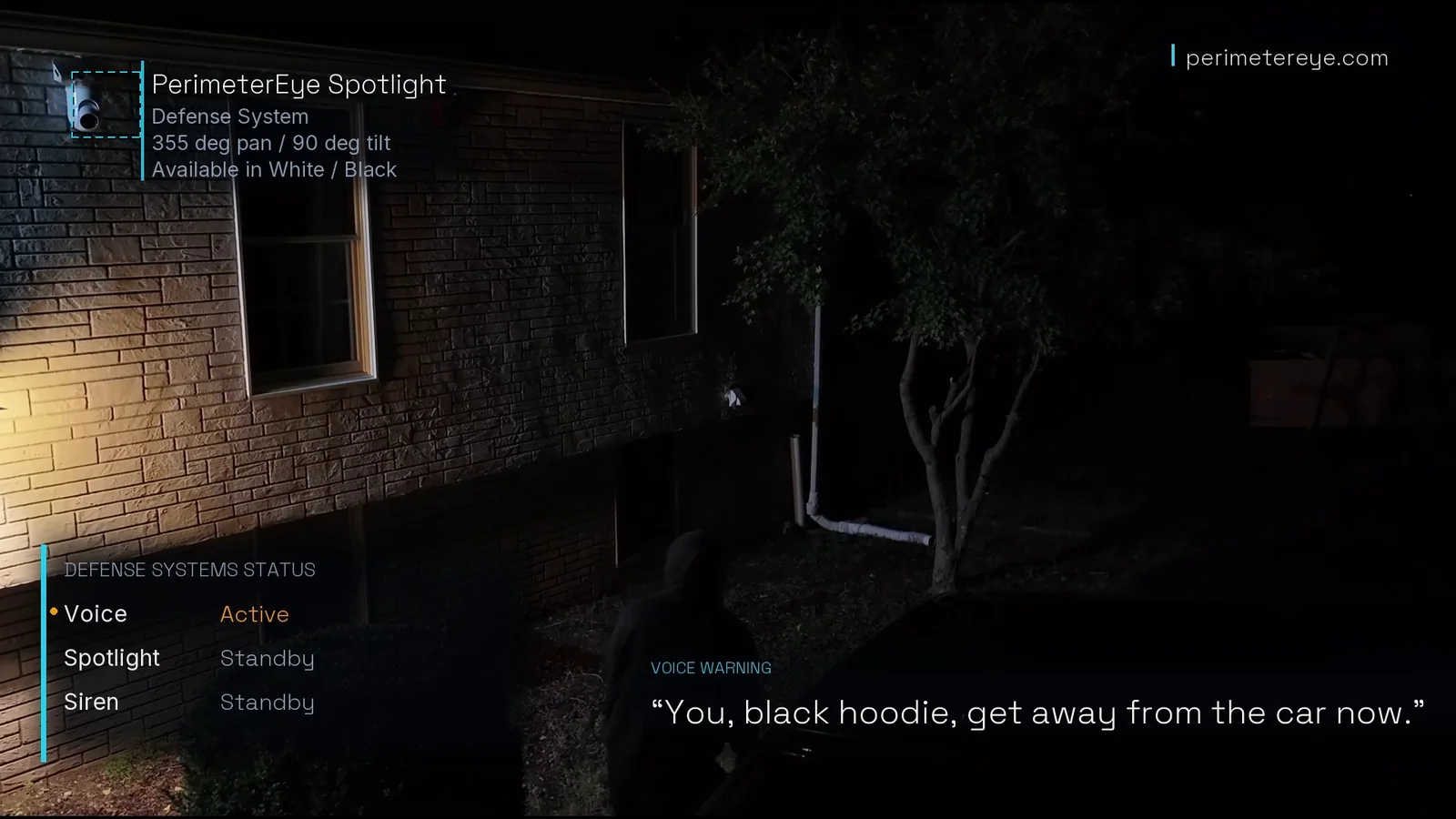
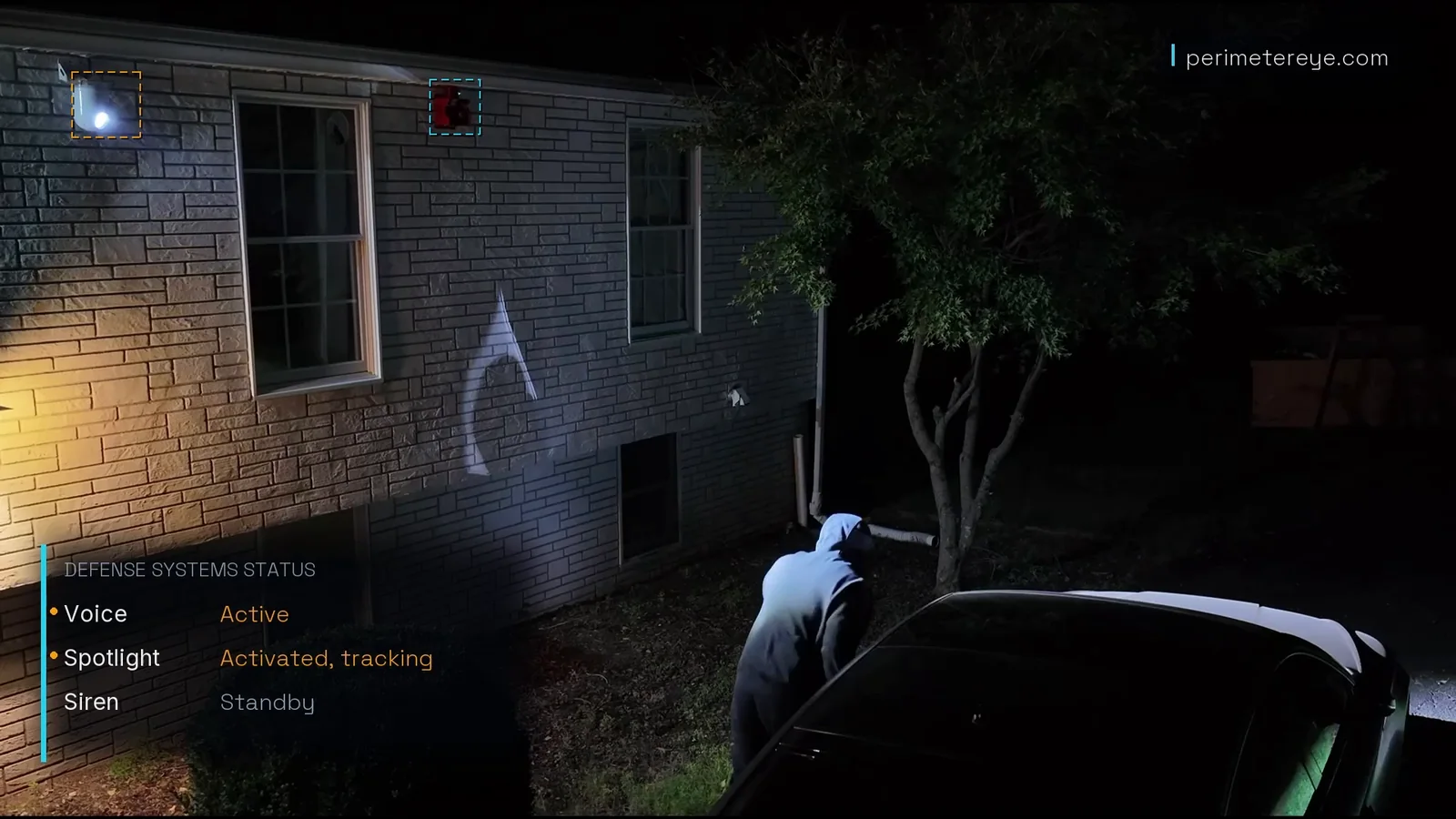
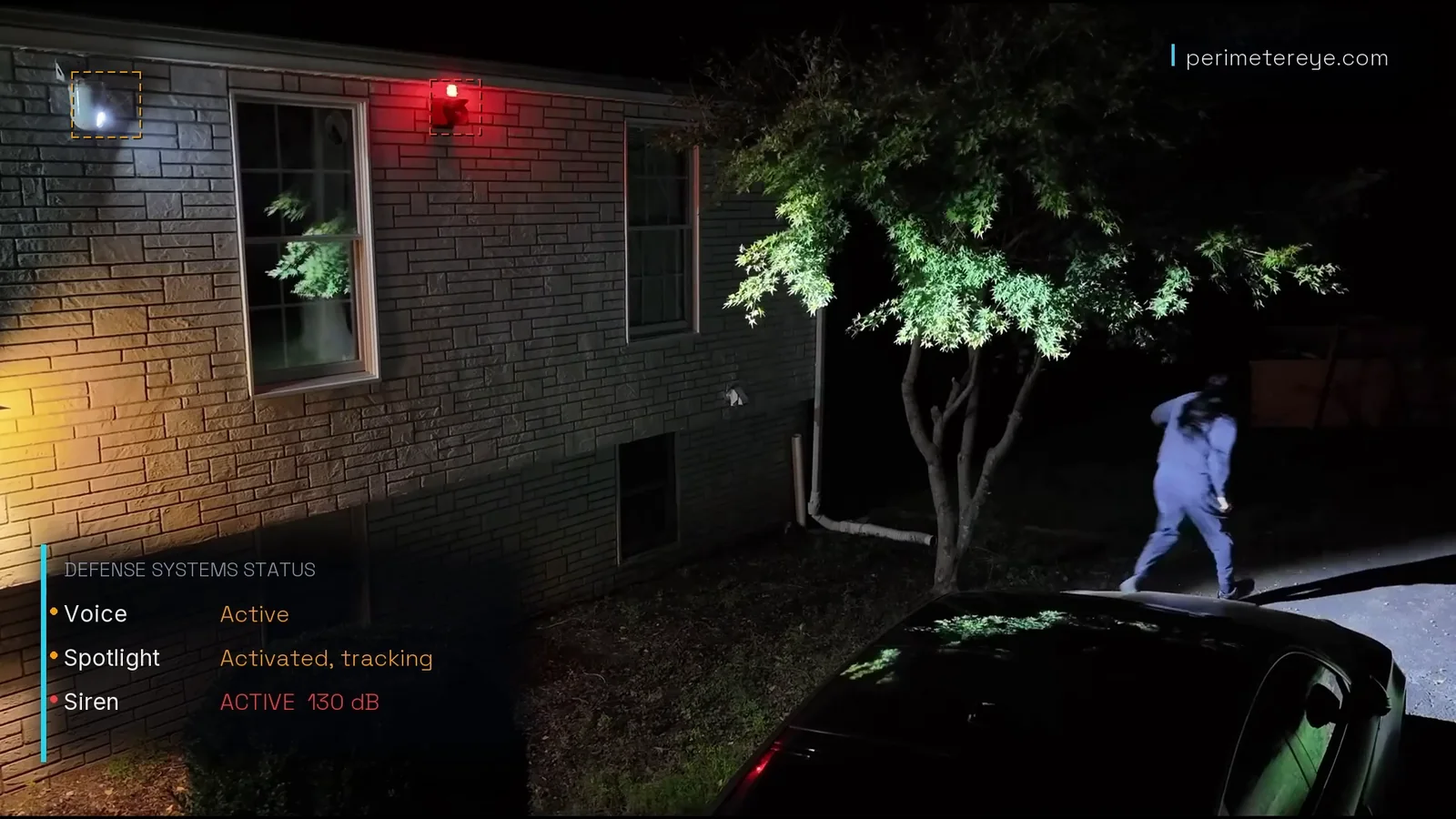
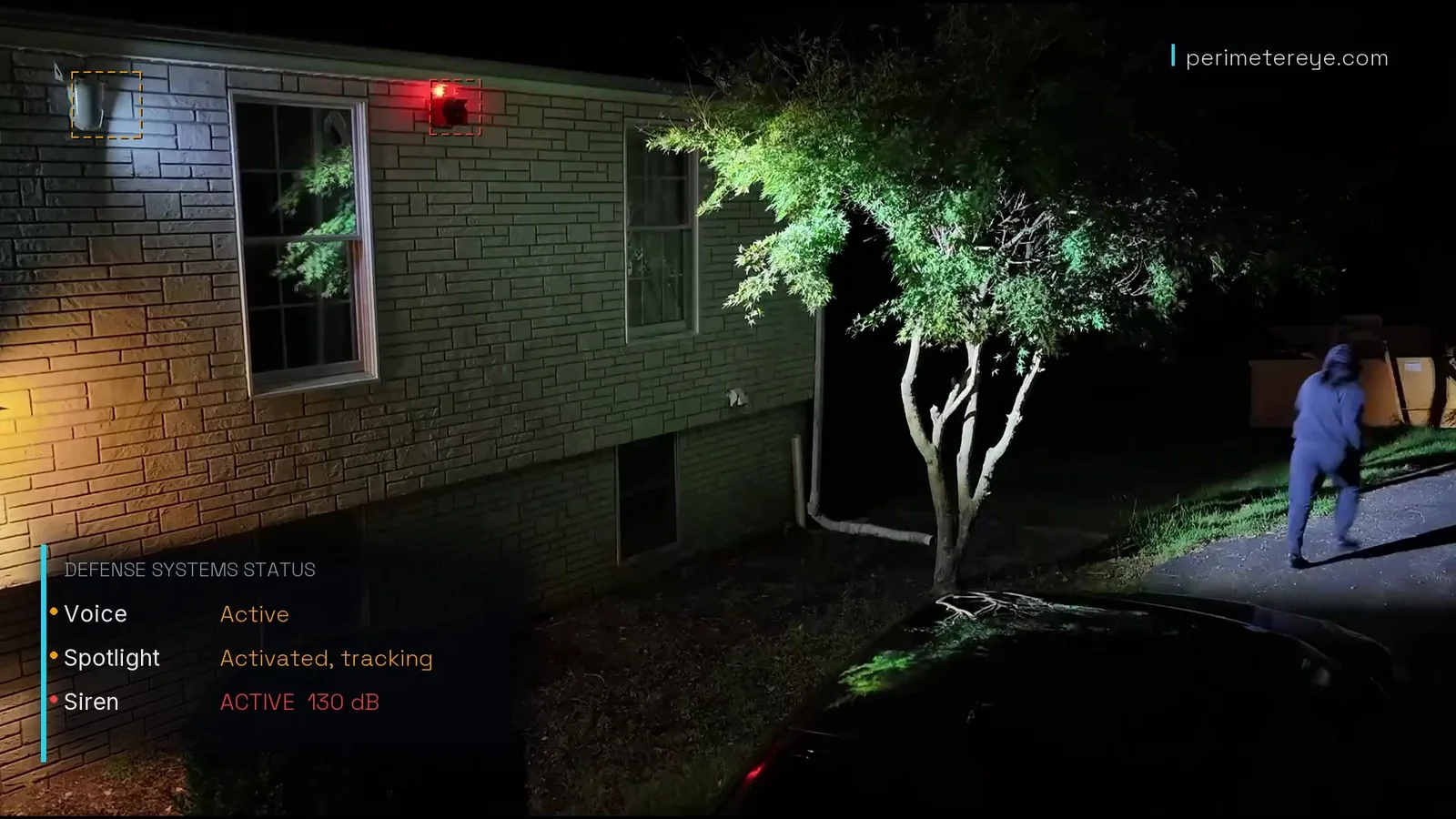
Stills from the demonstration with the system’s status on screen. Each part of the response switches on as the person keeps going, automatically.
1 of 4 · VoiceView full size
A warning with their description
The first response is spoken, and it is about them: “You, black hoodie, get away from the car now.” The searchlight and siren are on standby.
2 of 4 · SearchlightView full size
Then the light finds them
The person stays at the car, so the searchlight activates and tracks. They are lit up where they stand.
3 of 4 · SirenView full size
Then the 130 dB siren
The siren joins the voice and the light, and the person runs from the car.
4 of 4 · FollowedView full size
Followed as they go
The beam stays on them as they run past the tree, with every part of the response still active.
Filmed on a real property. The attempt was staged for filming; the system’s response was automatic, with no operator.
The two studies, and how much to trust them
The UNC Charlotte study (Kuhns et al., 2013) put structured surveys in front of 422 incarcerated burglars and asked how they chose targets, what they checked first, and what made them quit. It was funded by the Alarm Industry Research and Educational Foundation, so read its alarm findings with that in mind. The Oregon material is journalism, not peer review: in 2017, reporter Kyle Iboshi sent questionnaires to inmates convicted of burglary and published answers from 86 of them.
Neither is a randomized trial, and self-reports from prison have an obvious limit — these are, by definition, the burglars who got caught. But the two samples were collected independently, years apart, by people with different motives, and they converge on the same core finding. That convergence is why this article exists.
Fear one: somebody is home
Essentially every Oregon burglar said they knocked or rang the doorbell before trying a door, with a cover story ready in case anyone answered. A car in the driveway was among their strongest reasons to skip a house entirely. In the UNC Charlotte survey, the proximity of other people ranked among the top target-selection factors, ahead of any product you can buy.
The corollary is uncomfortable: the Bureau of Justice Statistics found a household member was present in roughly 28 percent of burglaries. The occupancy check fails often enough that "they'll leave if we're home" is not a plan — but the effort burglars put into that check tells you how badly they want to avoid you.
Fear two: noise, and the dogs that make it
Sound inside the house ranked with the car in the driveway among the Oregon burglars' strongest avoid signals — a TV, a radio, anything suggesting the knock might be answered. Big, loud dogs sat in the same tier. Not dogs generally: big and loud, the kind that announce an intruder to the whole street and cannot be predicted, distracted, or reasoned with.
Notice what the dog is actually doing in the burglar's mental model. It is not the bite; injury barely comes up in either study. It is exposure — a dog converts a quiet entry into a loud public event and sharply raises the odds that a person shows up to see what the noise is.
Fear three: being individually seen
Burglary works as a crime because it is anonymous. The UNC Charlotte respondents weighed escape routes and the nearness of other people — witnesses — as heavily as anything else. The Oregon burglars treated cameras with ambivalence, calling them a deterrent but also a possible sign of valuables, precisely because a camera is an uncertain witness: it might identify them later, or it might record an unrecognizable hood.
What burglars describe fearing is not being recorded in general but being seen in particular: a neighbor who gets a good look, a homeowner who speaks to them, anyone who can attach a face and a description to them while they still have to walk back down the same street they came in on.
Every classic deterrent is a proxy for confrontation
Run the standard checklist through that lens and it stops being a list of gadgets. An alarm's threat is not the sound itself; it is that the sound summons attention — roughly 60 percent of the UNC Charlotte burglars said they would pick another target if an alarm was present. A lit yard means a neighbor might see. A yard sign claims a system, and a system claims a response. A dog is a resident that always answers the door.
That is also why the weakest deterrents are the ones that fake the proxy without the payoff — a sticker with no system behind it, a dummy camera, a light on a timer that never varies. Burglars who case houses are testing whether the signal is connected to a person. The knock on the door is exactly that test, and most houses fail it silently.
When the property itself does the confronting
This is the finding a property-defense system is designed around. Monitoring systems — cameras, alarms, app alerts — record what happens and notify someone far away; the burglar's bet is that no person arrives in time to matter. PerimeterEye, an Automatic Property Defense System, is built to lose that bet for them: it verifies an unknown person, locks a motorized searchlight onto them and physically follows them across the property, and addresses them with live, targeted AI speech — "You, in the dark hoodie — you are not authorized to be on this property" — before escalating to a 130 dB siren and priority alerts with live video.
Every one of those steps is a confrontation signal straight from the survey research: you have been seen, individually; noise is now guaranteed; attention is on you. Because the system knows the household, family arrivals and mail carriers never trigger any of it, and you can watch, talk live, or take over at any point. The honest disclaimer belongs here too: no security system can guarantee prevention of every incident — the evidence simply says confrontation is the thing burglars leave to avoid.
Common questions
What scares burglars away the most?
People. In interviews with 422 incarcerated burglars and 86 Oregon inmates, the strongest avoid signals were an occupied-looking home, sound inside, neighbors close by, and big loud dogs. Alarms, cameras, and lights mattered mostly as evidence that someone might notice and respond. Confrontation is the fear; everything else is a proxy for it.
Do burglars really knock on the door first?
Yes — almost universally. In the Oregon prison interviews, essentially every burglar said they knocked or rang the doorbell before attempting entry, with a cover story ready if someone answered. The knock is an occupancy test. A home that answers every knock, even when the owner is away, removes the burglar's favorite reconnaissance tool.
Is someone usually home during a burglary?
More often than most people assume. The Bureau of Justice Statistics found a household member was present in roughly 28 percent of burglaries. Burglars try hard to avoid occupied homes, but they misjudge. That is a reason to care about deterrence at the perimeter rather than discovering an intruder at an interior door.
Are burglars afraid of cameras?
Somewhat, and less than you would hope. Oregon burglars described cameras as a deterrent but also as a possible sign of valuables, and the UNC Charlotte survey ranked outdoor cameras below alarms and occupancy cues. A camera that only records is a passive witness; the fear burglars actually describe is an active one.
Does a "Beware of Dog" sign work without a dog?
There is no credible evidence either way — the widely shared university studies about dog signs cannot be traced to a primary source. What the interviews support is the dog itself: big and loud ranked among the strongest avoid signals. A sign costs almost nothing, but noise and unpredictability are what burglars actually mentioned.
What it costs
See what a system costs for your property.
Essential system
As low as$146/mo*Essential covers a driveway and the approaches to the house. Larger properties usually suit Advanced or Estate; a specialist can size it with you before you order.
What’s included
- 5 ultra-HD 4K cameras
- 1 tracking spotlight
- 1 speaker/siren unit
- PerimeterEye Access intercom, included with every complete system
- 1 PerimeterEye control panel
- 1 PerimeterEye AI processor
*Essential system, $0 down: 36 monthly payments of $145.17 at 10% APR on the hardware price before sales tax, shown rounded up to the dollar. Affirm rates 0–36% APR; Klarna terms are shown at checkout. Subject to eligibility and lender approval; your rate, term and down payment may differ. US only; not available in all states. Software is billed separately: first 6 months included, then $99/month.
Make yours the house that answers back
PerimeterEye gives your property the responses burglars say they avoid — a tracking searchlight, a targeted voice, a 130 dB siren, and you watching live — automatically, in seconds.