PerimeterEye vs ADT: The Off-Property Alarm Chain vs the On-Property Ladder
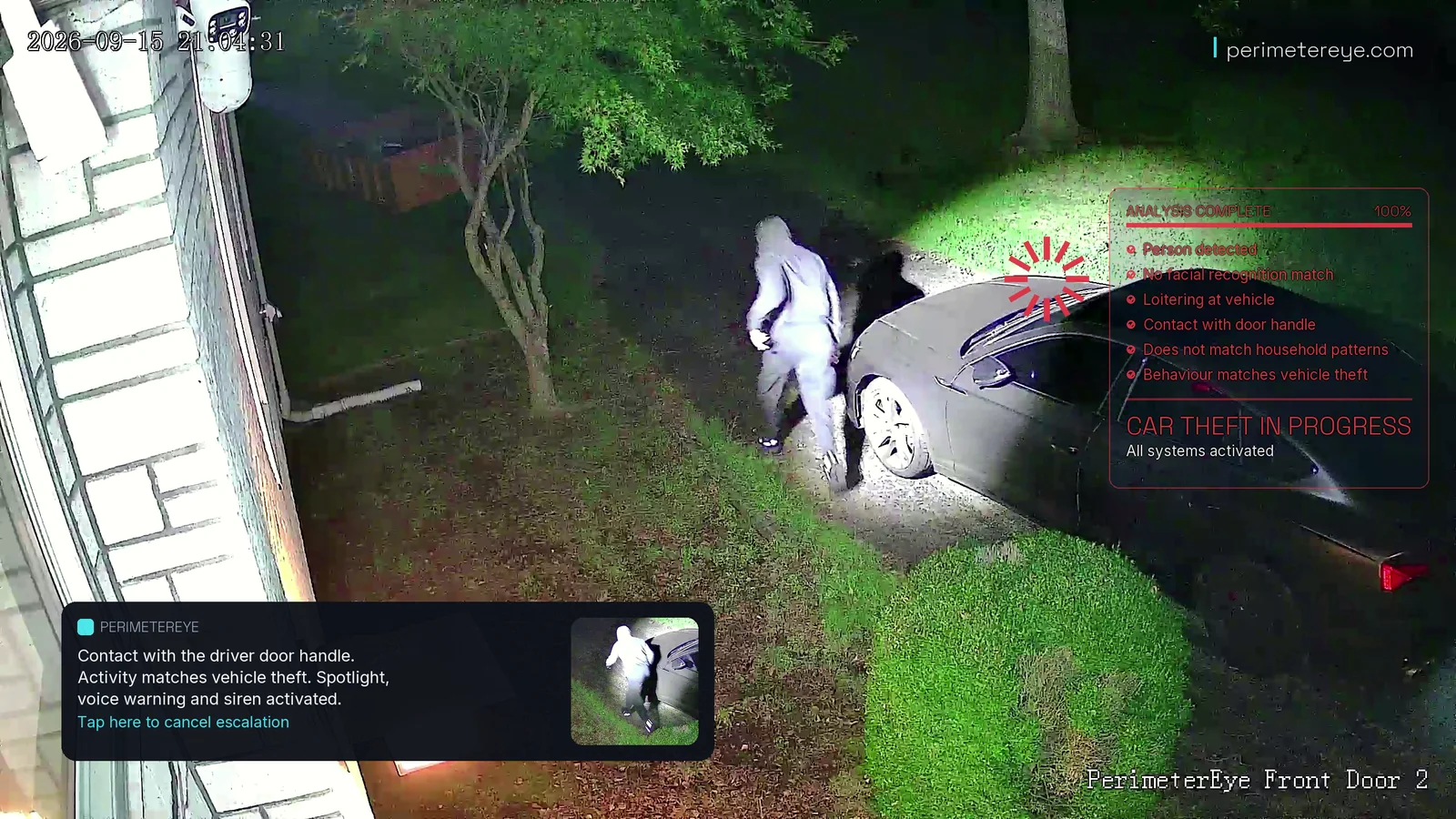
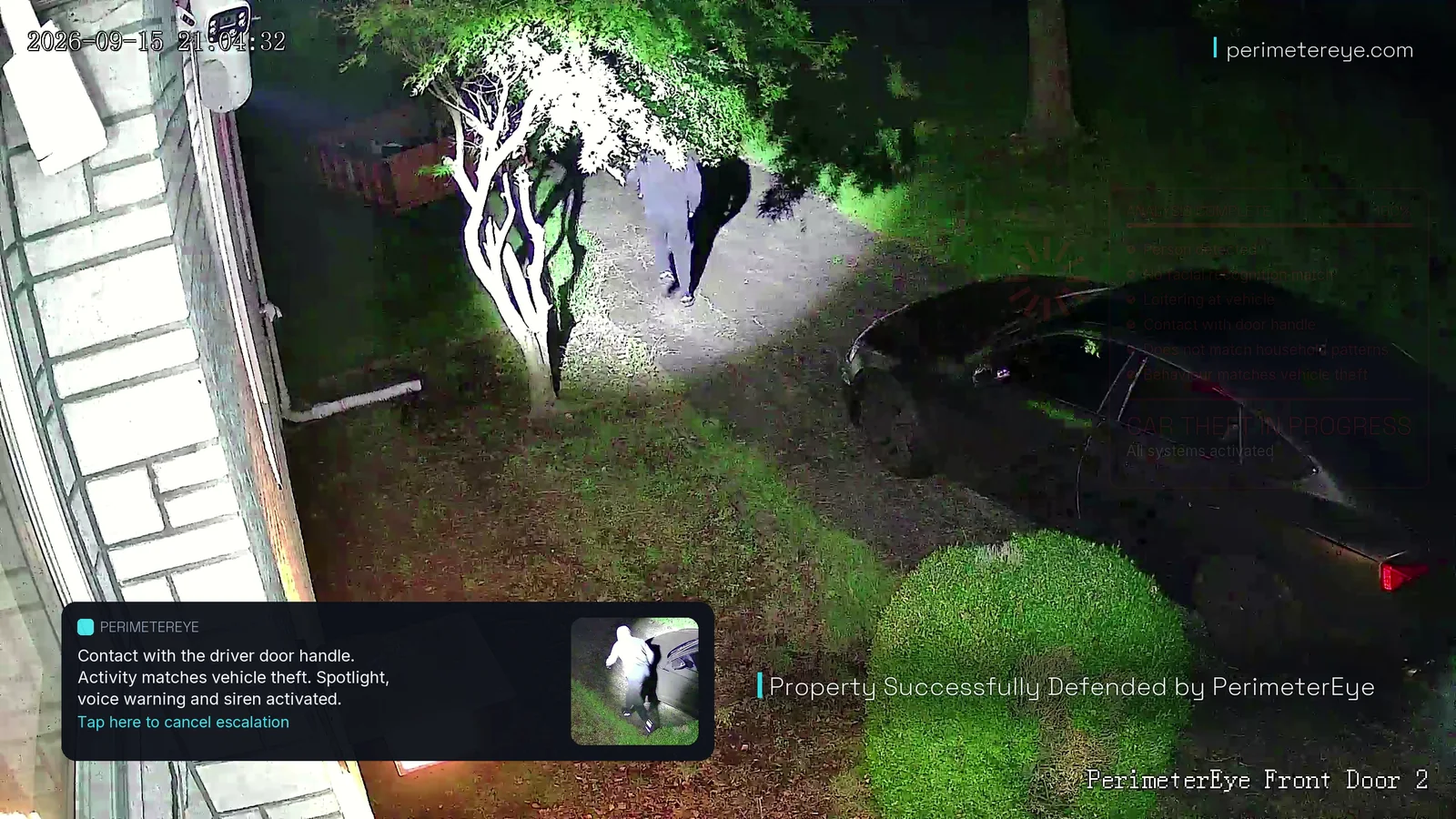
ADT is the classic professionally monitored alarm: sensors trip, a monitoring center receives the signal, an operator makes calls, and police may eventually be requested. Every step happens off the property while the intruder is on it. PerimeterEye is an Automatic Property Defense System — it verifies the threat on-site, locks a tracking searchlight on, delivers a targeted AI voice warning, and escalates to a 130 dB siren in seconds, while you watch live.
ADT's response happens in a call center and a patrol car; PerimeterEye's happens in your yard.
Light, voice, and siren begin in seconds — while an alarm chain is still verifying.
No contract, nothing to arm or disarm: you own the hardware and the alerts come straight to you.
The Alarm Was Built to Report. This Was Built to Respond.
A monitored alarm is a reporting instrument: it detects entry, tells a distant center, and sets a human process in motion. That process is legitimate, but every link in it — the queue, the verification calls, the dispatch request — runs off-property while the intruder stands on it. The architecture, not the operators, is the constraint.
PerimeterEye collapses the distance to zero. Verification, the tracking searchlight, the targeted voice warning, and the 130 dB siren all live on the property and act in seconds, with you watching live and able to step in at any moment. It is a different category — an Automatic Property Defense System — and once you see the timeline difference, the categories stop being interchangeable.
What every system includes
What ADT Is — and Why It Has Lasted
ADT more or less invented the category it leads. Door and window sensors, motion detectors, a keypad by the door, professional installation, and a monitoring center staffed around the clock — sold on a monthly contract. It is a mature, competent monitoring service, and for over a century the model has been the default answer to "what do I do about break-ins?"
The model's core promise is that when something trips, trained people respond on your behalf. That promise is real as far as it goes. The question this page examines is where those people are while they respond — and where the intruder is.
An Alarm Event, Step by Step
Walk through what a monitored alarm actually does, without inventing any numbers. A sensor trips — which usually means a door or window has already been forced. The panel sounds and transmits a signal to a monitoring center, where the event lands in an operator's queue. The operator typically calls the premises or your listed contacts first, because dispatch protocols require ruling out a false alarm before police are requested.
If the operator cannot reach anyone, or reaches someone who confirms trouble, they can request police dispatch. Officers then triage that request against everything else happening in the jurisdiction. We won't quote a response-time figure — no honest national number exists — but notice what every step shares: it happens in a phone queue, a call center, and a patrol car. Nothing in the chain touches the property.
Meanwhile, on the property, the only thing confronting the intruder is a generic siren and the ticking of the process above. The event that matters is happening in one place, and the response is happening everywhere else.
The Same Event on PerimeterEye
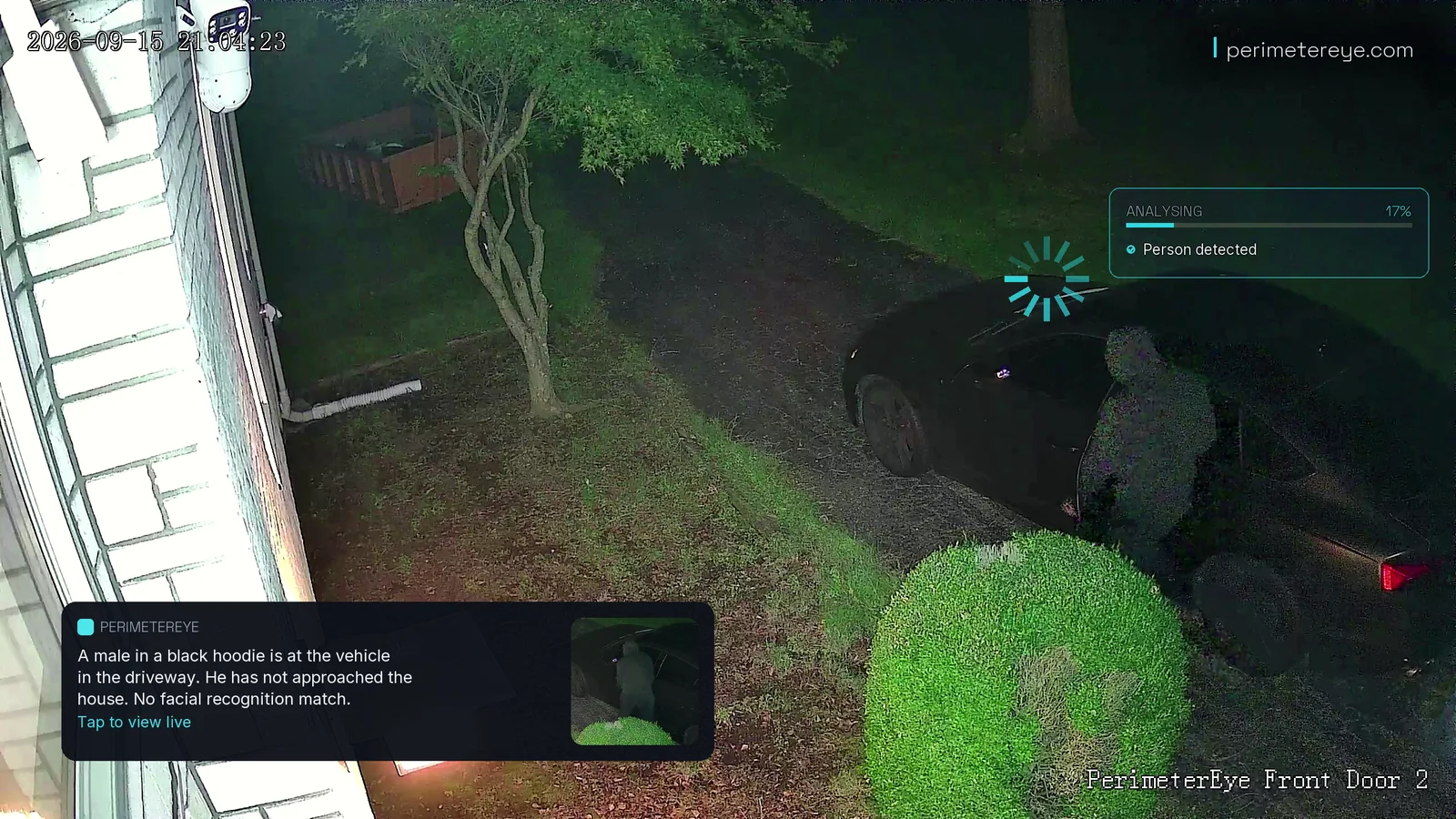
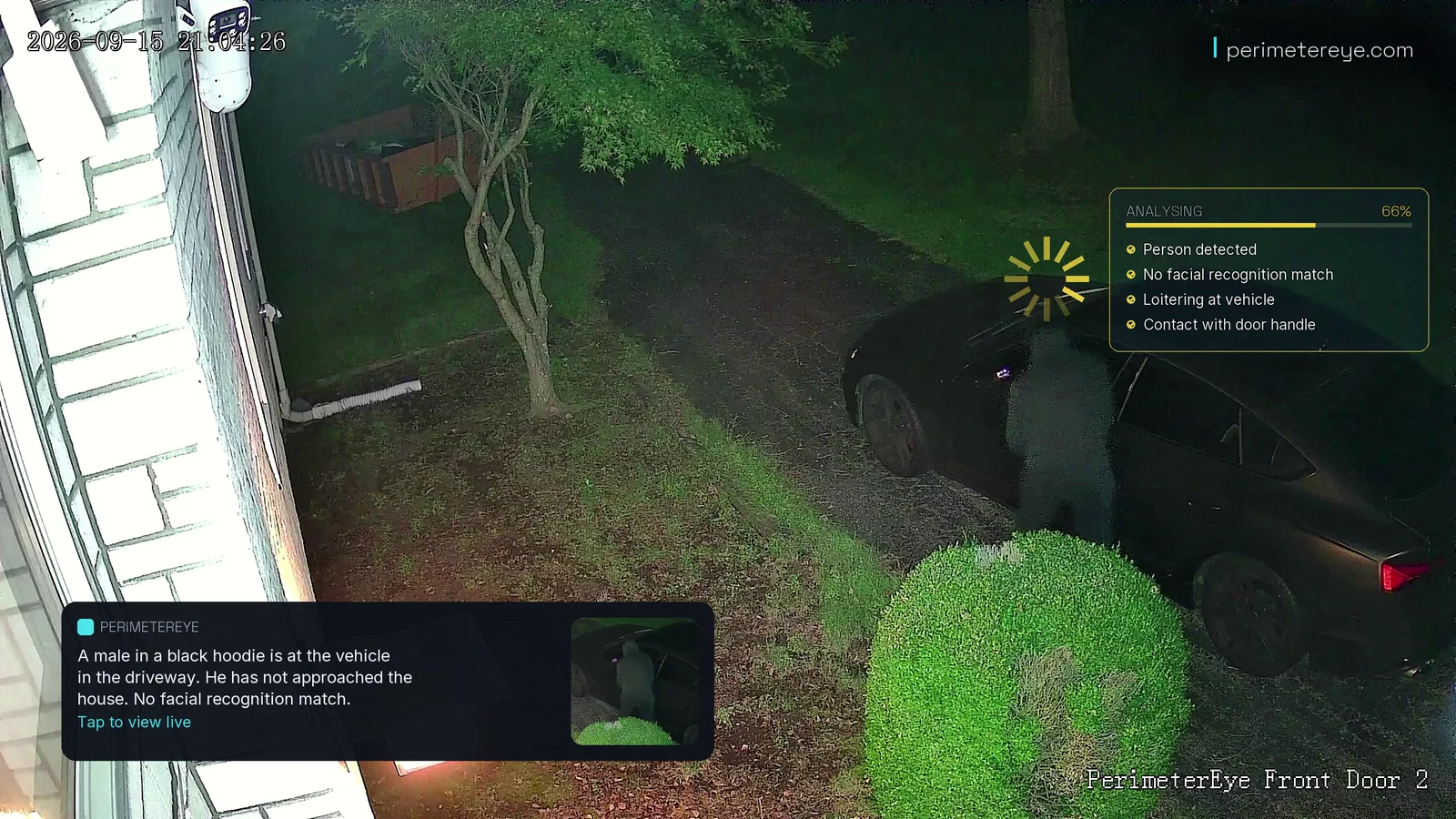
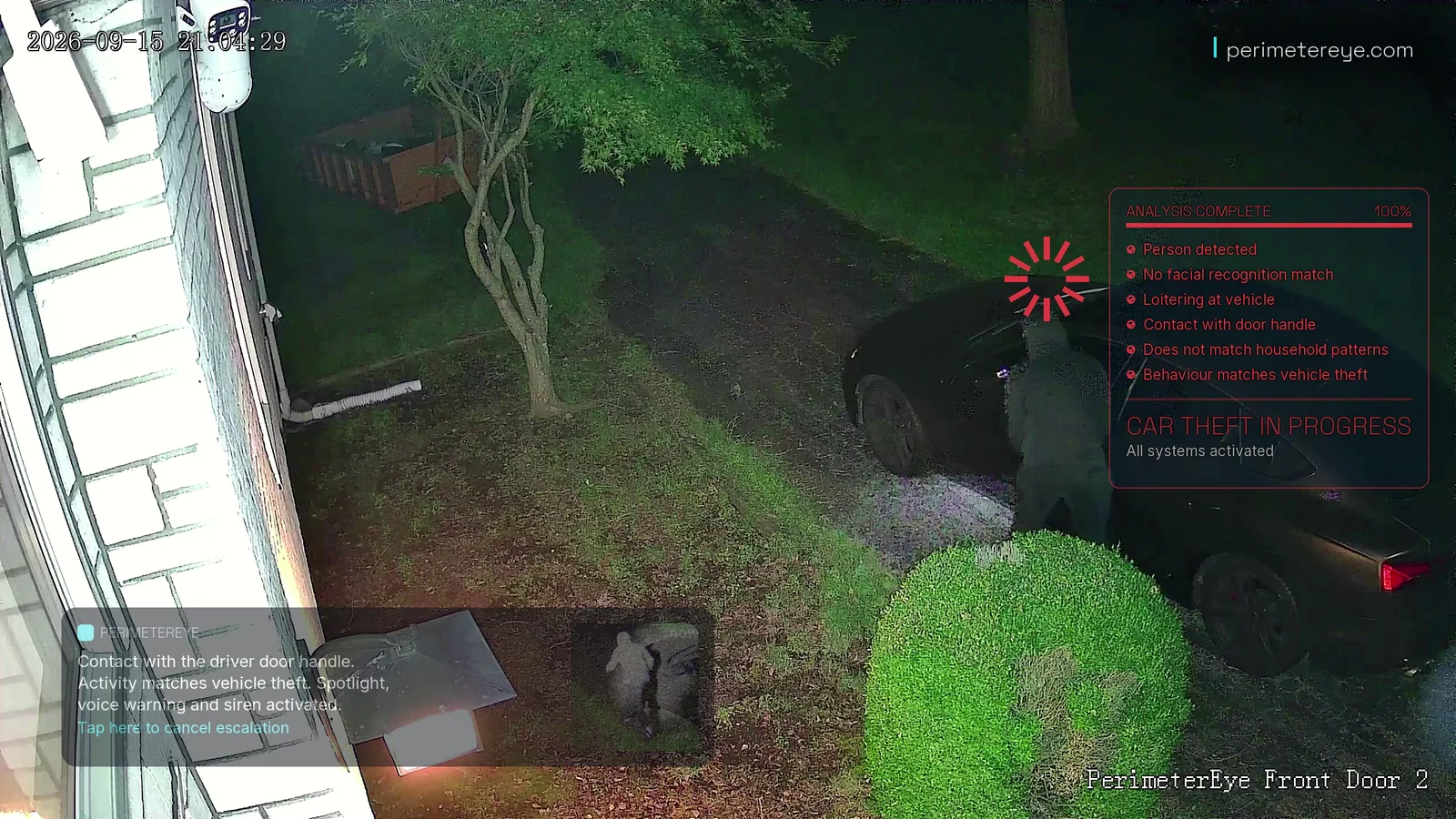
PerimeterEye starts before the door, not after it. The 4K cameras and the on-site Brain — a true edge computer running PerimeterEye OS — verify a person on the property and classify them against the household. Family arrivals, mail carriers, and expected visitors never trigger deterrence. An unknown person at the fence line at 2 a.m. does.
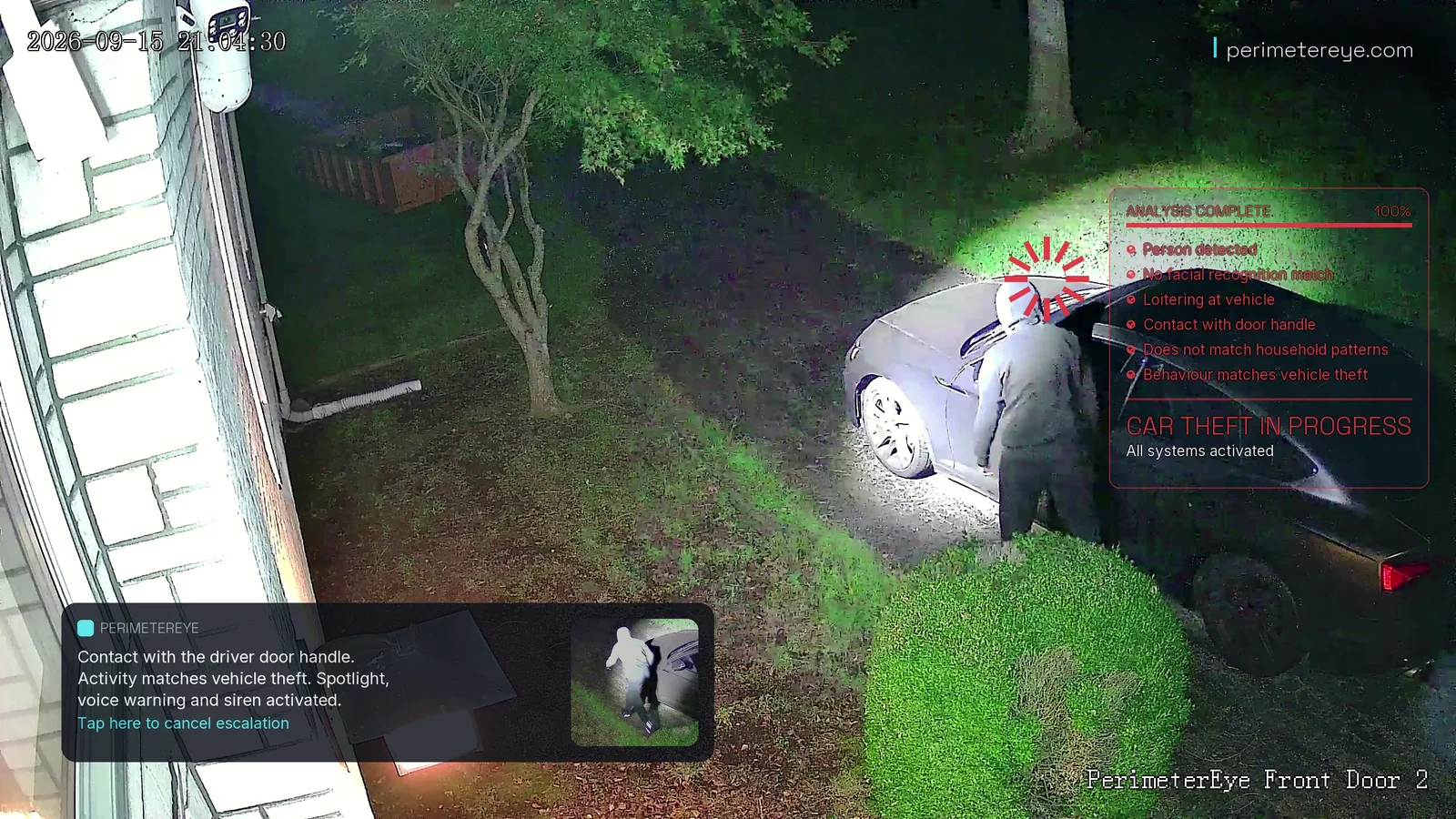
Then the ladder climbs, in seconds and entirely on-site: a searchlight-class motorized spotlight locks onto the person and follows them — 355 degrees of rotation, 90 of tilt, the effect owners compare to a prison guard tower light. A live AI voice addresses the specific person in frame by description. If they persist, the 130 dB siren fires and you get a priority alert with live video.
You can watch, speak through two-way audio, or take manual control at any rung. The intruder experiences light, voice, and sound directed at them personally while they are still deciding whether to proceed — which is precisely the window a phone-queue chain can never reach.
What Burglars Actually Weigh
The best available evidence on burglar decision-making is a 2013 UNC Charlotte survey of 422 incarcerated burglars (Kuhns et al., funded by the industry-backed research foundation AIREF — worth disclosing). Roughly 83% said they would try to determine whether an alarm was present before attempting a burglary, and about 60% would seek another target if one was. Over half said discovering an alarm mid-burglary would make them abort.
The same survey found the top target-selection factors were the proximity of other people, escape routes, and visible signs of security. Separately, a randomized street-lighting experiment across 77 New York City public-housing developments (Chalfin et al., NBER Working Paper 25798, 2019) cut nighttime outdoor index crimes by roughly 36%, with effects persisting for years. Light, visibility, and the sense of being noticed are what the evidence supports — and they are exactly what PerimeterEye projects. No security system can guarantee prevention of every incident, but the levers PerimeterEye pulls are the ones the research says matter.
Contracts vs Ownership
ADT's model is service-first: installed equipment tied to a monthly monitoring agreement, with terms and pricing that vary by package and region. You are effectively renting an outcome — the monitoring center's attention — for as long as you pay.
PerimeterEye's model is ownership-first. You buy the system outright — $3,500, $4,725, or $6,850 depending on property size, every package including the Brain, the video intercom with AI Doorman, and the wall panel — with financing from roughly $139 per month and no contract. The $99 per month software and AI subscription powers the analysis, briefings, and search. PerimeterEye is not an alarm-monitoring service — alerts and control go directly to you. Either system may help you qualify for an insurance discount — ask your carrier.
When ADT Makes Sense
If what you specifically want is a staffed monitoring center calling on your behalf when a sensor trips — because you travel constantly, or you simply want a human institution in the loop — ADT delivers that, and has for generations. Some people find the contract structure a fair trade for never thinking about it.
If you primarily need interior intrusion detection in a small home with little exterior ground to cover, a sensor-based alarm covers the actual risk surface. PerimeterEye earns its keep on properties where the event begins outside — driveways, yards, long approaches — and where seconds of on-site response matter more than a phone tree.
Questions about perimetereye vs adt
Does PerimeterEye call the police for me like ADT's center can?
No. PerimeterEye is not an alarm-monitoring service — alerts and control go directly to you. You receive a priority alert with live video the moment escalation begins, and you decide what to do next: watch, speak to the person through two-way audio, take manual control, or call authorities yourself with live footage in hand.
Do I arm and disarm PerimeterEye like an ADT panel?
No — there is nothing to arm or disarm, and no code to punch on the way in. PerimeterEye runs continuously in one of six modes: Off, Quiet, Visitor, Active, High Alert, and Maximum Security. Because the system knows the household, family arrivals and regular deliveries never trigger deterrence in any mode.
Isn't a professional monitoring center faster than handling it myself?
The comparison isn't you versus the center — it's the chain versus the ladder. A monitoring chain necessarily adds off-property steps: signal, queue, verification calls, a dispatch request, triage. PerimeterEye's light, voice, and siren begin on the property in seconds, before you or anyone else picks up a phone.
Will PerimeterEye prevent break-ins that ADT couldn't?
No system can promise that — no security system can guarantee prevention of every incident. What the evidence supports is that visible security signals and active lighting change burglar behavior: in the 2013 UNC Charlotte survey of 422 incarcerated burglars, roughly 60% said they'd seek another target when they detected an alarm. PerimeterEye makes its presence unmistakable.
How does the cost compare to an ADT contract over time?
ADT's pricing varies by package and region, so compare your actual quote. PerimeterEye is a one-time hardware purchase — $3,500 to $6,850, financing from roughly $139 per month — that you own, plus $99 per month for software and AI after activation. There is no long-term contract, and the hardware never has to be returned.
What happens during a power or internet outage?
Live view, recording, instant rewind, the siren, and the spotlight tracking all continue through an internet outage — they run on the Brain at your property, not on a connection. Monitored alarms typically rely on their connection paths to reach the center; ask any provider how theirs behaves offline.
Related reading
Skip the Monitoring Contract. Keep the Response.
Monitoring contracts pay a call center to phone you after the fact. PerimeterEye's on-site AI acts in seconds — no long-term contract, you own the hardware.
Property Defense vs. Home Security: The Same 40 Seconds, Two Different Systems
Shopping for a home security system? Everything in that category watches and notifies. See what an Automatic Property Defense System does in 40 seconds.
PerimeterEye vs Deep Sentinel: Guards in a Center vs Defense on the Ground
Deep Sentinel puts human guards behind your cameras. PerimeterEye responds on-site in seconds with light, voice, and siren — and nobody watching your feeds.
Reserve a PerimeterEye setup.
PerimeterEye will review your property layout, likely coverage zones, deployment model, hardware needs, and onboarding steps before shipment or activation.