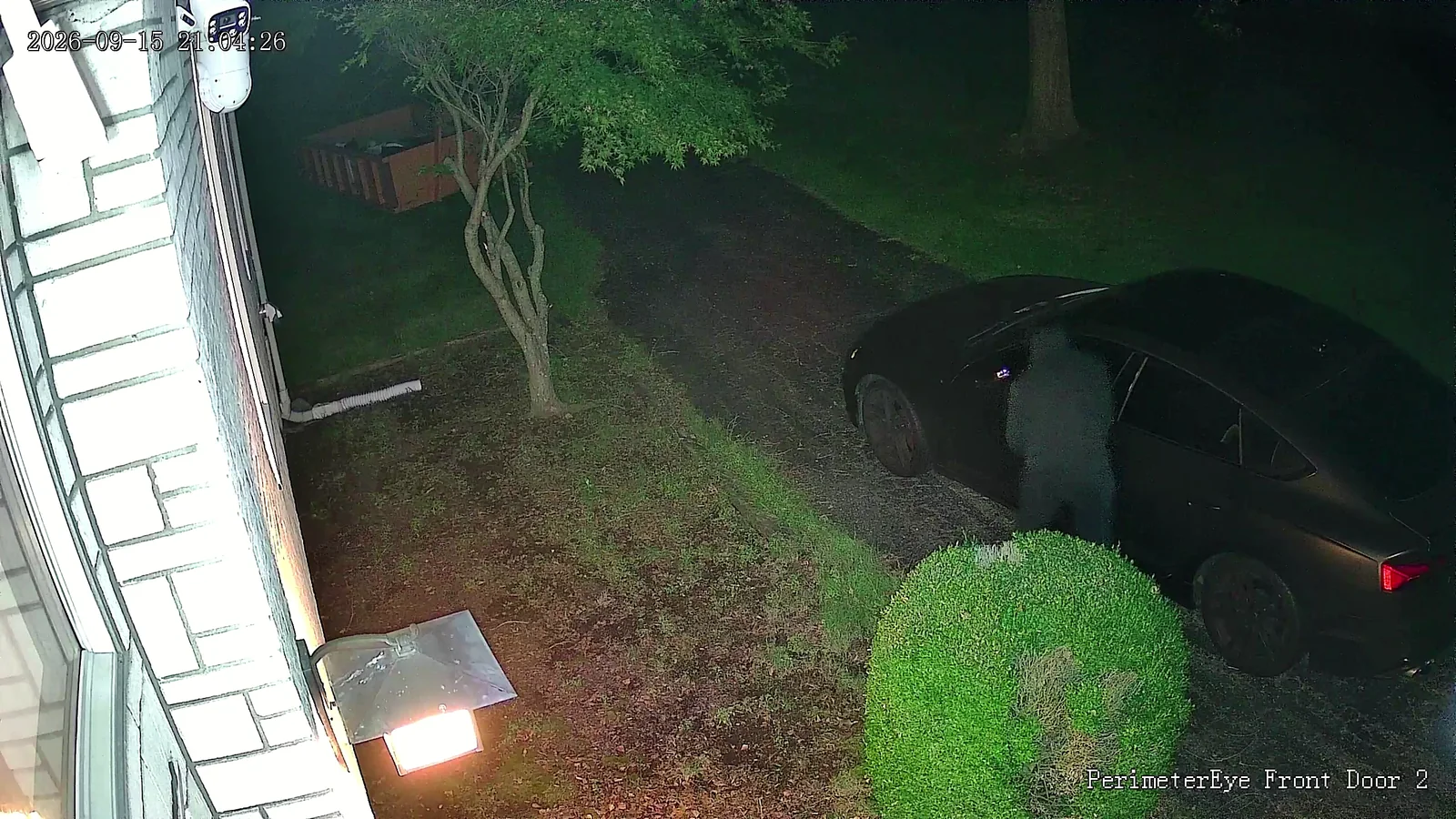
PerimeterEye vs Ring: Recording the Crime vs Acting on It
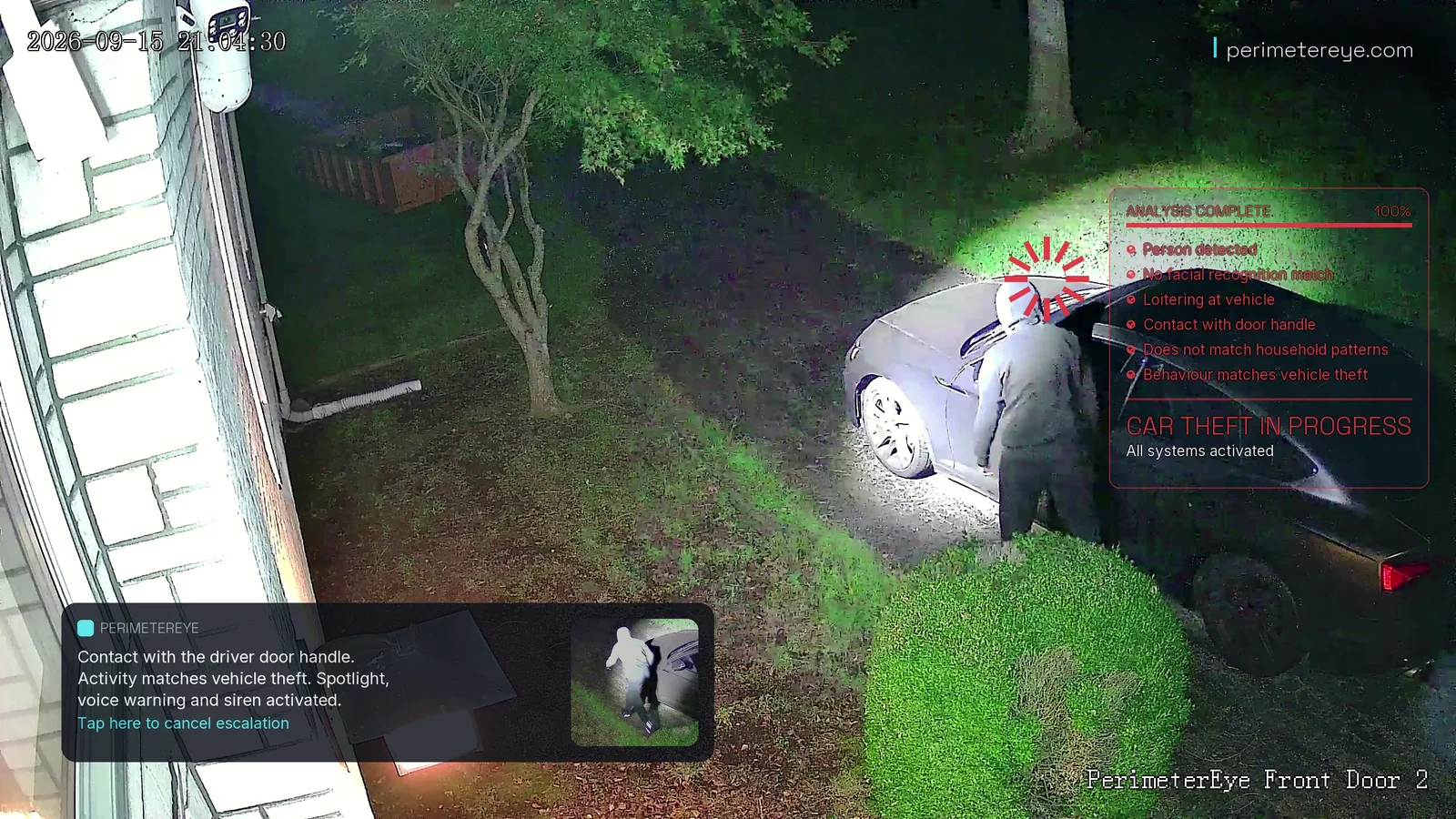
Ring is a good monitoring product: affordable cameras, motion alerts, recorded clips. But everything Ring does ends the same way — a notification and a video of what already happened. PerimeterEye is an Automatic Property Defense System: when it verifies an intruder, a searchlight locks on and follows, a live AI voice calls them out by description, and a 130 dB siren escalates — on the property, in seconds, while you watch.
Ring's response ends at your lock screen; PerimeterEye's starts at your property line.
A searchlight that locks on and follows beats a clip of someone walking away.
You own the hardware — the $99 monthly fee buys intelligence, not a watching service.
From Recorded Clips to Real-Time Defense
Ring and PerimeterEye are not rivals in the same category. Ring is a monitoring product — it watches, records, and notifies, and it does those things well for the money. PerimeterEye is an Automatic Property Defense System: it verifies who is on the property and then acts there, in seconds, with a searchlight that follows, a voice that names, and a siren that escalates.
The practical question is not which brand is better but which category your situation calls for. A single door in a rented apartment calls for a camera. A home with a driveway, a yard, and approaches worth defending calls for a system that does something while the event is still happening — and lets you watch live, talk, or take control at any moment.
What every system includes
What Ring Does Well
Credit first. Ring built the most accessible camera and doorbell ecosystem in the country: inexpensive hardware, a polished app, reliable motion alerts, and optional subscriptions that add clip storage and smarter notifications. For seeing who is at the door from your phone, it is genuinely hard to beat on price.
Ring has also acknowledged the limits of notifications. Its Virtual Security Guard add-on (around $99 per month as of mid-2026) puts a professional agent behind eligible cameras to review motion events and respond. That is a real upgrade over a silent clip — and a telling admission that recording alone was never the finish line.
"Ring Recorded the Theft, But Nothing Happened"
That sentence — some version of it — is why most people land on this page. The doorbell caught the porch pirate in crisp detail. The phone buzzed. You were in a meeting, or asleep, or driving. By the time anyone looked, the package and the person were gone. The system worked exactly as designed. The design is the problem.
The scale of it is well documented: in SafeWise's 2025 Package Theft Report, a survey of 7,500 U.S. adults, 31% said a package had been stolen from them in the previous 12 months, with a median value of $143. A camera that watches a theft produces evidence. It does not produce an outcome.
There is even a wrinkle worth knowing: in KGW-TV's 2017 journalistic survey of 86 Oregon burglars, inmates described cameras as a deterrent — but some also read them as a signal that a home has things worth taking. A passive camera is ambiguous. A property that visibly responds is not.
What PerimeterEye Does During the Event
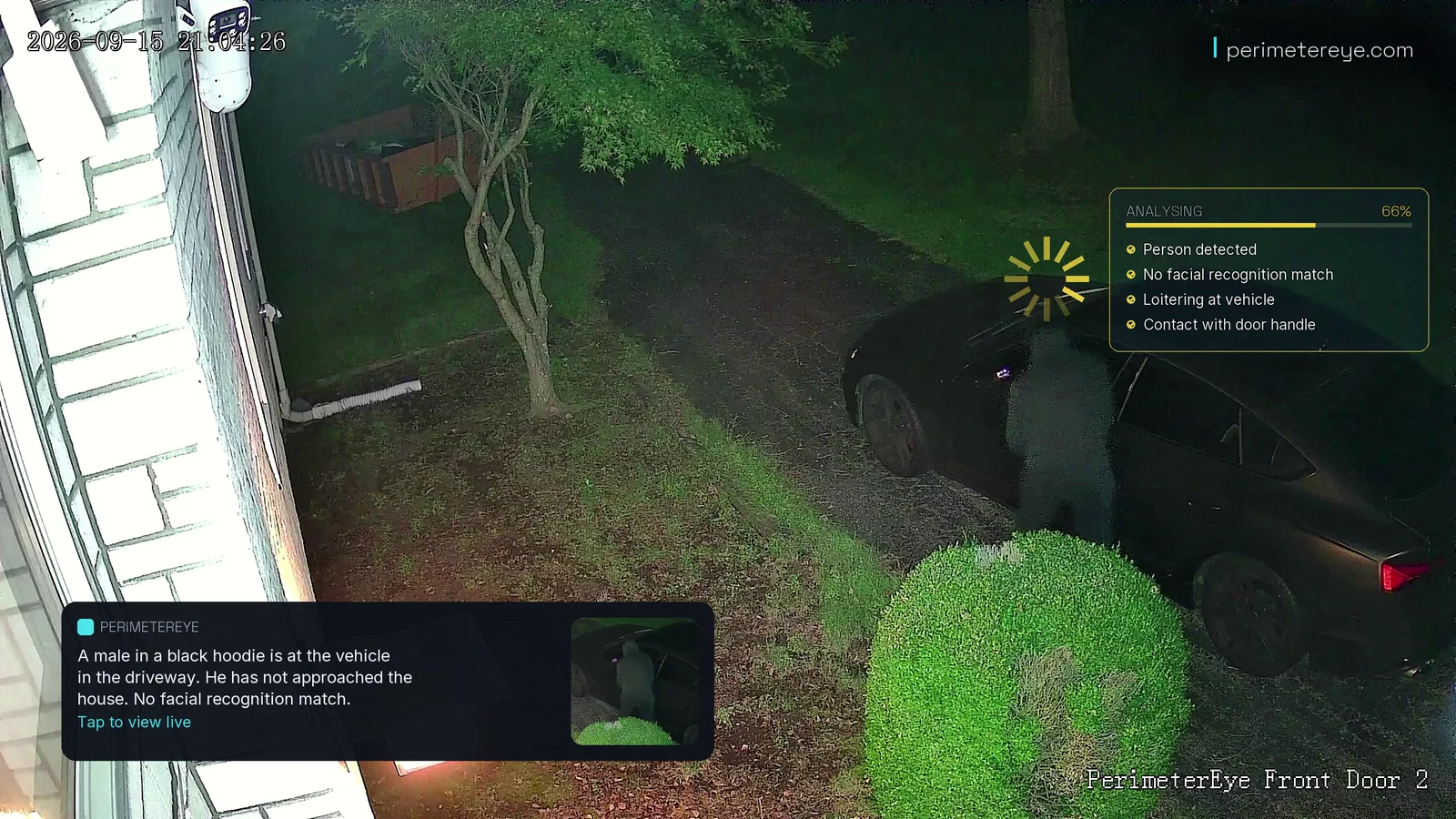
PerimeterEye's response happens while the person is still standing there. The on-site Brain — a true edge computer, not a recording box — verifies the threat first, so a delivery driver or a family arrival never triggers anything. The system knows the household. Package detection and delivery guidance work in every mode except Off and Quiet.
For a verified intruder, the ladder climbs in seconds: a motorized searchlight with 355 degrees of rotation and 90 degrees of tilt locks onto the person and physically follows them — owners compare it to a police helicopter searchlight. Then a live AI voice addresses them specifically: "You, in the dark hoodie — you are not authorized to be on this property." Not a pre-recorded chime. A description of them, spoken to them.
If they stay, a 130 dB siren fires and you get a priority alert with live video. At any rung you can watch, talk through two-way audio, or take manual control. Ring's event ends on your lock screen. PerimeterEye's event ends with light on the intruder's back as they leave.
Price, Ownership, and What the Monthly Fee Buys
Ring wins on entry price, no argument. A doorbell and a camera or two cost a few hundred dollars, with subscriptions layered on for storage and, if you choose, the agent add-on at around $99 per month as of mid-2026. You are paying modest hardware prices plus recurring fees for watching services.
PerimeterEye is a complete system: $3,500 for smaller properties (4 cameras, 1 tracking spotlight, 1 siren), $4,725 for medium (7, 2, 2), $6,850 for estates (12+, 4, 2) — every package includes the video intercom with AI Doorman, the wall panel, and the Brain. You own the hardware outright, with financing from roughly $139 per month through Klarna or Affirm and no contract.
After activation, the $99 per month software and AI subscription covers the intelligence, not surveillance labor. PerimeterEye is not an alarm-monitoring service — alerts and control go directly to you.
When Ring Is the Right Choice
Honestly: sometimes it is. If you rent and cannot mount permanent equipment, Ring's peel-and-stick footprint is the practical answer. If the budget is a few hundred dollars, Ring delivers real value at that price, and a doorbell camera beats no camera.
If your exposure is a single door — an apartment entry, a condo hallway — a full perimeter system is more than the problem requires. PerimeterEye is built for properties with actual perimeters: driveways, yards, approaches, multiple sight lines. If the thing you are protecting is a property rather than a doorway, that is when the categories stop being comparable.
Questions about perimetereye vs ring
Isn't Ring's Virtual Security Guard basically the same idea?
It shares the diagnosis — notifications aren't enough — but not the mechanism. Virtual Security Guard (around $99 per month as of mid-2026) routes eligible motion events to a remote human agent. PerimeterEye responds on-site and autonomously in seconds, with a tracking searchlight, targeted live AI voice, and 130 dB siren, not a remote review queue.
Does PerimeterEye still send alerts like Ring does?
Yes — priority alerts with live 4K video, two-way talk, clip export, and instant DVR rewind from the iOS app. The difference is that with PerimeterEye, the alert is the last rung of a ladder that already includes light, voice, and siren, not the entire response.
What happens to each system when the internet goes out?
Cloud-dependent camera features generally degrade without connectivity. PerimeterEye's core defense — live view, recording, instant rewind, the siren, and the tracking spotlights — keeps working through an outage because everything runs on the on-site Brain, a dedicated edge computer at your property, not in a distant data center.
Will PerimeterEye guarantee my packages never get stolen?
No, and you should distrust anyone who promises that — no security system can guarantee prevention of every incident. What PerimeterEye does is detect deliveries, give delivery guidance in every mode except Off and Quiet, verify anyone who approaches afterward, and respond with light, voice, sound, and alerts while documenting everything.
Do I need a monitoring contract with PerimeterEye?
No. PerimeterEye is not an alarm-monitoring service — alerts and control go directly to you. You buy and own the hardware, and the $99 per month software and AI subscription covers analysis, threat verification, daily briefings, and plain-language search. There is no long-term contract and no monitoring center in the loop.
Related reading
Security Cameras vs. Active Deterrence: The Three Tiers
Passive cameras record. Strobe cameras flash at everything. Compare all three tiers of deterrence and see what a response aimed at a specific person looks like.
Security Cameras That Talk to Intruders — and the System That Talks First
Want a security camera that talks to intruders? Most play canned clips or wait for a human. PerimeterEye speaks first — live, targeted AI voice in seconds.
PerimeterEye vs SimpliSafe: Around-the-Clock Defense vs Overnight Agents
SimpliSafe added overnight human agents because watching isn't enough. PerimeterEye acts 24/7 — a searchlight that follows, a voice that names, a 130 dB siren.
Reserve a PerimeterEye setup.
PerimeterEye will review your property layout, likely coverage zones, deployment model, hardware needs, and onboarding steps before shipment or activation.