Property Defense vs. Home Security: The Same 40 Seconds, Two Different Systems
Shopping for a home security system? Every option on the review sites is a monitoring system — it watches, records, and notifies. Here is what a property defense system does in the same 40 seconds: verifies the person, locks a tracking searchlight on them, calls them out by what they are wearing, and sounds a 130 dB siren — while you watch live.
 View photo
Frame by frame, from the film
Five seconds from the door handle to running away.
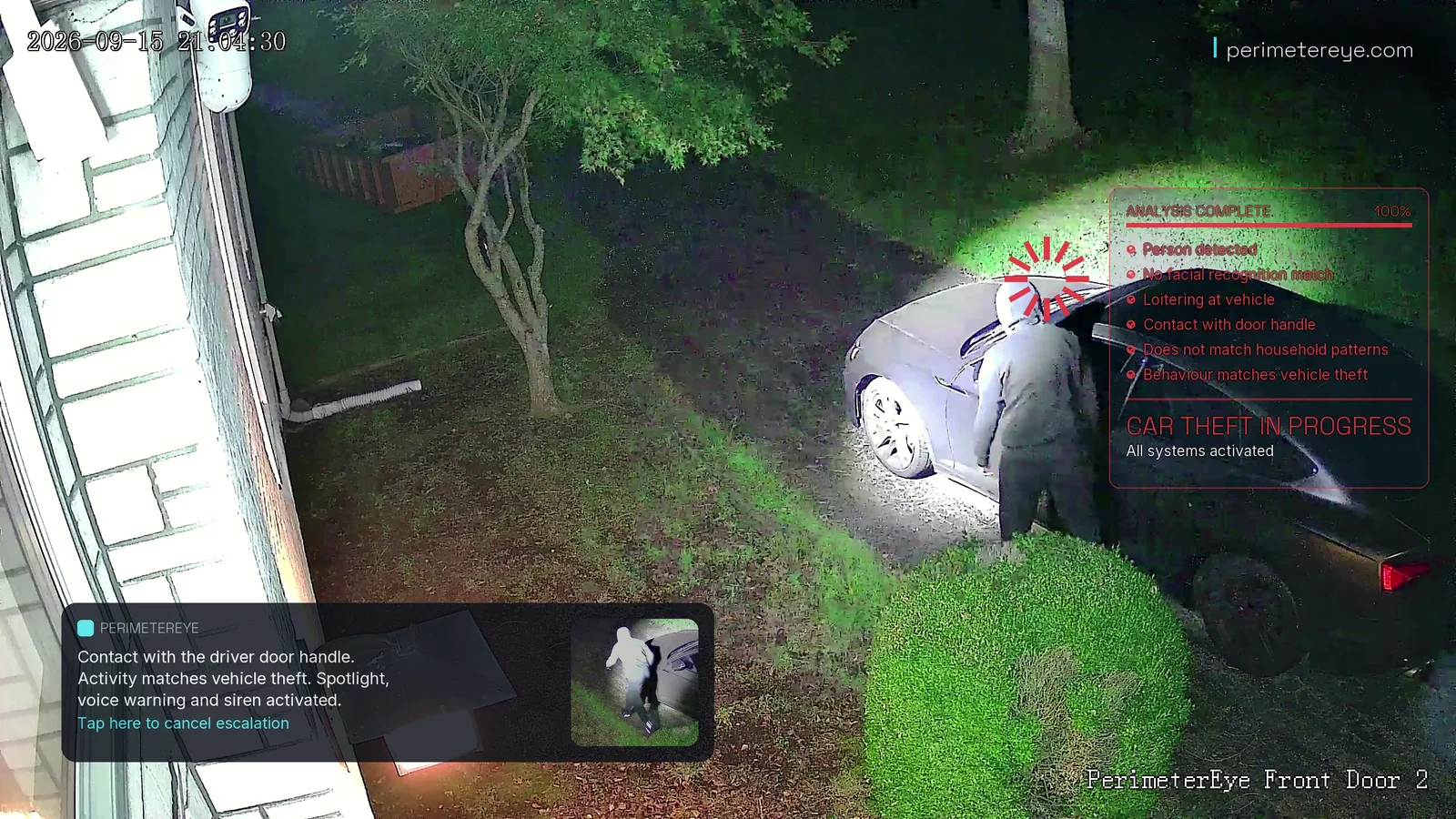
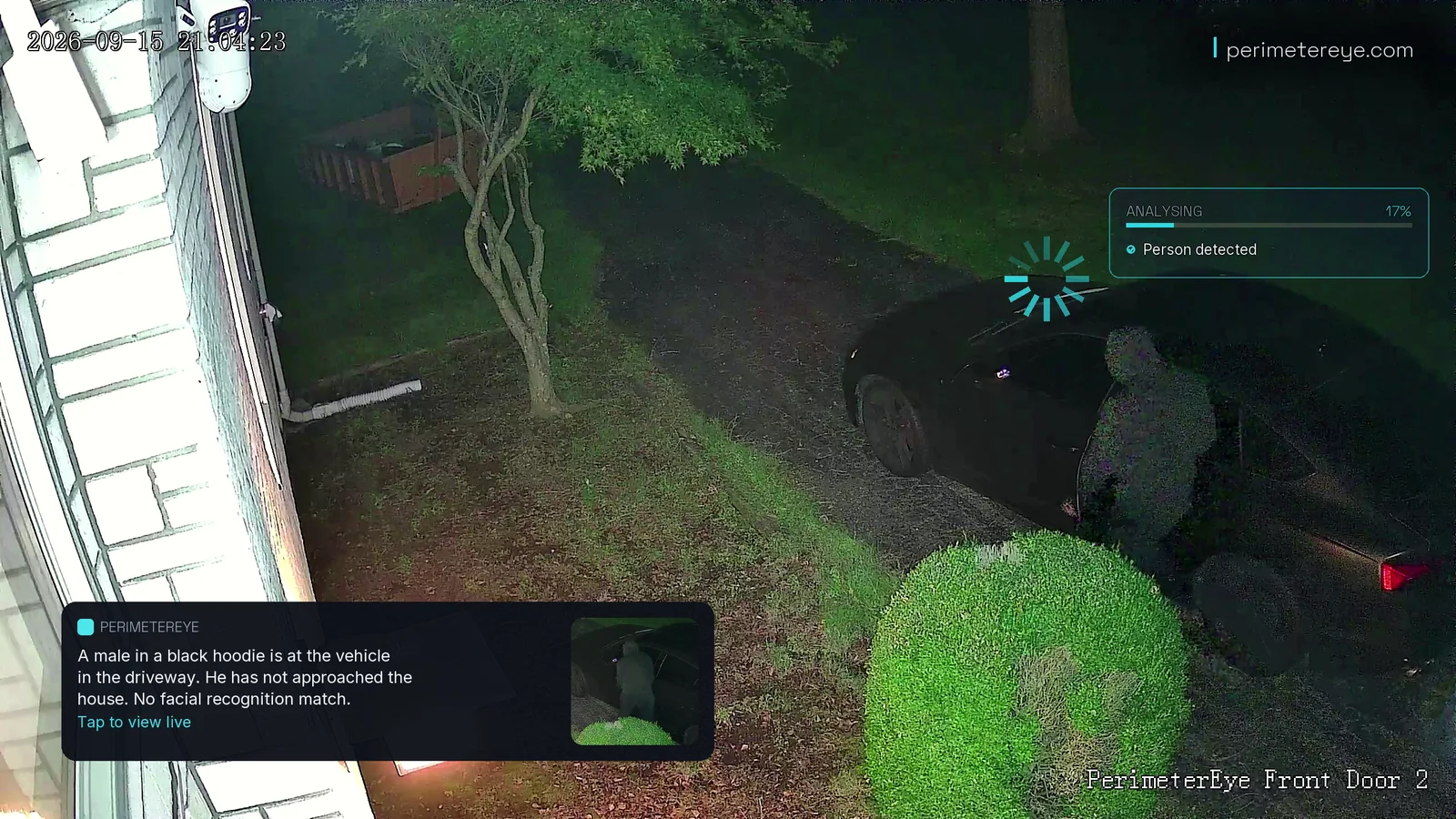
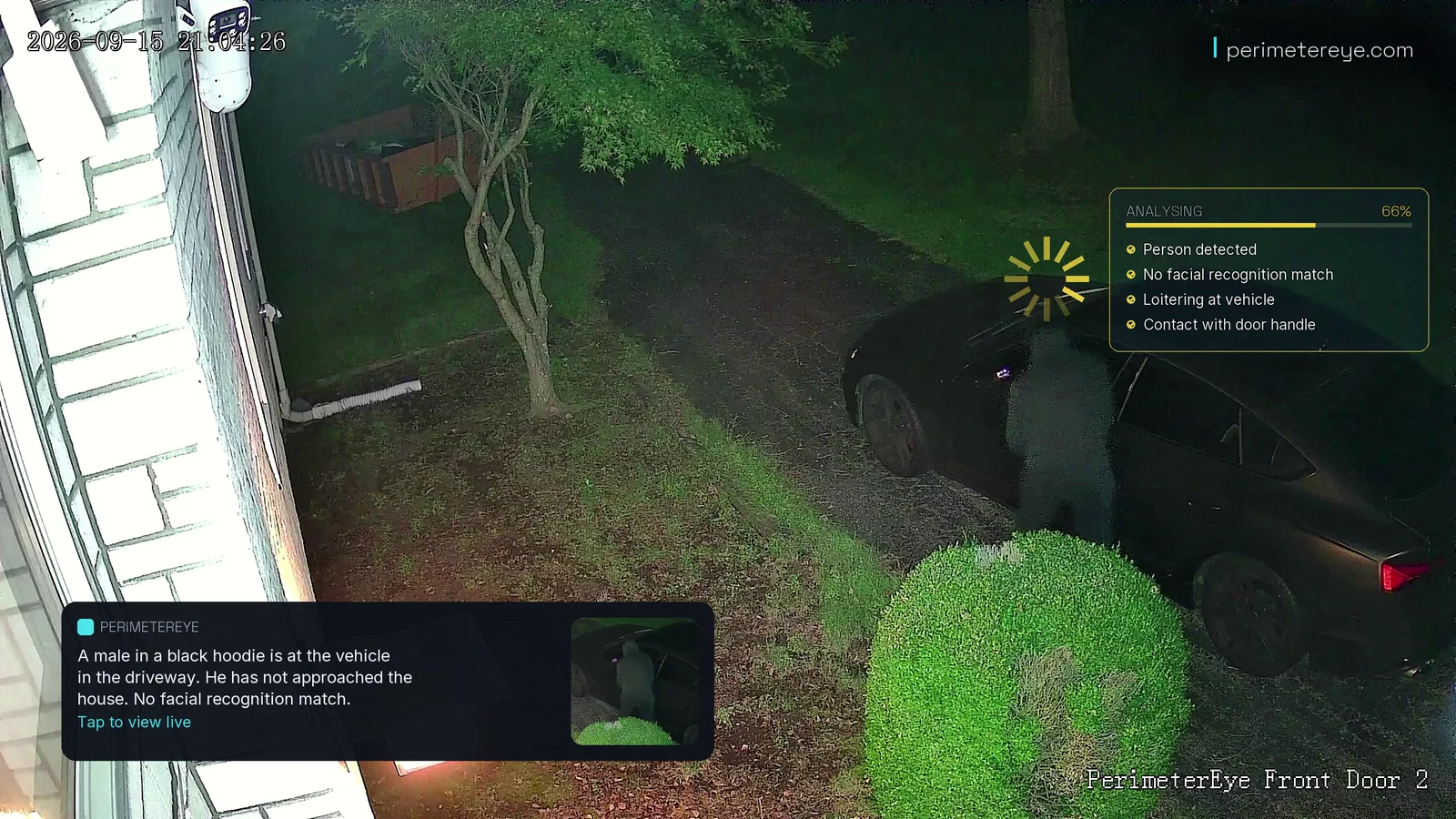
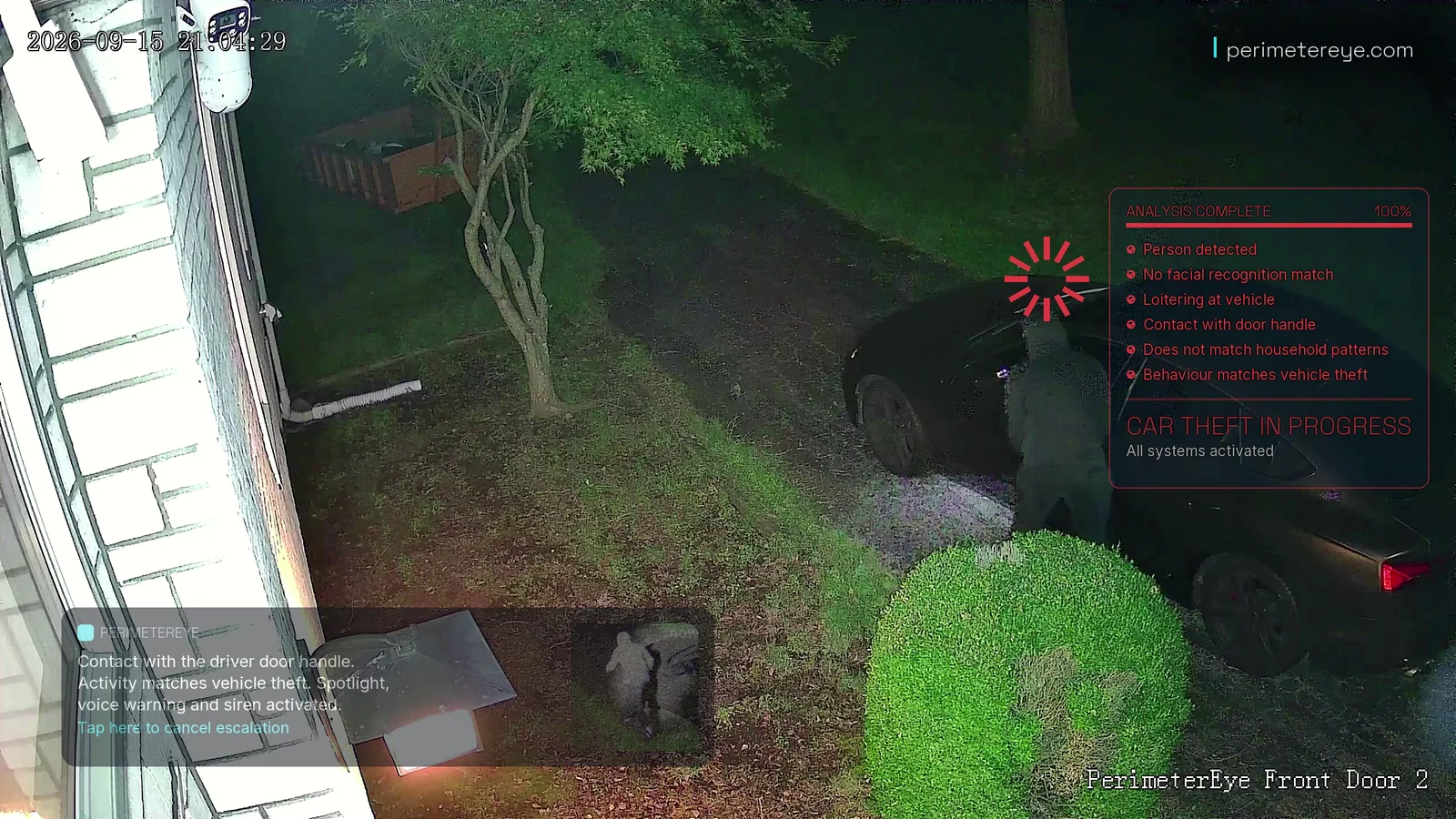
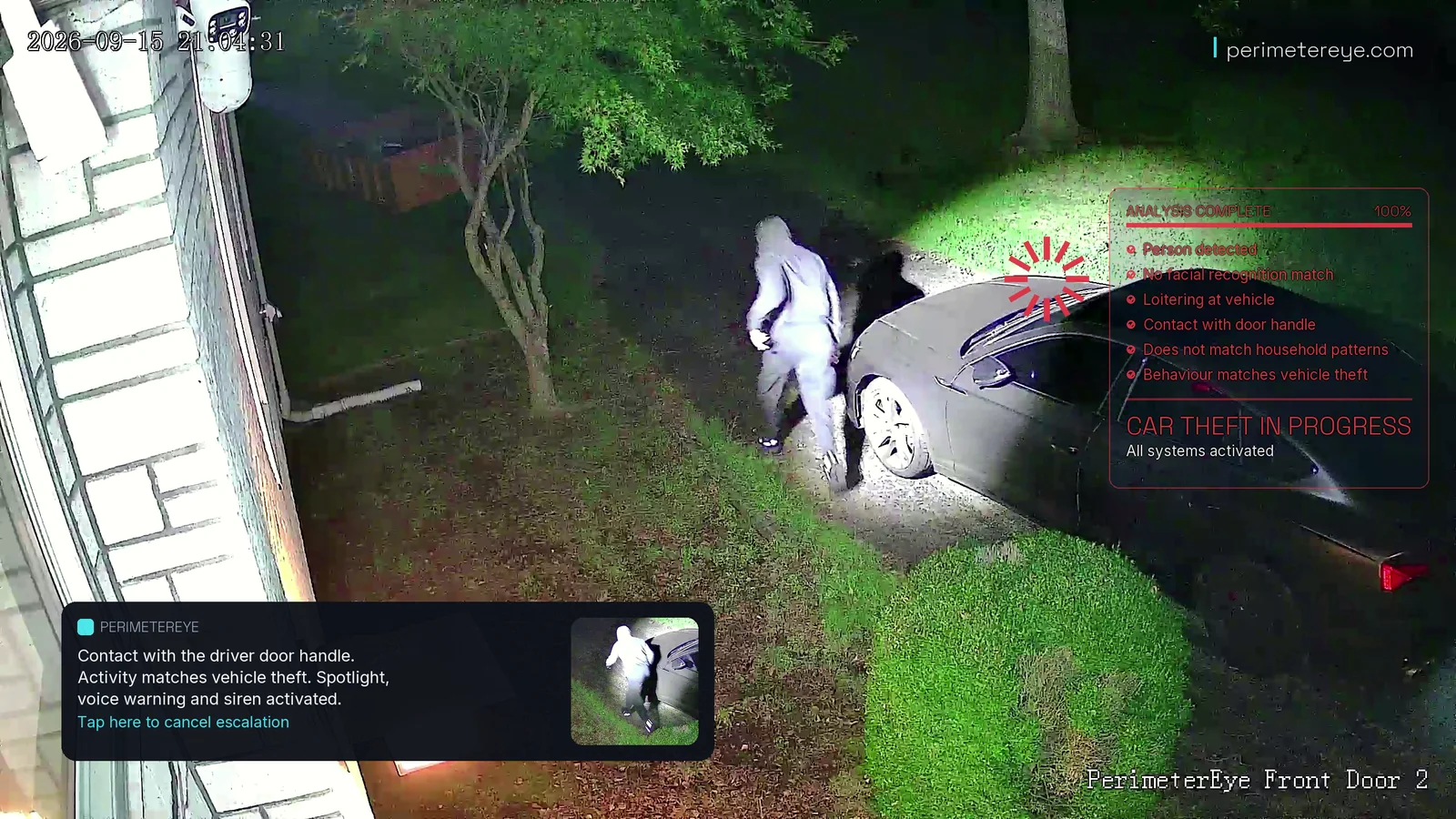
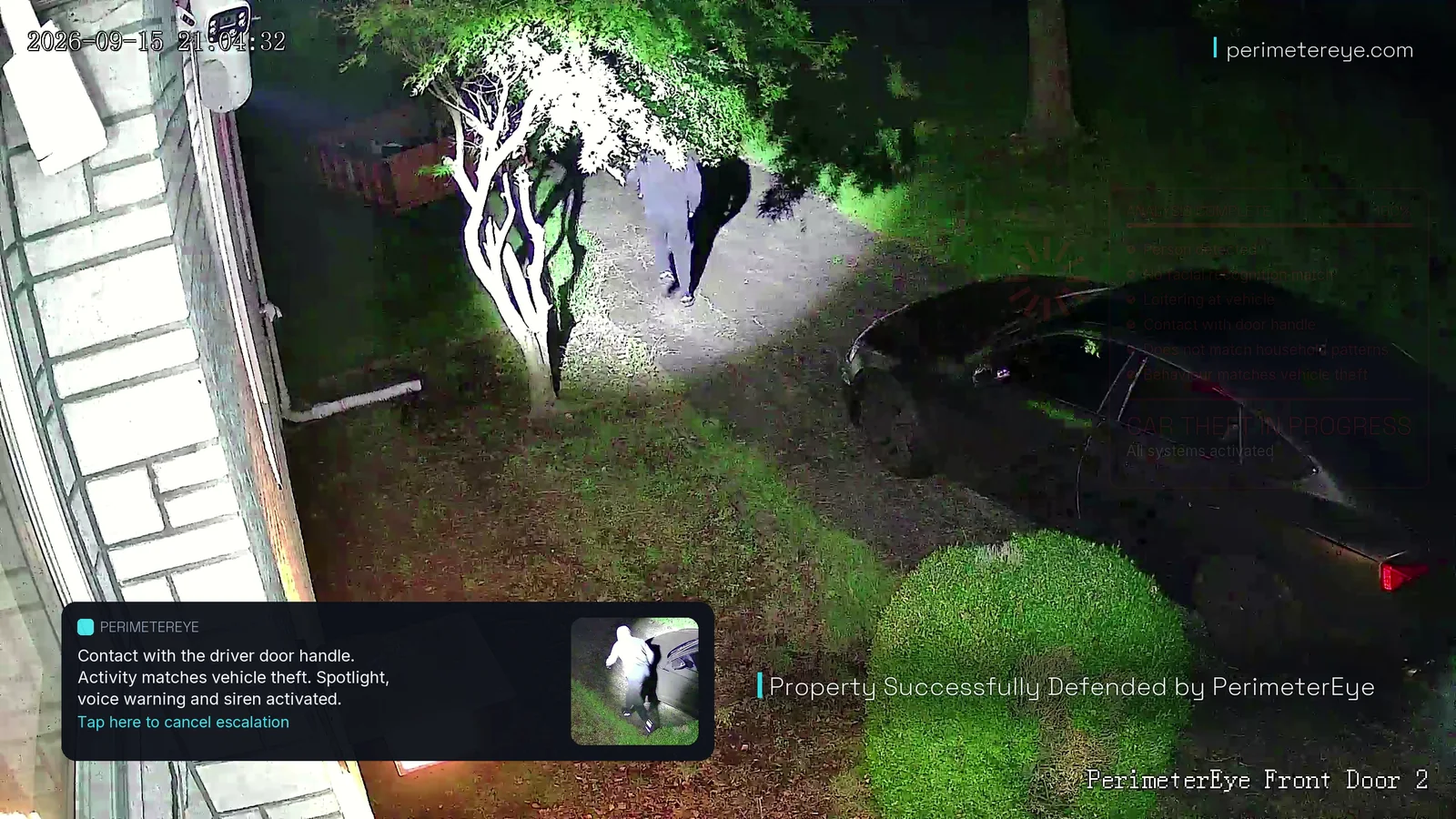
Stills from the film with its on-screen analysis and phone alert, on the Front Door 2 camera’s own clock. The door handle registers at 21:04:26. By 21:04:29 all systems are activated, and at 21:04:31 the person is running.
1 of 6 · 21:04:23View full size
The first alert
The person in the black hoodie is at the car, and the first alert already describes them: at the vehicle in the driveway, and has not approached the house.
2 of 6 · 21:04:26View full size
Contact with the door handle
The person reaches for the driver’s door. The analysis builds second by second: a person, no match to anyone it knows, loitering at the vehicle, and now contact with the door handle.
3 of 6 · 21:04:29View full size
Car theft in progress
Three seconds after the door handle, the analysis is complete: the activity doesn’t match the household’s patterns and matches vehicle theft. All systems activate.
4 of 6 · 21:04:30View full size
The searchlight lands
The searchlight hits the person at the driver’s door. The alert reads: spotlight, voice warning and siren activated, with a tap to cancel the escalation.
5 of 6 · 21:04:31View full size
Running, and the beam follows
Five seconds after touching the door handle, the person is running down the drive, and the searchlight has moved with them, away from the car.
6 of 6 · 21:04:32View full size
Followed away from the car
The searchlight follows the person past the tree and along the drive. The car hasn’t moved.
Filmed September 15, 2026, on a real property. The break-in was staged for filming; the system’s response was automatic, with no operator.
What changes
The Category, Not the Brand
- Monitoring tells you something happened; defense acts on the property while it is still happening.
- In the same 40 seconds a monitoring system spends notifying you, PerimeterEye has lit, named, and documented the intruder.
- Nothing to arm, no monitoring contract, no middleman — the system knows the household and answers to you alone.
This page is deliberately not a review roundup. Review sites rank monitoring systems against each other on camera resolution, app polish, and monitoring fees — legitimate criteria inside the box. The argument here is about the box itself: whether a system that watches and notifies is the right tool for a standalone property, or whether the property should respond on its own.
PerimeterEye is the shipping example of the second box — deployed and running in customer homes today, not a concept. Everything on this page describes what it does: verify, light, speak, sound, alert, document. What no system in either box can honestly promise is prevention of every incident.
What every system includes
- On-site edge computer (the Brain)
- 4K AI cameras
- Tracking searchlights
- Live targeted AI voice
- 130 dB siren escalation
- Doorbell video intercom
- Wall panel command center
- iOS app with live 4K video
01
Two Boxes: Everything You Can Buy in 2026
Sort every product on the market into two boxes and buying gets simpler. Box one is monitoring: it watches, records, and notifies. That covers camera brands like Ring, Nest, and Eufy; alarm platforms like ADT and SimpliSafe; every video doorbell; and the human add-ons — agent services around $80–$100 per month as of mid-2026 that put a person behind the notifications. All of it is built to tell someone that something happened. A few products straddle the line: Vivint's cameras light a ring and sound a tone at people who linger, and its Spotlight Pro light bar sweeps and strobes at them — real deterrence, inside a professionally monitored plan.
Box two is property defense: systems that act on the property itself while the event is still happening. When PerimeterEye verifies an intruder, a motorized searchlight locks on and physically follows them, a live AI voice calls them out by description, and a 130 dB siren stands one rung up — all automatic, all in seconds, with you watching live from your phone. The boxes are not competing on quality. They are doing different jobs.
- Monitoring box: cameras, alarms, doorbells, and monitored services — they record evidence, send notifications, and some add human reviewers.
- Defense box: acts on the property — verified detection, tracking searchlights, live targeted AI voice, siren escalation, with the owner watching live.
02
The Same Intrusion, Second by Second
Run one scenario through both boxes: 1:40 a.m., someone crosses the side fence and starts toward the garage where you keep the cars. Both systems see him at second zero. What happens next is the entire difference between the categories, so it is worth walking through in real time.
The timeline is illustrative — timing varies with the scene — but the structure does not: monitoring's 40 seconds end with a notification; defense's 40 seconds end with a lit, named, documented intruder and an owner watching live. No security system can guarantee prevention of every incident, but the two categories are plainly not attempting the same job.
- Monitoring, 0:00–0:10 — motion detected; the system starts recording and prepares a notification.
- Monitoring, 0:10–0:40 — a phone buzzes on a nightstand. If you wake, you open the app, squint at a dark clip, and decide what to do. If you sleep, the system keeps recording.
- Monitoring, 0:40 — he is at the garage door. Everything so far has happened inside your phone.
- Defense, 0:00–0:10 — PerimeterEye verifies a person, and a tracking searchlight snaps on, locks on, and starts physically following him.
- Defense, 0:10–0:25 — the live AI voice addresses him directly: "You, in the dark jacket by the garage — you are not authorized to be on this property." A priority alert with live video reaches your phone and wall panel.
- Defense, 0:25–0:40 — still there? The 130 dB siren fires. You can watch, talk, or take manual control. The property has been lit, loud, and specific for half a minute.
03
What Burglars and the Evidence Actually Say
The best data on deterrence comes from the people being deterred. In a 2013 UNC Charlotte survey of 422 incarcerated burglars (Kuhns et al., funded by an alarm-industry research foundation — worth disclosing), about 83% said they would try to determine whether an alarm was present before attempting a burglary, roughly 60% would seek another target if one was, and over half would abort a burglary in progress on discovering one. Their top selection factors: nearby people, escape routes, and visible signs of security.
A 2017 KGW-TV survey of 86 Oregon inmates by journalist Kyle Iboshi — journalistic, not peer-reviewed — found nearly all knocked or rang first to test occupancy, and that a car in the driveway, sound inside, and big dogs were the strongest avoid signals. Burglars probe for a response. On light itself: a randomized experiment across 77 NYC public-housing developments (NBER Working Paper 25798, 2019) cut nighttime outdoor index crimes by roughly 36%, with effects persisting about three years.
None of this proves any product prevents crime, and no security system can guarantee prevention of every incident. But the through-line is consistent: intruders avoid places that respond — light, occupancy, attention. Monitoring responds later, to you. Defense responds now, to them.
04
Honestly: When Monitoring Is Enough
Monitoring products are competent at what they do, and for plenty of situations they are the right call. If you rent, share walls, or your whole exposure is one front porch, a doorbell camera and an alarm are proportionate. If what you mainly want is package photos, clip history, and a record for the insurance claim, the monitoring box does that for less money.
Defense earns its price when the property has a perimeter worth defending: a standalone home with dark approaches, a long driveway, a detached garage, cars or equipment outside, a vacation home that sits empty, or a prior incident you do not want repeated. One number worth knowing: the Bureau of Justice Statistics found a household member was present in roughly 28% of burglaries (Victimization During Household Burglary, 2010). A system that acts during the event is aimed at exactly those minutes.
For context, FBI Crime in the Nation 2024 puts the national burglary rate at 229.2 per 100,000 — a record low — with roughly 52% of burglaries residential, and daytime residential burglaries (216,601) outnumbering nighttime ones (174,053). Rarer does not mean random: burglars still select the softest visible target, which is precisely the variable a homeowner controls.
05
What Is Actually in the Defense Box
Every PerimeterEye system is complete out of the box: 4K AI cameras (4, 7, or 12+ depending on property size) with two-way audio; motorized tracking searchlights — every spotlight tracks, 355 degrees of rotation, 90 degrees of tilt, with a configurable nightly Perimeter Sweep patrolling your boundary one hour after sunset; a 130 dB siren; the PerimeterEye Access doorbell intercom with AI Doorman; a wall panel command center; and the iOS app with live 4K, instant rewind, and clip export.
The intelligence is the Brain — a true edge computer with dedicated processing, running PerimeterEye OS at your property. It writes a plain-language analysis of every event, knows the household so family and mail carriers never trigger deterrence, composes a daily briefing, and keeps core defense — live view, recording, rewind, spotlights, siren — running through internet outages. There is nothing to arm or disarm: six modes from Off to Maximum Security, and the system carries the context.
Packages come in three sizes, Essential, Advanced, and Estate, each including the intercom, wall panel, and Brain. Pay monthly, as low as $145.17/mo for Essential (36 monthly payments at 10% APR, $0 down, through Affirm or Klarna, subject to approval), or in full at checkout; you own the hardware, no contract, plus $99 per month for software and AI after six included months from activation for launch system orders. It is designed for self-installation with full instructions — or hire from a list of independent installers with a pre-filled job spec and pay them directly. It may also help you qualify for an insurance discount — ask your carrier.
06
Go Deeper: The Comparison Shelf
If you came here comparing specific brands, we keep the head-to-heads honest — the competitors are competent monitoring products, and the differences are categorical, not a spec race. Start with /perimetereye-vs-ring for the camera-first model, /perimetereye-vs-adt for traditional monitored alarms, /perimetereye-vs-vivint for professionally installed monitored deterrence, and /perimetereye-vs-deep-sentinel for the human-guard model.
For the underlying ideas, /security-cameras-vs-active-deterrence covers why recording alone changes so little, /static-floodlights-vs-tracking-spotlights covers why a light that follows beats a light that blinks, and /how-it-works walks the full escalation ladder. When you are ready to see the 40 seconds live, book a demo at /demo.
What separates PerimeterEye
The same 40 seconds, side by side.
A home alarm waits for a door or window. Cameras wait for you. PerimeterEye starts in the driveway.
| Option | While they are outside | By the time they reach a door |
|---|---|---|
| Home alarm | Nothing. The sensors are on the doors and windows. | A siren inside and a call from the alarm company, once a door or window opens. |
| Cameras | A recording and a notification. | More recording. |
| PerimeterEye | An alert that describes them, a searchlight that follows them, a live AI voice, and a 130 dB siren. | They have already been lit up, spoken to, and put under a siren. |
Watch it at full speed
The same response, on film.
Real footage of the working system. Play it with sound to hear the voice warning and the siren.
A staged vehicle break-in on a real property. Voice warning, tracking searchlight and a 130 dB siren — automatic, on-site, no operator. The scenario was staged for filming; the system's responses were not.
Play with sound to hear the voice warning and siren.What it costs
See what a system costs for your property.
Essential system
As low as$146/mo*Essential covers a driveway and the approaches to the house. Larger properties usually suit Advanced or Estate; a specialist can size it with you before you order.
What’s included
- 5 ultra-HD 4K cameras
- 1 tracking spotlight
- 1 speaker/siren unit
- PerimeterEye Access intercom, included with every complete system
- 1 PerimeterEye control panel
- 1 PerimeterEye AI processor
*Essential system, $0 down: 36 monthly payments of $145.17 at 10% APR on the hardware price before sales tax, shown rounded up to the dollar. Affirm rates 0–36% APR; Klarna terms are shown at checkout. Subject to eligibility and lender approval; your rate, term and down payment may differ. US only; not available in all states. Software is billed separately: first 6 months included, then $99/month.
Before you choose
Common questions
Is PerimeterEye a home security system?
No — that label belongs to the monitoring category: cameras, alarms, and doorbells that watch, record, and notify. PerimeterEye is an Automatic Property Defense System: when it verifies an intruder, it acts on the property — tracking searchlight, live targeted voice, siren — in seconds, automatically, while you watch live.
Does it replace professional monitoring?
It replaces the reason people buy it. PerimeterEye is not an alarm-monitoring service — alerts and control go directly to you, with live 4K video and the AI's written analysis attached, so any call you make is an informed one. There is no middleman deciding whether your event deserves attention.
Can any system actually stop burglars?
No security system can guarantee prevention of every incident — treat any promise otherwise as marketing. What surveys of burglars consistently report is avoidance of places that respond: in the 2013 UNC Charlotte survey of 422 incarcerated burglars (industry-funded), roughly 60% would seek another target on finding an alarm. Defense means being the property that visibly responds.
What still works if my internet goes down?
Core defense: live view, recording, instant rewind, the tracking spotlights, and the siren all run on the Brain at your property, not in a data center. Remote alerts need connectivity, but the on-site response does not. Cloud-first camera systems, by contrast, generally lose live view and recording when their internet does — and monitored alarms depend on a backup connection reaching the center.
Do I have to arm it every night?
No — there is nothing to arm or disarm. PerimeterEye runs in one of six modes, from Off to Maximum Security, and it knows the household, so a family arrival at midnight is greeted while an unknown person at midnight is challenged. You change modes when your life changes, not twice a day.
What does switching actually cost?
Packages cover 5, 7, or 12+ cameras with tracking searchlights, siren, doorbell intercom, wall panel, and the Brain included. You own the hardware whether you pay monthly, as low as $145.17/mo for Essential (36 monthly payments at 10% APR, $0 down, through Affirm or Klarna, subject to approval), or in full at checkout, where your exact total is shown, with no contract, plus $99 per month for the software and AI after six included months from activation for launch system orders.
Keep exploring
Related reading
Put a response behind your property.
Tell a specialist about your property, your driveway, and where people approach. They’ll size the cameras, searchlights, and sirens with you, or book a call first if you’d rather talk it through.
Explore an upgrade for your existing camerasSystem launch offer
Your first 6 months
of service included.
First 6 months included from activation. Then $99/month.
Compare system packages