Skip the Monitoring Contract. Keep the Response.
Looking for a security system without a monitoring contract? Your instinct is sound: traditional monitoring bills you monthly so a call center can phone you after something already happened. PerimeterEye is an Automatic Property Defense System — the AI at your property verifies, lights, speaks, and sounds the siren in seconds, and alerts go directly to you. No long-term contract. You own the hardware.
 View photo
Frame by frame, from the demonstration
Voice first. Then the light. Then the siren.
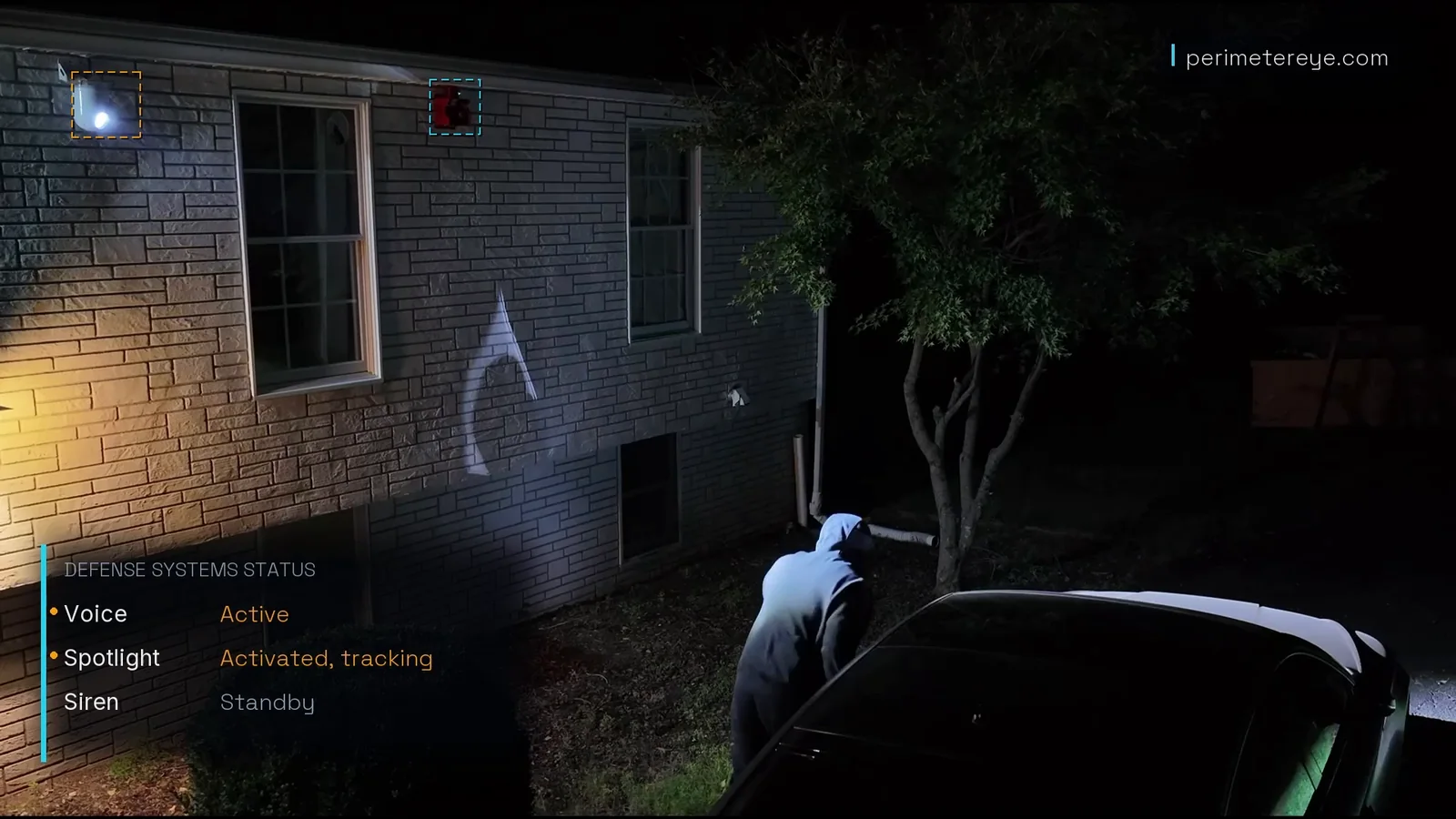
Stills from the demonstration with the system’s status on screen. Each part of the response switches on as the person keeps going, automatically.
1 of 4 · VoiceView full size
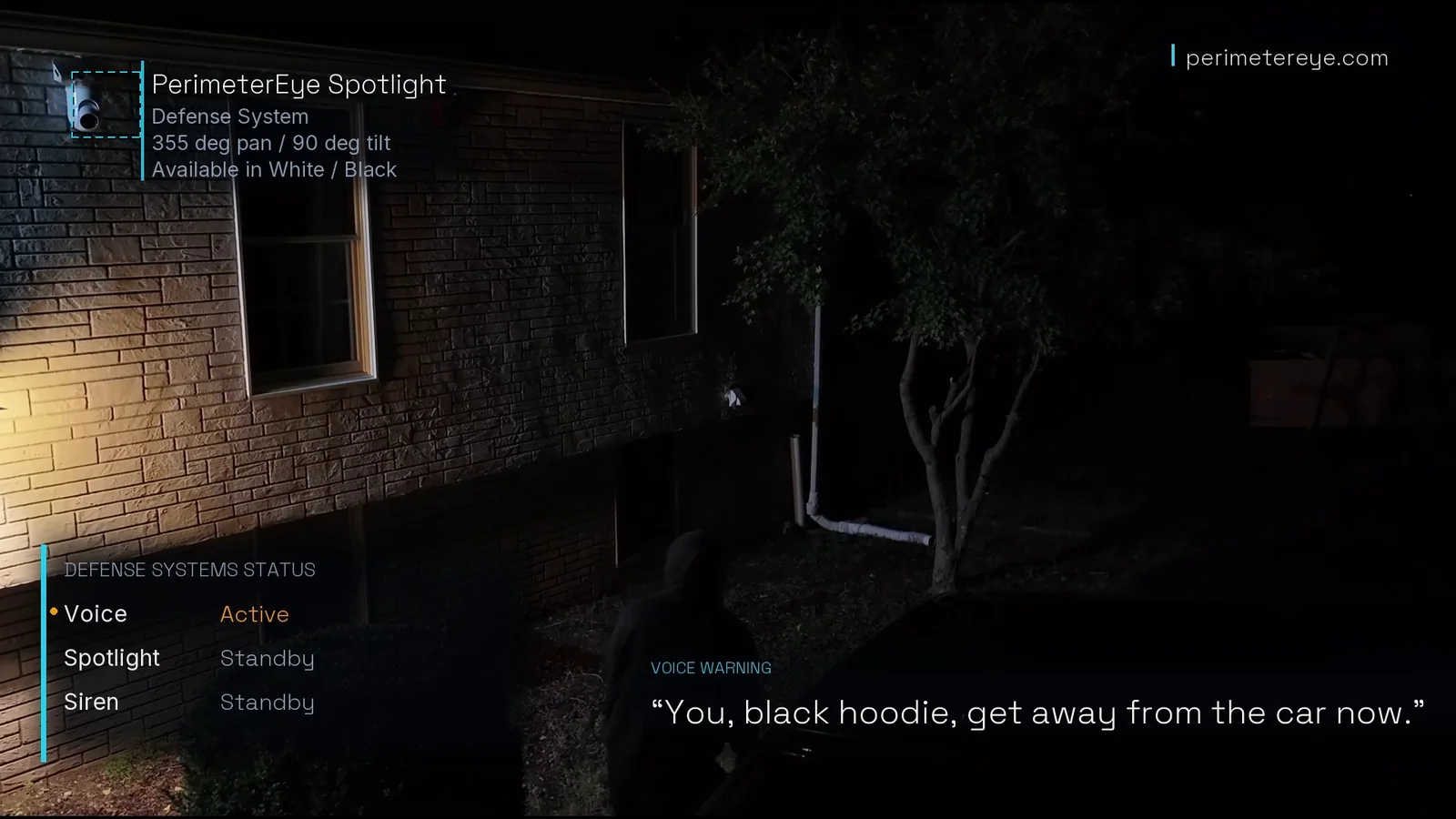
A warning with their description
The first response is spoken, and it is about them: “You, black hoodie, get away from the car now.” The searchlight and siren are on standby.
2 of 4 · SearchlightView full size
Then the light finds them
The person stays at the car, so the searchlight activates and tracks. They are lit up where they stand.
3 of 4 · SirenView full size
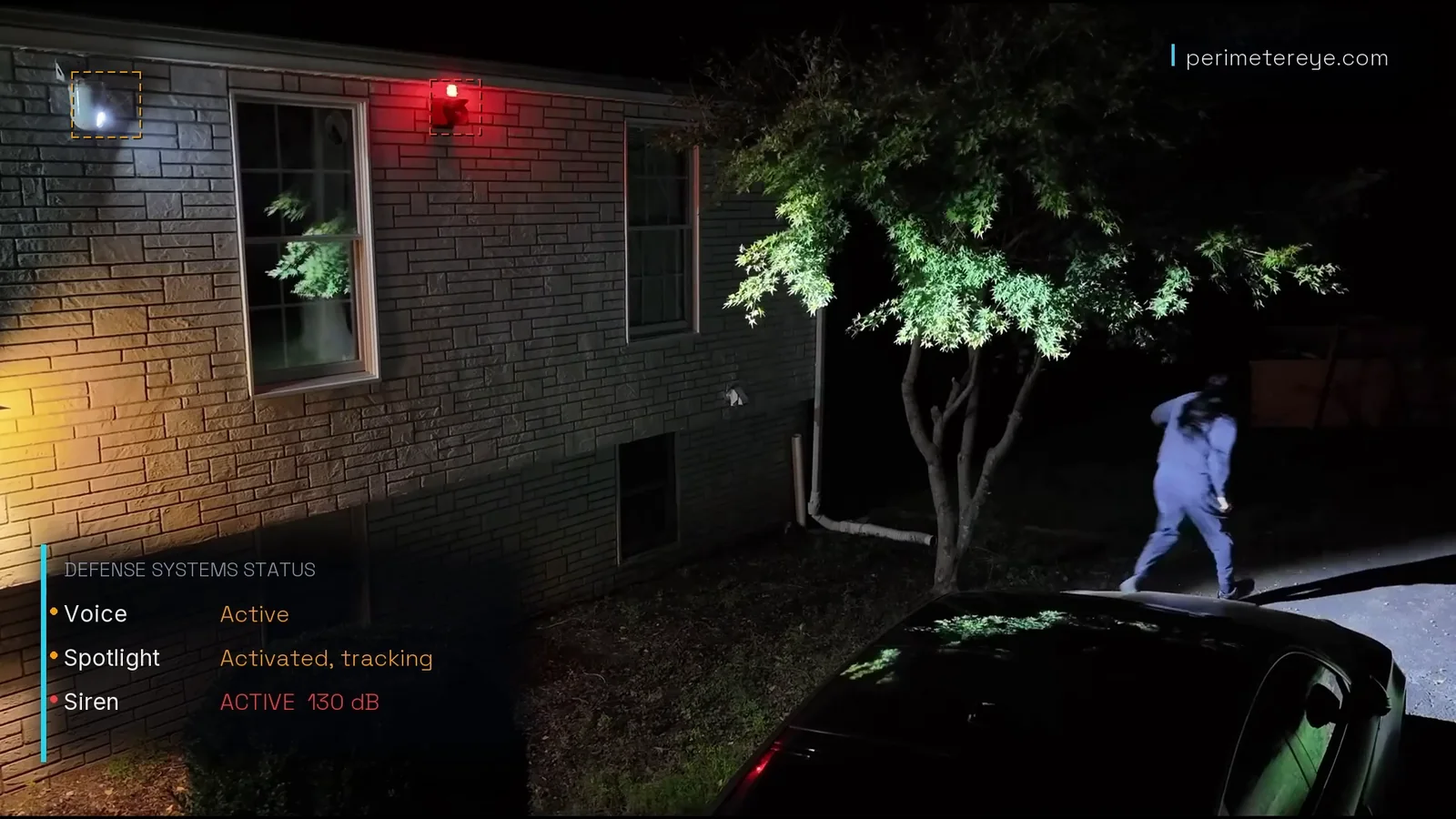
Then the 130 dB siren
The siren joins the voice and the light, and the person runs from the car.
4 of 4 · FollowedView full size
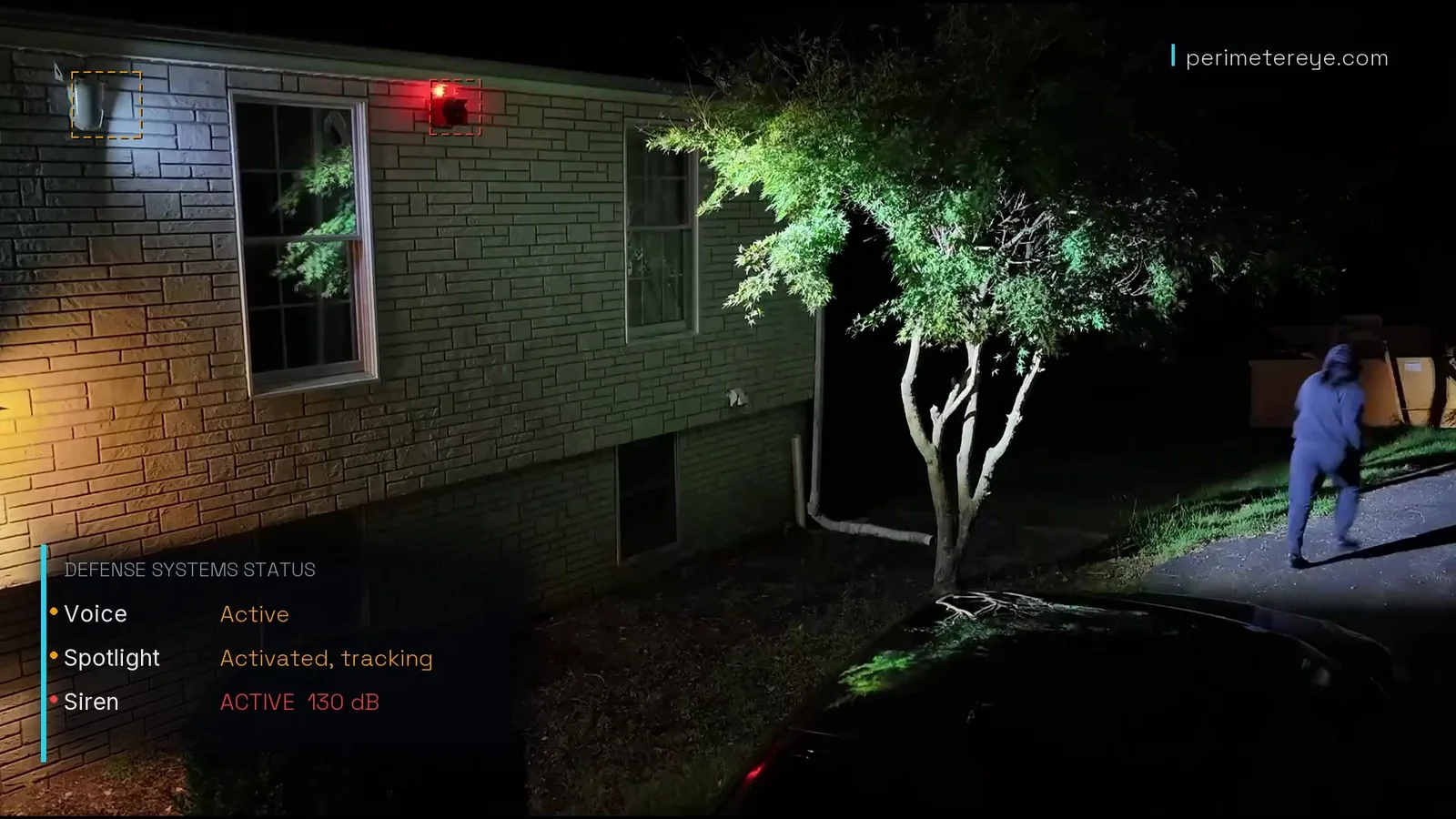
Followed as they go
The beam stays on them as they run past the tree, with every part of the response still active.
Filmed on a real property. The attempt was staged for filming; the system’s response was automatic, with no operator.
What changes
Contract-free is the start, not the point
- No long-term contract — you own every camera, searchlight, siren, and the Brain.
- $99/mo runs on-site AI that acts in seconds, not a chair in a call center.
- Alerts and control go directly to you, with live 4K video and two-way talk.
Plenty of products will sell you contract-free monitoring — the same after-the-fact phone call, billed month to month. That fixes the paperwork and keeps the flaw. The reason to leave a monitoring contract isn't the contract; it's that a call placed after the event was never a defense to begin with.
PerimeterEye replaces the model, not just the billing: hardware you own, a $99/mo software and AI subscription with no long-term commitment, and a system that acts on the property in seconds while every alert and every control goes directly to you.
What every system includes
- On-site edge computer (the Brain)
- 4K AI cameras
- Tracking searchlights
- Live targeted AI voice
- 130 dB siren escalation
- Doorbell video intercom
- Wall panel command center
- iOS app with live 4K video
01
Why people walk away from monitoring contracts
The traditional bundle is easy to resent: a multi-year agreement, a monthly fee, and in exchange a tripped sensor routes to an operator who calls to ask if everything is okay — minutes after the glass broke. The person paying is you; the person acting is a stranger in a chair, working from a script, with nothing on your property but an account number.
The contract exists because the business model needs it, not because you do. When the product is a phone call, retention has to be enforced on paper. People searching for a way out aren't being cheap — they've noticed that the thing they're paying for happens after the event, not during it.
02
An honest answer to "is professional monitoring worth it?"
For some homes, a human backstop has real value — if you can't receive alerts reliably, or you want someone else making the 3 a.m. decision, monitoring is a legitimate choice, and the newer human-in-the-loop products are more capable than the old call centers. As of mid-2026, Deep Sentinel staffs live guards in a surveillance center from roughly $100/mo, SimpliSafe's Active Guard puts live agents on up to three outdoor cameras, 24/7 on its $79.99/mo Pro Plus tier, and Ring's Virtual Security Guard is a professional agent add-on around $99/mo.
But notice what every one of those buys: a person, watching remotely, who can talk, sound a siren, and make calls. The response still travels through human reaction time, and the fee is rent — stop paying and the capability vanishes entirely. None of it lives on your property, and none of it belongs to you.
03
What the $99 a month runs instead
PerimeterEye has a subscription too — $99/mo for software and AI after activation — and the difference is what the money runs. Not an operator's chair: an AI on the PerimeterEye Brain at your property that verifies threats and acts in seconds — locking a tracking searchlight onto the subject, delivering a live targeted voice warning, firing a 130 dB siren — while writing a plain-language analysis of every event on every camera.
PerimeterEye is not an alarm-monitoring service — alerts and control go directly to you. There's no long-term contract, and the hardware is yours outright: pay in full at checkout or finance it through Klarna or Affirm. You own the cameras, the searchlights, the siren, the intercom, and the Brain on day one.
04
You're not the call center — the property responds first
The classic knock on self-monitoring is that it makes you the call center — every alert demands your eyes right now. PerimeterEye inverts that. The property responds first: verification, searchlight, targeted voice, siren, in seconds, automatically. Your phone shows you a response already in progress, with live video, instead of a raw motion ping begging for a decision.
The AI also does the filtering an operator never could. It knows the household, so family arrivals and mail carriers never trigger deterrence; it classifies deliveries, visitors, and service workers; it writes a daily briefing so you can skim the night instead of scrubbing it. Six modes set the posture, and there's nothing to arm or disarm.
05
What deters — evidence, not promises
In a 2013 UNC Charlotte survey of 422 incarcerated burglars (industry-funded, worth noting), about 83% said they would try to determine whether an alarm was present before proceeding, and roughly 60% would seek another target if one was. Separately, a randomized experiment across 77 NYC public-housing developments (NBER Working Paper 25798, 2019) found added nighttime lighting cut outdoor nighttime index crimes by about 36%.
That's the honest case: visible, active defense changes intruder math, and light is one of the best-evidenced tools there is. PerimeterEye concentrates both — a searchlight that finds and follows, a live voice that proves real attention, a siren behind it. No security system can guarantee prevention of every incident; this one makes the attempt lit, loud, and documented.
What separates PerimeterEye
No contract. Still a response.
A contract buys a call center’s time. PerimeterEye puts the response on the property.
| Option | Commitment | Who responds in the moment |
|---|---|---|
| Contract alarm company | Usually a multi-year agreement, with a charge for ending early. | A call center, after verification calls. |
| DIY system with an optional plan | Month to month. | You, from the app, or an agent on a paid plan. |
| PerimeterEye | No contract. Software and AI service included for the first 6 months, then $99/month. | The system itself, on the property, in seconds, while you watch the live view. |
Watch it at full speed
The same response, on film.
Real footage of the working system. Play it with sound to hear the voice warning and the siren.
Detection, tracking searchlight, spoken warning and siren escalation, end to end — all recorded output from a working system.
Play with sound to hear the voice warning and siren.What it costs
See what a system costs for your property.
Essential system
As low as$146/mo*Essential covers a driveway and the approaches to the house. Larger properties usually suit Advanced or Estate; a specialist can size it with you before you order.
What’s included
- 5 ultra-HD 4K cameras
- 1 tracking spotlight
- 1 speaker/siren unit
- PerimeterEye Access intercom, included with every complete system
- 1 PerimeterEye control panel
- 1 PerimeterEye AI processor
*Essential system, $0 down: 36 monthly payments of $145.17 at 10% APR on the hardware price before sales tax, shown rounded up to the dollar. Affirm rates 0–36% APR; Klarna terms are shown at checkout. Subject to eligibility and lender approval; your rate, term and down payment may differ. US only; not available in all states. Software is billed separately: first 6 months included, then $99/month.
Before you choose
Common questions
Is there really no contract?
There's no long-term monitoring contract. You buy the hardware and own it either way: pay monthly, as low as $145.17/mo for Essential (36 monthly payments at 10% APR, $0 down, through Affirm or Klarna, subject to approval), or pay in full at checkout. The $99/mo software and AI subscription starts after the six included months from activation for launch system orders and is not a multi-year commitment.
If there's no monitoring center, who calls the police?
You do, with better information than any operator ever has. PerimeterEye is not an alarm-monitoring service — alerts and control go directly to you. When something real happens, you get priority alerts with live 4K video while the system is already lighting, warning, and sounding the siren on-site.
What does the $99 a month actually pay for?
The software and AI that make the hardware act: written plain-language analysis of every event, live targeted voice warnings, plate reads and the known-vehicle registry, threat classification, daily briefings, plain-English search, and the iOS app with live 4K, instant rewind, and clip export. The hardware is yours regardless.
Is professional monitoring worth it compared to this?
If you specifically want a human deciding for you overnight, services like Deep Sentinel sell that from roughly $100/mo as of mid-2026. What monitoring can't remove is the human step: someone has to see it, decide, then act. PerimeterEye's response starts on the property the moment a threat is verified, with you watching live.
Without monitoring, am I less protected?
Monitoring never acted on the property — it reported on it, and no security system can guarantee prevention of every incident either way. What interviews with convicted burglars (UNC Charlotte, 2013 — an industry-funded survey) suggest changes behavior is discovering an active system. PerimeterEye makes that discovery immediate: searchlight, targeted voice, siren, in seconds.
Does it depend on the internet like self-monitoring apps do?
Core defense doesn't. Live view, recording, rewind, spotlights, and the siren all run on the PerimeterEye Brain at your property, so they keep working through internet outages. Remote alerts and app control resume when your connection does, and the wall panel gives you full command on-site the whole time.
Keep exploring
Related reading
Put a response behind your property.
Tell a specialist about your property, your driveway, and where people approach. They’ll size the cameras, searchlights, and sirens with you, or book a call first if you’d rather talk it through.
Explore an upgrade for your existing camerasSystem launch offer
Your first 6 months
of service included.
First 6 months included from activation. Then $99/month.
Compare system packages