What actually deters burglars: the evidence
The strongest evidence says burglars avoid people, not products. In surveys of convicted burglars, occupancy, noise, and confrontation risk rank first; alarms rank next; cameras and signs trail behind. The single best-tested environmental deterrent is bright lighting, which cut nighttime outdoor crime roughly 36% in a randomized New York City experiment.
That ranking comes from a thin but real evidence base: two structured interview projects with convicted burglars (one funded by the alarm industry, one journalistic), one genuine randomized experiment, one neighborhood-level density study, and federal victimization data. Most of the other numbers you have read — the 300-percent claims, the yard-sign percentages — cannot be traced to a primary source at all.
This page grades each common deterrent strictly against the verified research, discloses who paid for which study, and names the zombie statistics that fail sourcing. It is the reference we link from everything else we write about deterrence.
What this looks like on a real property
Voice first. Then the light. Then the siren.
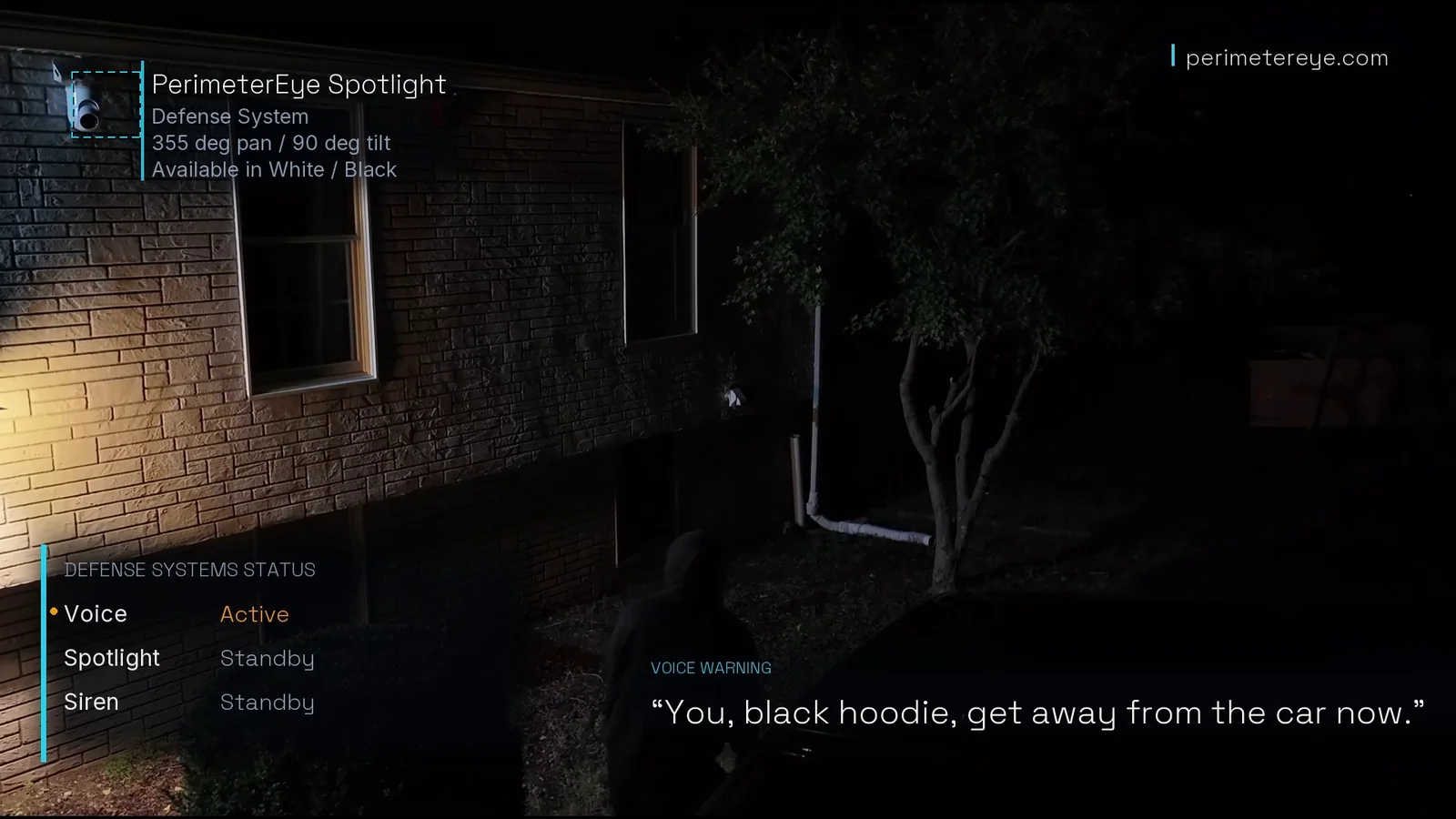
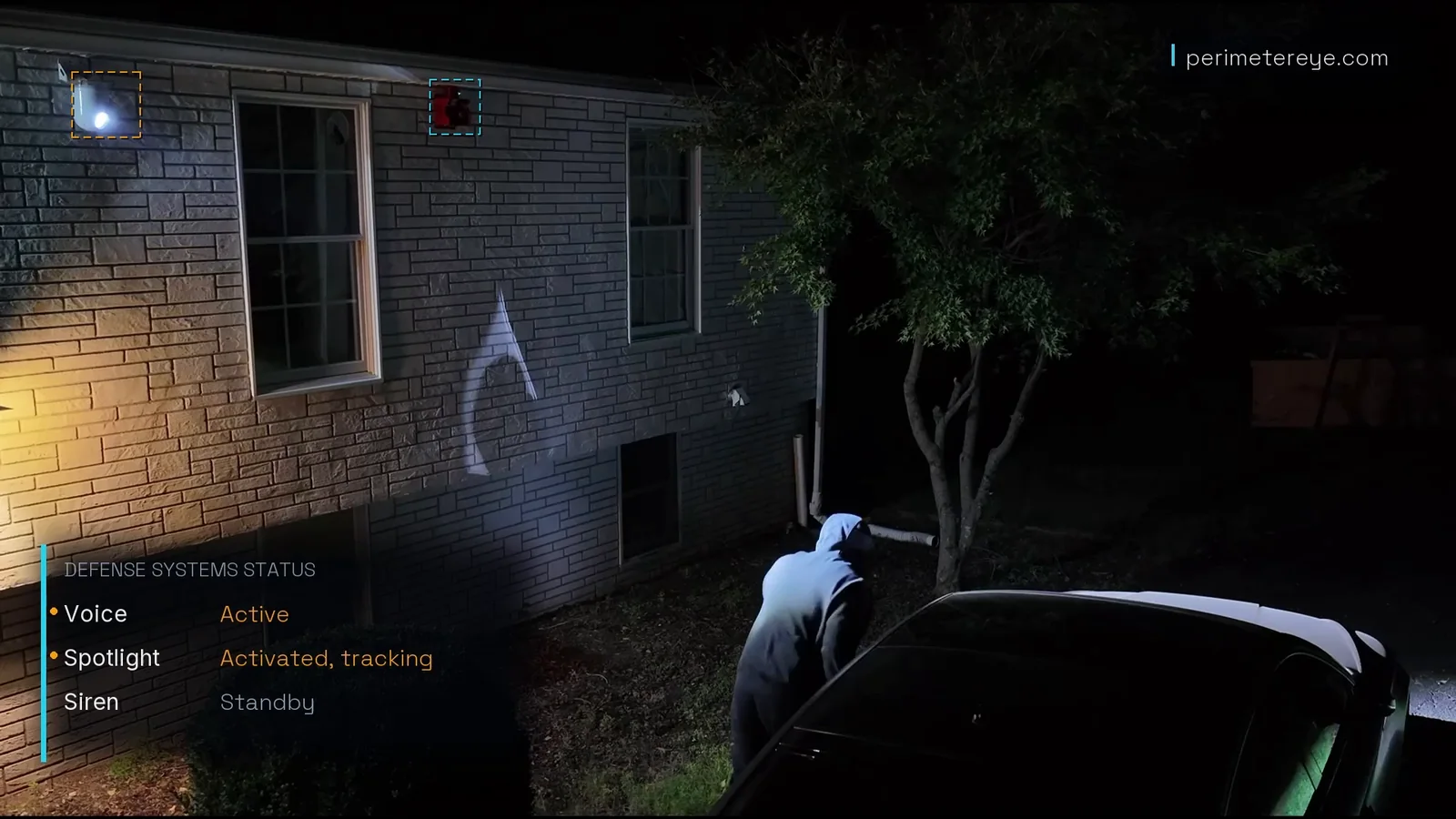
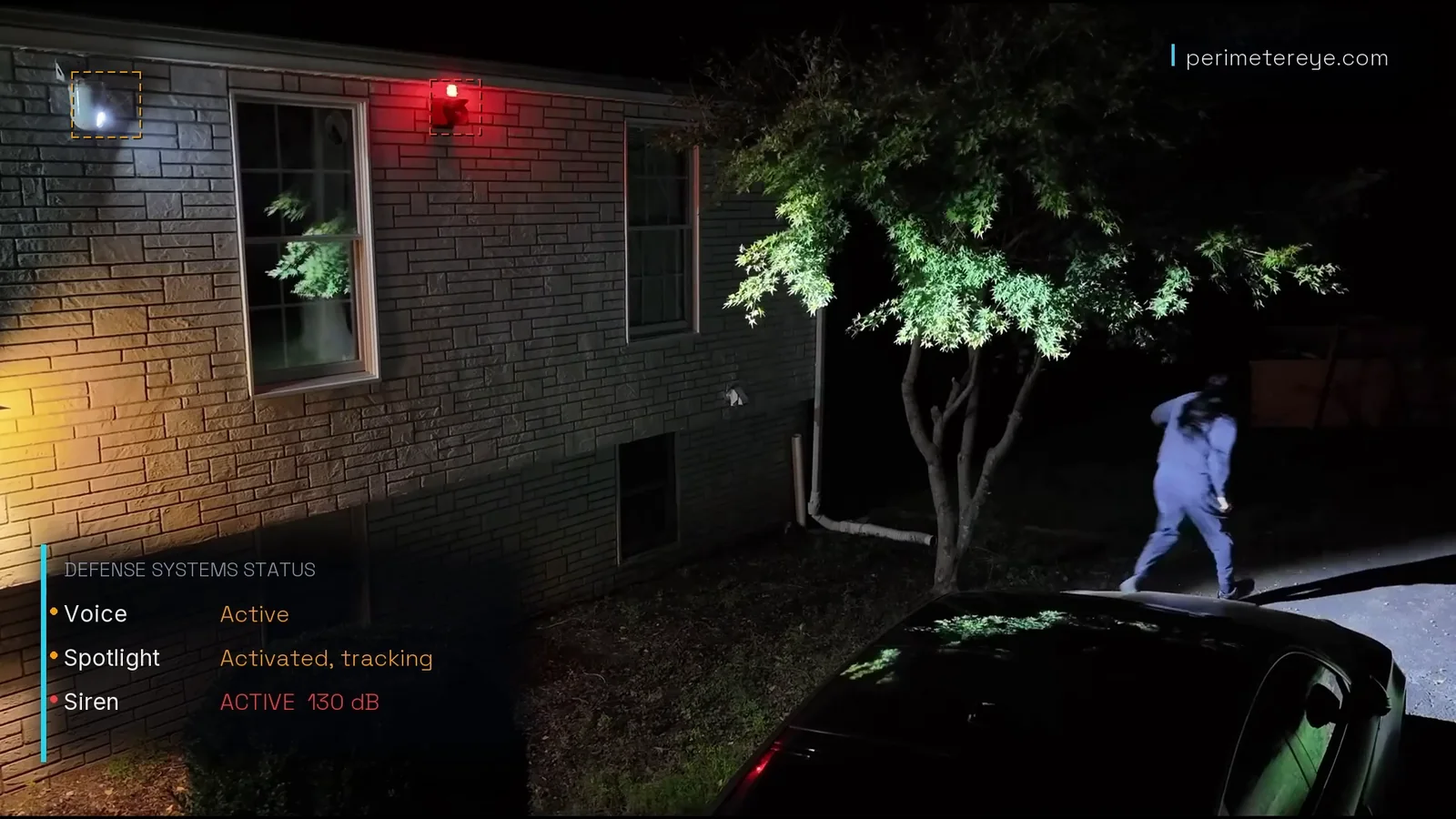
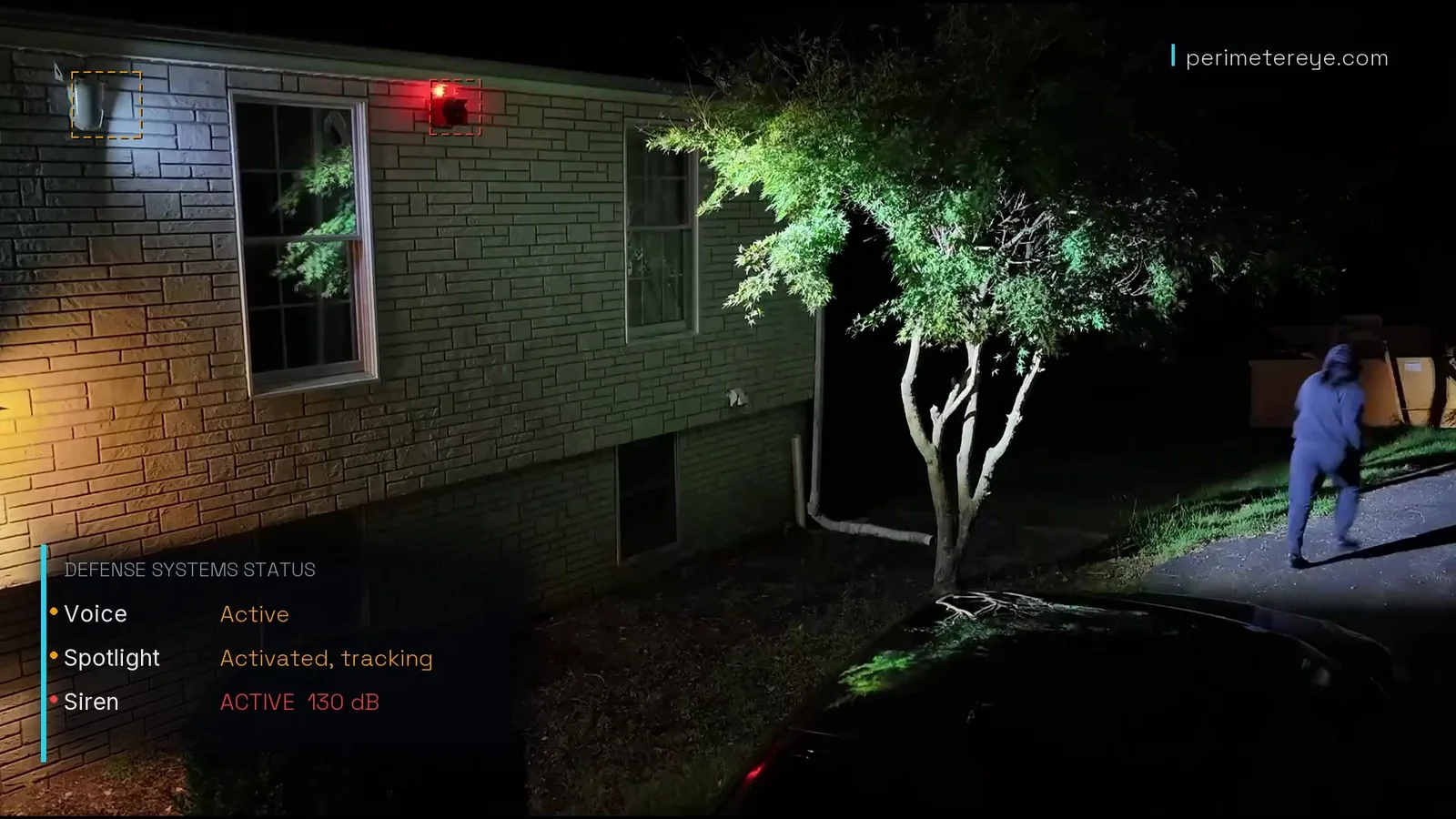
Stills from the demonstration with the system’s status on screen. Each part of the response switches on as the person keeps going, automatically.
1 of 4 · VoiceView full size
A warning with their description
The first response is spoken, and it is about them: “You, black hoodie, get away from the car now.” The searchlight and siren are on standby.
2 of 4 · SearchlightView full size
Then the light finds them
The person stays at the car, so the searchlight activates and tracks. They are lit up where they stand.
3 of 4 · SirenView full size
Then the 130 dB siren
The siren joins the voice and the light, and the person runs from the car.
4 of 4 · FollowedView full size
Followed as they go
The beam stays on them as they run past the tree, with every part of the response still active.
Filmed on a real property. The attempt was staged for filming; the system’s response was automatic, with no operator.
Occupancy: the strongest deterrent on record
Verdict: the strongest deterrent on record. In the UNC Charlotte survey of 422 incarcerated burglars, the proximity of other people was a top factor in choosing targets, and most burglars in the Oregon interviews knocked or rang first to make sure nobody was home. If a burglar believes someone is present, most simply leave.
The UNC Charlotte study (Kuhns et al., 2013) asked 422 incarcerated burglars how they picked targets; the proximity of other people topped the list alongside escape routes and visible signs of security. The Oregon material — 86 inmates answering a KGW-TV journalist's questionnaire in 2017 — reads the same way: essentially all of them knocked or rang the doorbell before entry, and a car in the driveway or sound inside the house was among the strongest signals to move on.
The stakes are worth stating plainly. The Bureau of Justice Statistics found a household member was present during roughly 28 percent of burglaries. Burglars try hard to avoid people and still regularly fail, which is exactly why the appearance of occupancy — light, sound, a vehicle, an answered doorbell — does so much work.
Lighting: the only deterrent with a randomized trial
Verdict: the best-tested environmental deterrent, with real causal evidence. A randomized experiment across 77 New York City public-housing developments found that intense new outdoor lighting cut nighttime outdoor index crimes by roughly 36 percent, and follow-up work found the effect persisted for about three years. No other common deterrent has evidence this strong.
Because the developments were randomized, the study (Chalfin, Hansen, Lerner & Parker, NBER Working Paper 25798) supports a causal claim rather than a correlation — rare in this field. The follow-up published in Criminology & Public Policy in 2022 confirmed the reduction was not a novelty effect that faded within months.
The caveat: the experiment used intense, constant lighting installations, not a cheap motion flood over a garage. Treat it as strong evidence that visibility deters nighttime crime, and as weaker evidence about any particular fixture. We take that question up in detail in our article on motion lighting.
Alarms: solid survey evidence, industry funding
Verdict: solidly supported, with a disclosure. About 83 percent of surveyed burglars said they would try to determine whether an alarm was present, and roughly 60 percent would pick another target if one was. A Newark study tied higher alarm density to fewer burglaries. Both studies were funded by the alarm industry's research foundation.
In the UNC Charlotte survey, over half of the burglars also said they would abort a burglary already in progress on discovering an alarm — a striking finding, because it means the deterrent works even after the decision to enter. Separately, a 2009 study by Seungmug Lee at the Rutgers School of Criminal Justice found Newark neighborhoods with higher residential alarm density had fewer burglaries, with no displacement of crime to neighboring homes.
Disclosure: both were funded by the Alarm Industry Research and Educational Foundation. That does not make them wrong — the methods are documented, and the direction matches what burglars told an independent journalist in Oregon — but it is why we flag the funding rather than quoting the percentages as settled fact.
Dogs: better than most hardware
Verdict: better than most hardware, by burglars' own account. In the Oregon interviews, big, loud dogs ranked with occupancy and noise among the strongest reasons to walk away, and the UNC Charlotte survey listed dogs inside among the top signs burglars checked for. The deterrent is the noise and unpredictability, not the breed.
Notice what a dog actually is in this framework: a resident that always answers the door. It guarantees the burglar will not work in silence, and it cannot be predicted, distracted, or reasoned with. That is why the interviews specify big and loud — the deterrence is exposure, not injury. There is no credible population-level study of dog ownership versus burglary rates, so the survey testimony is the evidence, and it is consistent across both samples.
Cameras: real but weak, and double-edged
Verdict: real but weak, and double-edged. Outdoor cameras appear in the UNC Charlotte survey as one of the signs of security burglars checked for, ranked below alarms and occupancy. In the Oregon interviews, some burglars read cameras as a deterrent — and some read them as a hint that the house held something worth taking.
The structural problem is timing. Every deterrent burglars rank highly threatens a consequence during the crime; a camera mostly threatens one after it — footage that may matter someday, if anyone follows up. A hood and a fast exit shrink that threat to a size many burglars accept. Our full article on cameras walks through this; the short version is that recording is a witness, not a response.
Signs and stickers: unproven on their own
Verdict: unproven on their own. Alarm signs show up in the UNC Charlotte survey only as part of a broader cluster of "signs of security" burglars looked for — never isolated as an independent deterrent. Every popular statistic about yard signs alone traces to sources that cannot be verified. Treat signs as a supporting detail, not a defense.
The logic is easy to reconstruct: a sign claims a system, and a system claims a response. Burglars who case houses test whether the claim is real — the knock on the door is exactly that test — so a sign with nothing behind it fails at the first probe. Put the sign up; it costs almost nothing. Just do not confuse it with a plan.
Statistics you should not trust
Security marketing runs on a small set of zombie statistics — numbers that circulate endlessly without a locatable primary source. We looked for the original research behind each of the following and could not find it. If one of these appears on a vendor's page with no author, institution, year, or methodology attached, treat the claim as unsupported:
None of this means deterrence is fake — the verified research above is genuinely encouraging. It means the honest evidence base is smaller than the marketing implies, and the numbers that survive scrutiny are the only ones worth building decisions on.
- "Homes without security are 300% more likely to be burglarized" (and its mirror, "homes with cameras are 300% less likely") — repeated for decades, never with a citable study, author, or dataset.
- "46% of burglars avoid homes with alarms" — a suspiciously precise figure with no locatable survey behind it.
- The UTSA "38% deterred by yard signs" study — widely attributed, not locatable in any published research from the university.
- The University of Chicago "3x neighborhood watch" figure and the Yale "18%" statistic — neither traces to a published paper.
- The Penn "beware of dog" study — cited on hundreds of blogs; no such study can be found.
- Any national "average police response time" — response varies so much by agency, call priority, and geography that a single national figure is unsupportable, and none of the circulating versions cite a real dataset.
- Ring's claim that its doorbells "reduced burglaries 55% in LA" — a company pilot claim with no verifiable published study behind it.
Active response: where the evidence points
Verdict: the logical endpoint of everything above, with the least published research. Burglars avoid people who might confront them; active response makes confrontation immediate instead of hypothetical. The category is young — human guard services and AI deterrence products emerged in the last few years — so grade it by the mechanism, not by long-run studies that don't yet exist.
The market has started building toward this conclusion. As of mid-2026, Deep Sentinel stations live human guards in a surveillance center from roughly $100 per month, SimpliSafe's Active Guard tier adds live human agents on up to three outdoor cameras, 24/7 at around $80 per month, and Ring offers a Virtual Security Guard professional-agent add-on at about $99 per month. Alarm.com introduced an automated AI deterrence service at CES 2025. All of these are monitoring models: people or software watching feeds from somewhere else.
This is the finding an Automatic Property Defense System like PerimeterEye is built on. Instead of adding a distant watcher, it makes the property itself respond: when it verifies a genuine unknown person, a motorized searchlight locks onto them and physically follows — homeowners compare it to a police-helicopter beam — while the AI speaks to them directly, describing the specific person in frame, then escalates to a 130 dB siren and priority alerts with live video if they stay. It knows the household, so family arrivals and mail carriers never trigger any of it. PerimeterEye is not an alarm-monitoring service — alerts and control go directly to you. And to be plain about limits: no security system can guarantee prevention of every incident.
Common questions
What is the single most effective burglar deterrent?
The evidence points to occupancy — the belief that someone is home and might confront the intruder. In both major burglar surveys, people-related signals (occupied houses, noise inside, neighbors nearby) outranked every product. Among purchasable deterrents, bright outdoor lighting has the strongest causal evidence, from a randomized New York City experiment.
Should I trust studies funded by the security industry?
Read them with the funding in mind, not in the trash. The UNC Charlotte burglar survey and the Newark alarm-density study were both funded by an alarm-industry foundation, which is why we disclose it. Their findings are directionally consistent with independent sources, but the exact percentages deserve more caution than a randomized experiment.
Do most burglaries happen at night?
No. FBI data for 2024 shows daytime residential burglaries (216,601) outnumbered nighttime ones (174,053). Burglars prefer empty houses, and houses are most reliably empty on weekday afternoons. Lighting still matters — the strongest deterrence experiment on record is about nighttime crime — but a plan that only defends the dark hours is half a plan.
Why do so many popular security statistics fail fact-checking?
Because they circulate through marketing pages that cite each other instead of a primary source. Claims like "homes without security are 300% more likely to be burglarized" have no locatable study behind them. When a statistic has no named researcher, institution, year, and methodology you can check, treat it as decoration, not evidence.
What is the most effective way to avoid being burglarized?
Stack the deterrents burglars themselves report avoiding: signs of occupancy, noise, bright light, and a credible chance of being confronted, plus good documentation if someone tries anyway. Distrust anyone who promises certainty; no security system can guarantee prevention of every incident.
Sources
- Kuhns et al., Understanding Decisions to Burglarize from the Offender's Perspective (UNC Charlotte, 2013, AIREF-funded)
- KGW-TV, "We Asked 86 Burglars" (Kyle Iboshi, 2017)
- Chalfin, Hansen, Lerner & Parker, NBER Working Paper 25798 (2019); follow-up in Criminology & Public Policy (2022)
- Lee, Rutgers School of Criminal Justice, Newark alarm-density study (2009, AIREF-sponsored)
- FBI Crime in the Nation 2024, Crime Data Explorer
- BJS, Victimization During Household Burglary (2010)
What it costs
See what a system costs for your property.
Essential system
As low as$146/mo*Essential covers a driveway and the approaches to the house. Larger properties usually suit Advanced or Estate; a specialist can size it with you before you order.
What’s included
- 5 ultra-HD 4K cameras
- 1 tracking spotlight
- 1 speaker/siren unit
- PerimeterEye Access intercom, included with every complete system
- 1 PerimeterEye control panel
- 1 PerimeterEye AI processor
*Essential system, $0 down: 36 monthly payments of $145.17 at 10% APR on the hardware price before sales tax, shown rounded up to the dollar. Affirm rates 0–36% APR; Klarna terms are shown at checkout. Subject to eligibility and lender approval; your rate, term and down payment may differ. US only; not available in all states. Software is billed separately: first 6 months included, then $99/month.
Deterrence, applied automatically
PerimeterEye turns the deterrents the evidence supports — bright light that locks on, a voice that addresses the specific person, a 130 dB siren, and instant alerts with live video — into an escalation your property runs on its own, in seconds, while you watch.