Do motion lights deter crime? What a randomized experiment found
Yes — lighting has the strongest causal evidence of any common deterrent. A randomized experiment across 77 New York City public-housing developments cut nighttime outdoor index crimes by roughly 36%, with effects lasting about three years. The caveat: that was massive, constant lighting. A consumer motion flood is a much weaker version of the same idea.
That experiment — NBER Working Paper 25798, with a peer-reviewed follow-up in 2022 — is the closest thing residential deterrence has to gold-standard evidence, and it is about light. This article explains what it found, why it worked, where the motion flood over your garage falls short of it, and how to close the gap.
What this looks like on a real property
You don’t see anyone. PerimeterEye does.
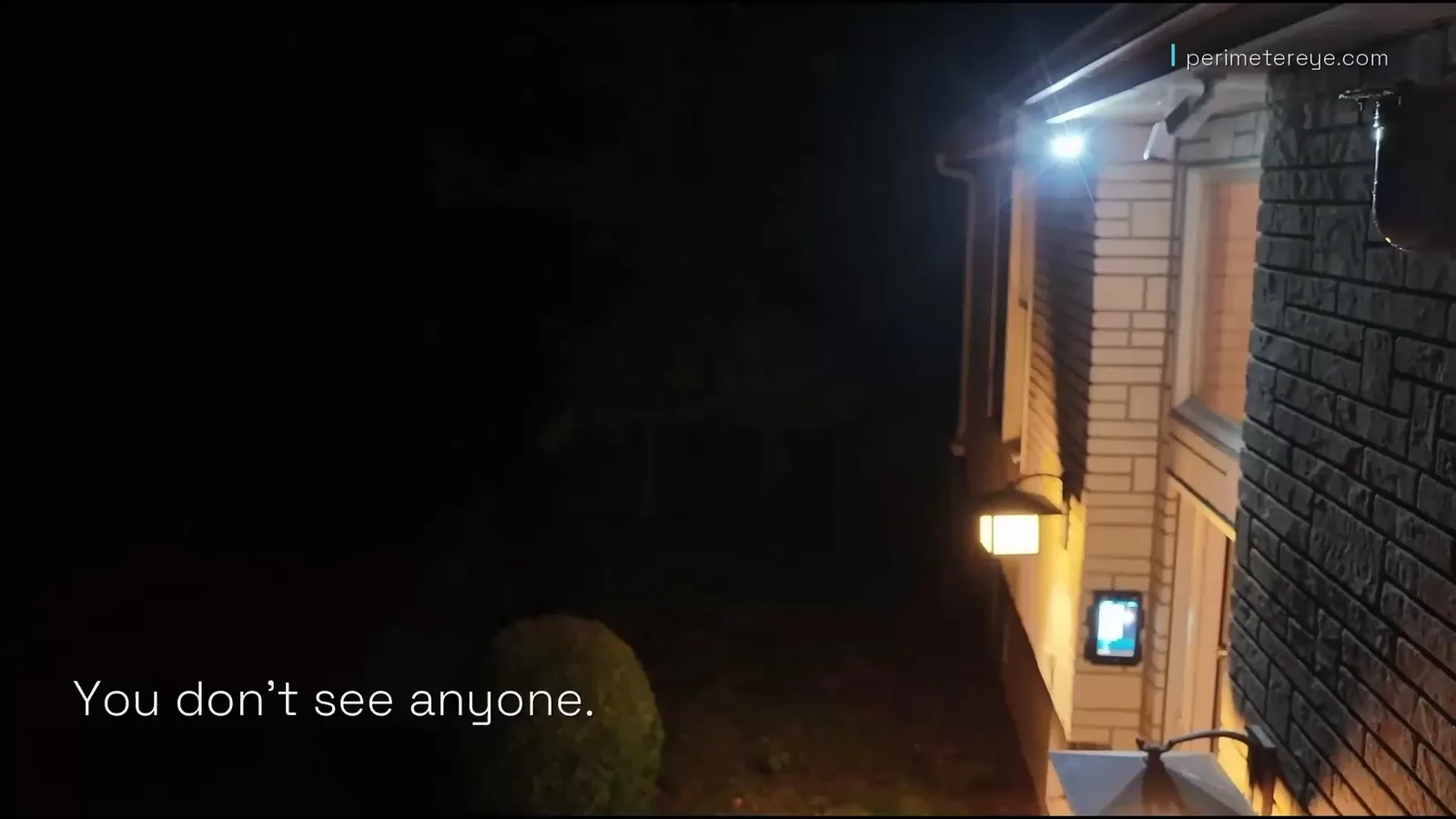
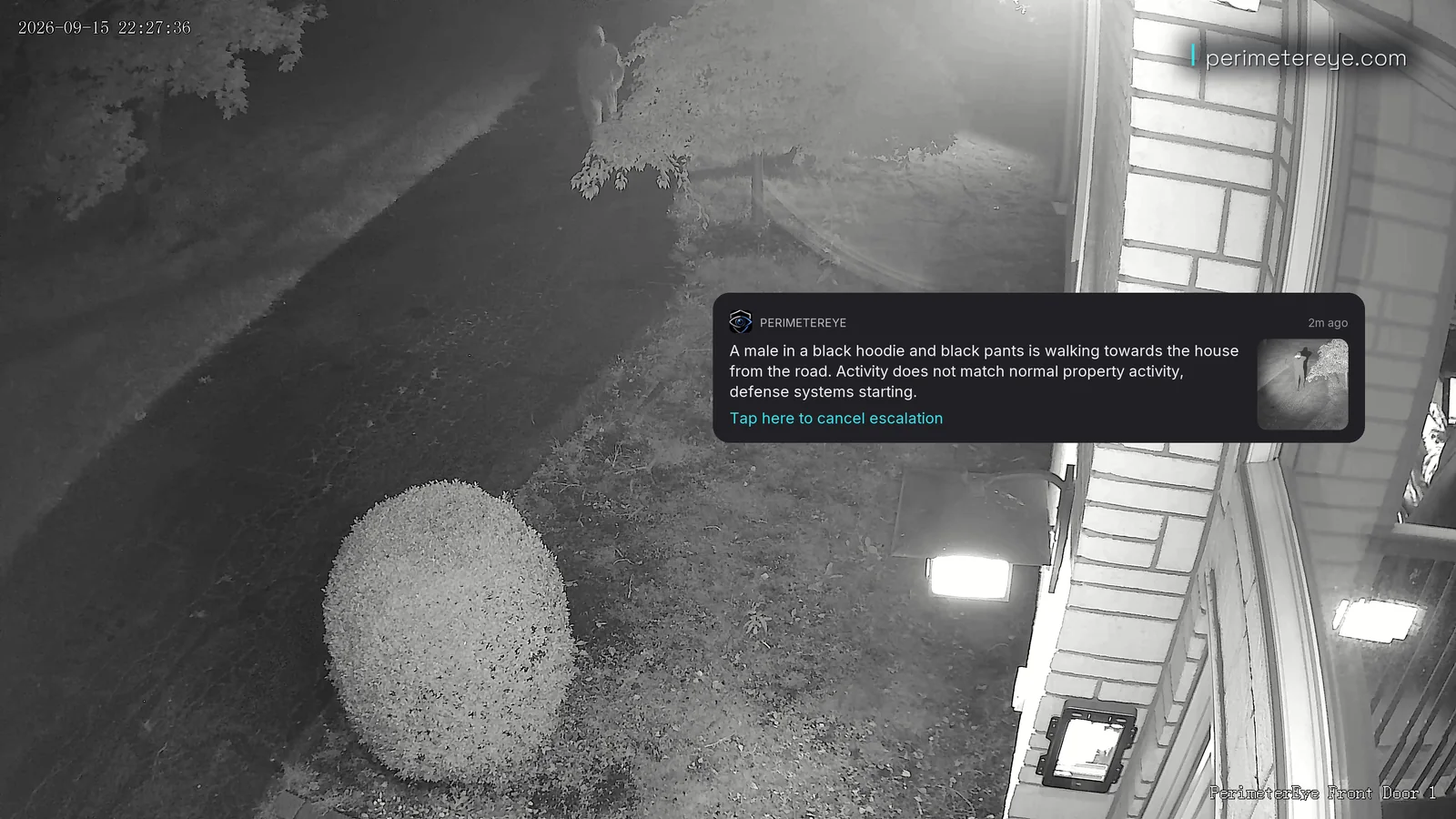
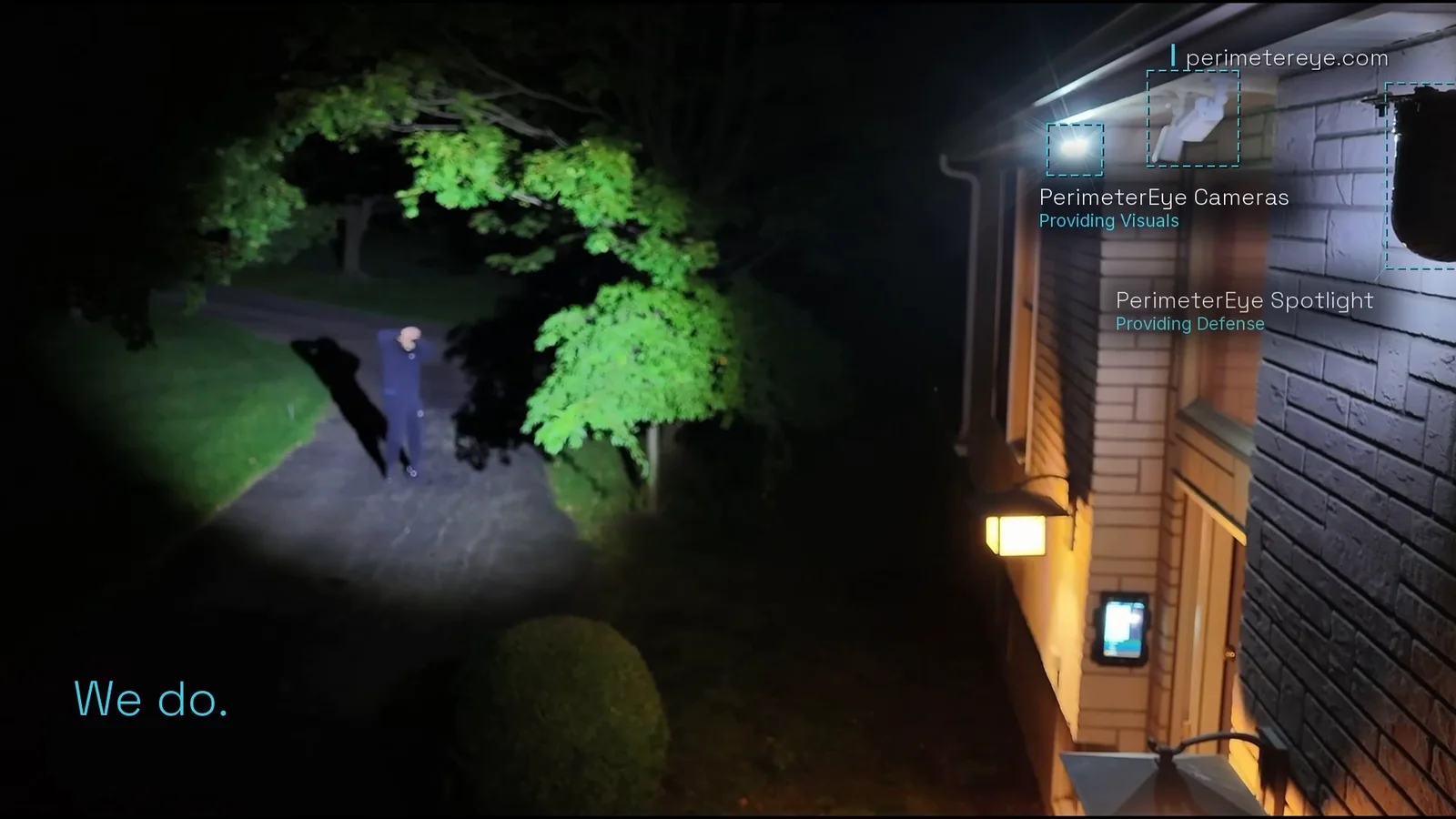
The same approach three ways: what you see from the house at night, what the camera sees in infrared, and the moment the searchlight catches the person.
1 of 3 · Your viewView full size
You don’t see anyone.
From the house, the driveway is dark. Whoever is out there is invisible to you.
2 of 3 · PerimeterEye’s viewView full size
The camera sees them in infrared
In infrared the person is in plain view, and the alert is already describing them: walking toward the house from the road, not normal activity for the property.
3 of 3 · The searchlightView full size
We do.
The searchlight catches the person on the driveway, and their hands go up against the light. The cameras provide the view; the searchlight provides the defense.
Filmed on a real property with PerimeterEye cameras and a searchlight. The approach was staged for filming; the system’s response was automatic, with no operator.
The experiment: randomized light, measured crime
Researchers Aaron Chalfin, Benjamin Hansen, Jason Lerner, and Lucie Parker worked with New York City to randomly assign intense temporary lighting across 77 public-housing developments. Random assignment is the crucial part: it rules out the usual objection that safer neighborhoods simply have more lighting. The result, published as NBER Working Paper 25798: nighttime outdoor index crimes fell by roughly 36 percent where the lights went in.
A follow-up published in Criminology & Public Policy in 2022 answered the obvious next question — do people just adjust? — and found the reduction persisted for about three years. In a field otherwise built on surveys and correlations, a randomized experiment with multi-year persistence is as strong as the evidence gets.
Why light deters: witnesses, not wattage
The mechanism matters for everything that follows. Light does not physically stop anyone; it changes the odds of being seen. That maps directly onto what convicted burglars say they weigh: in the UNC Charlotte survey of 422 incarcerated burglars (industry-funded, disclosed in our sources), the proximity of other people and the availability of escape routes topped target selection. Darkness protects an offender on both counts — no witnesses, easy retreat. Lit ground strips away the anonymity the crime depends on.
In other words, the NYC lights worked for the same reason occupancy, noise, and dogs rank highest in burglar interviews: they raise the chance that a person notices. Light deters because a lit person is an identifiable person.
The honest caveat: your motion flood is not the NYC experiment
Now the part consumer marketing skips. The experiment used high-output lighting running constantly, all night, across entire developments. A cheap motion flood over the garage is a different object: dimmer, momentary, and triggered by everything — cats, cars, rain, swaying branches.
That produces two problems the experiment never had. Habituation: a light that fires twenty times a night for wildlife becomes background noise to the neighbors and to anyone watching the house. And anonymity: an ordinary flood illuminates a patch of ground, not a person — someone can simply step out of the beam. No one has run a randomized trial of consumer motion lights, so the honest statement is this: constant bright lighting has excellent evidence, and the cheap motion version inherits the mechanism in weakened form.
Getting real deterrence from ordinary lighting
Until someone runs that trial, the reasonable play is to make consumer lighting behave as much like the evidence as possible:
And keep the FBI's 2024 numbers in view: daytime residential burglaries (216,601) outnumbered nighttime ones (174,053). Lighting is a nighttime layer. It cannot be the whole plan.
- Use constant dusk-to-dawn fixtures where visibility matters most — entries, the driveway apron, the paths between buildings — because steady light is what the experiment actually tested.
- Aim motion floods across approach routes rather than at the street, and tune sensitivity so triggers are rare enough to mean something.
- Mount high and angle down, lighting faces and ground instead of blinding the sightline; glare creates shadows an intruder can work behind.
- Pair light with occupancy cues — light plus sound inside reads as "someone is here," the top avoid signal in both burglar surveys.
A light that follows: closing the anonymity gap
There is one more step between a static flood and what the evidence describes. The NYC lights deterred by making offenders visible in general. A tracking light makes one person visible in particular. PerimeterEye — an Automatic Property Defense System, not another camera kit — uses motorized searchlights that rotate 355 degrees, tilt 90, and, once the system verifies a genuine unknown person, lock on and physically follow them across the property. Homeowners compare the effect to a police-helicopter beam: it does not just light the yard, it announces that you, specifically, have been seen.
The light is one rung on an escalation ladder — verification first, then the tracking beam, then live AI voice describing the specific person in frame, then a 130 dB siren with priority alerts and live video to your phone. The system knows the household, so family arrivals never trigger it, and each night, an hour after sunset, the spotlights run a visible Perimeter Sweep that never crosses the property boundary. Because the beam moves only for a verified person, it never becomes the background noise a static flood turns into. No security system can guarantee prevention of every incident; this one is built to make the strongest finding in the deterrence literature personal.
Common questions
Do motion sensor lights really deter crime?
Lighting in general has the strongest causal evidence of any deterrent: a randomized New York City experiment cut nighttime outdoor index crimes roughly 36 percent. But that used massive constant installations. Consumer motion floods have never been tested at that scale, and their effect likely depends on surprising someone who expects darkness.
Is it better to leave lights on all night or use motion sensors?
The strongest study tested constant bright light, which argues for dusk-to-dawn fixtures in key areas. Motion lights add something constant light cannot: an event — a change that says movement was noticed. A reasonable approach uses steady light where visibility matters most and motion-triggered light as the attention signal on approaches.
Why do burglars care about lighting at all?
Because light means witnesses. In surveys, burglars chose targets by the proximity of other people and the availability of escape routes; darkness protects both. Light raises the odds of being seen, described, and remembered. It converts an anonymous silhouette into a person a neighbor can identify — which is the thing burglars fear.
Do criminals get used to motion lights?
Habituation is the honest weakness. A flood that fires for every cat, car, and raccoon becomes background noise to neighbors and to anyone watching the house. The NYC experiment avoided this by never turning off. For motion lights, careful aim and sensitivity tuning — so triggers are rare and meaningful — preserve the signal.
Does lighting help during the day?
No, and that matters: FBI data for 2024 counted more daytime residential burglaries (216,601) than nighttime (174,053). Lighting is a nighttime tool. Daytime deterrence leans on occupancy signals, visible activity, and a property that responds to an unexpected visitor — which is why lighting should be one layer, not the whole plan.
Sources
- Chalfin, Hansen, Lerner & Parker, NBER Working Paper 25798 (2019); follow-up in Criminology & Public Policy (2022)
- Kuhns et al., Understanding Decisions to Burglarize from the Offender's Perspective (UNC Charlotte, 2013, AIREF-funded)
- KGW-TV, "We Asked 86 Burglars" (Kyle Iboshi, 2017)
- FBI Crime in the Nation 2024, Crime Data Explorer
What it costs
See what a system costs for your property.
Essential system
As low as$146/mo*Essential covers a driveway and the approaches to the house. Larger properties usually suit Advanced or Estate; a specialist can size it with you before you order.
What’s included
- 5 ultra-HD 4K cameras
- 1 tracking spotlight
- 1 speaker/siren unit
- PerimeterEye Access intercom, included with every complete system
- 1 PerimeterEye control panel
- 1 PerimeterEye AI processor
*Essential system, $0 down: 36 monthly payments of $145.17 at 10% APR on the hardware price before sales tax, shown rounded up to the dollar. Affirm rates 0–36% APR; Klarna terms are shown at checkout. Subject to eligibility and lender approval; your rate, term and down payment may differ. US only; not available in all states. Software is billed separately: first 6 months included, then $99/month.
Light that locks on
PerimeterEye turns the best-evidenced deterrent — bright light — into a searchlight that verifies, locks on, and follows, backed by live targeted voice and a 130 dB siren.