Do dogs deter burglars?
Yes — dogs are one of the most consistent deterrents in offender research. Incarcerated burglars in a 2013 survey listed dogs inside among their top deterrents, and Oregon inmates surveyed by KGW-TV in 2017 called big, loud dogs one of the strongest avoid signals. The reason is the mechanism: a dog detects, confronts, and escalates in real time.
That mechanism point is the part worth sitting with. Almost everything sold as a deterrent — signs, stickers, decoy cameras, even real cameras — is a passive signal that hopes to be believed. A dog is different in kind. It is an on-site responder that notices an intruder early, announces them immediately, and keeps escalating for as long as they stay.
This article lays out what both surveys found, why the mechanism rather than the bite does the deterring, where the dog evidence is honestly thin, and what to do if you want the mechanism without signing up for the dog.
What this looks like on a real property
Voice first. Then the light. Then the siren.
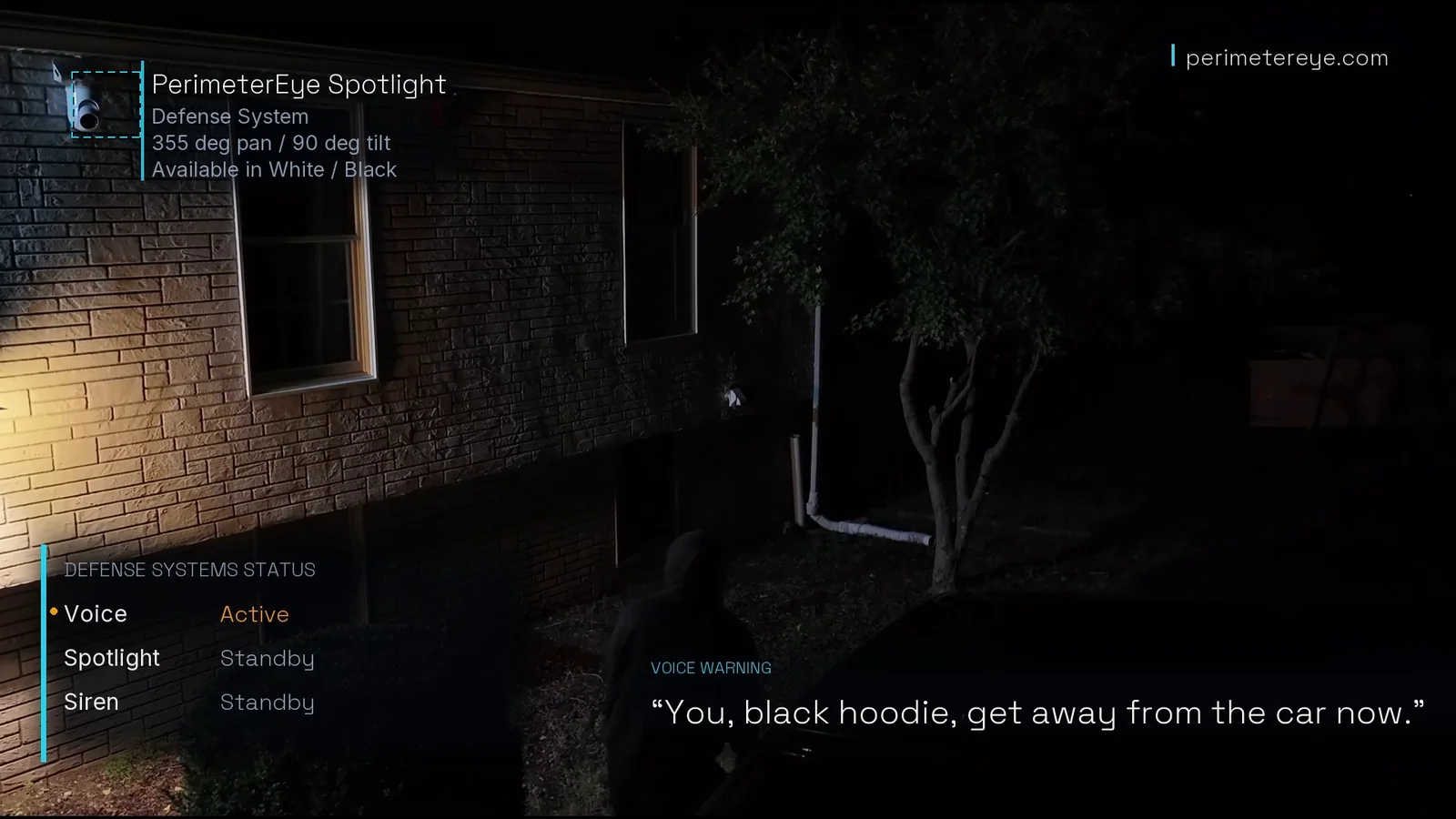
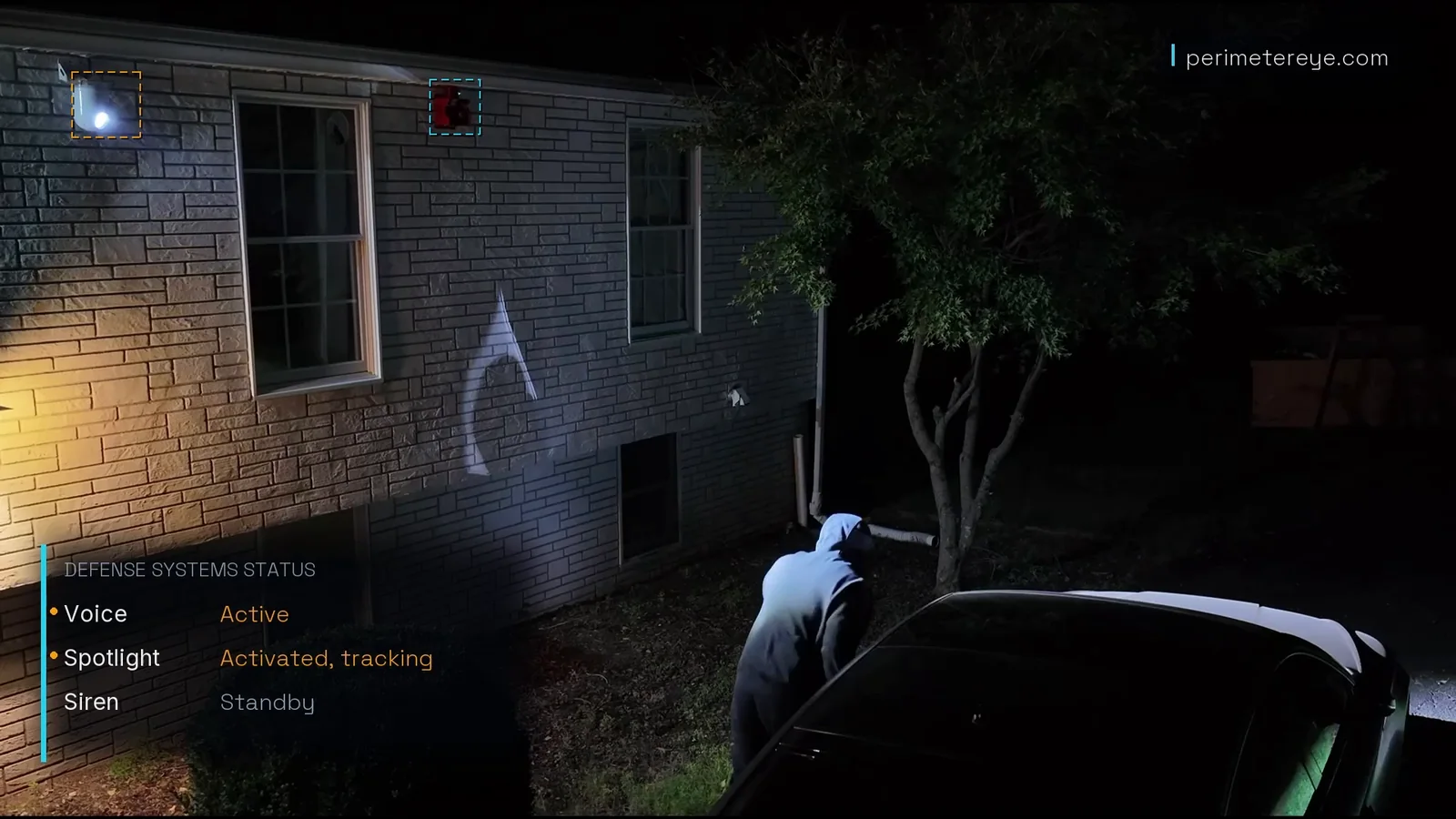
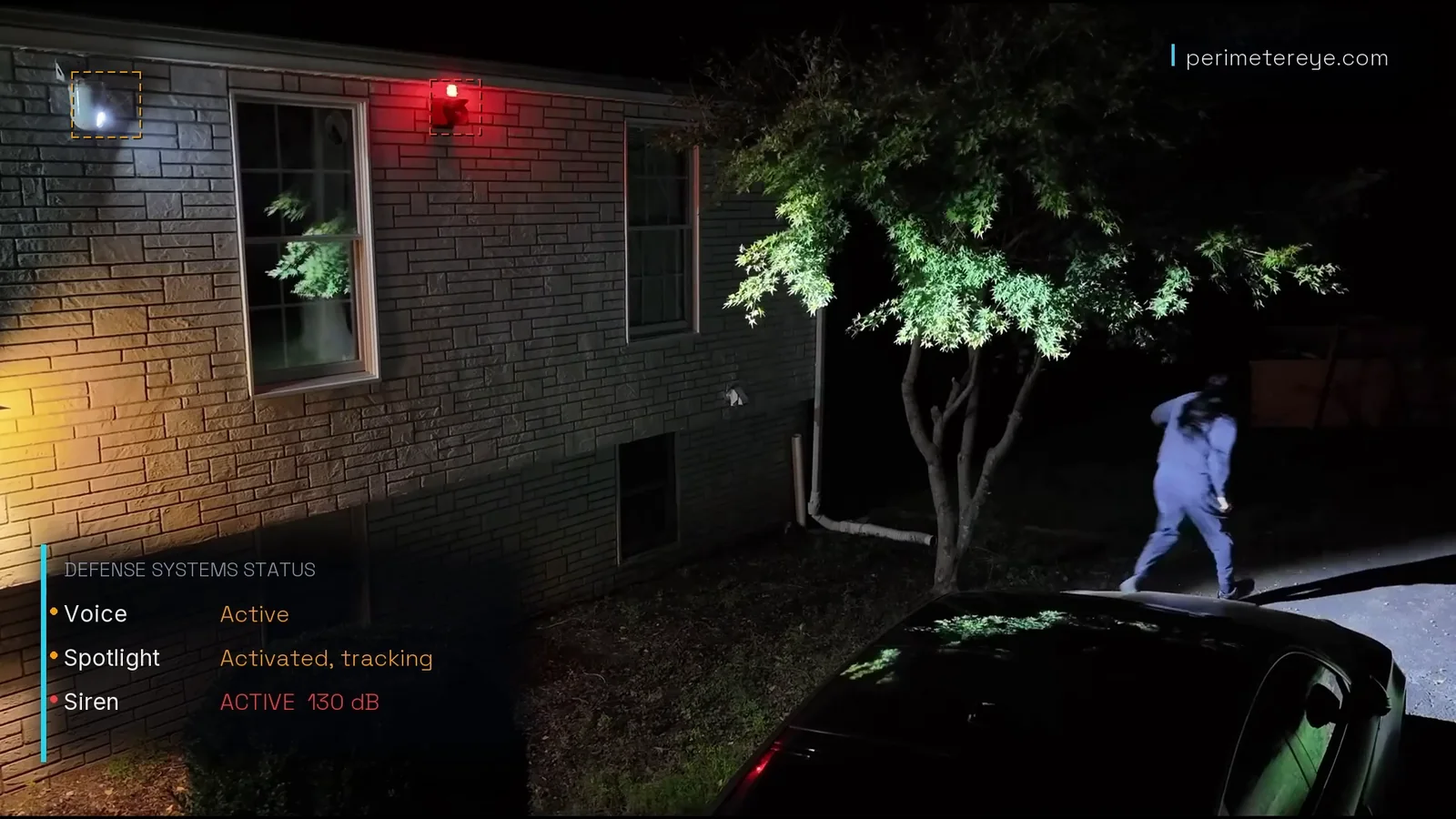
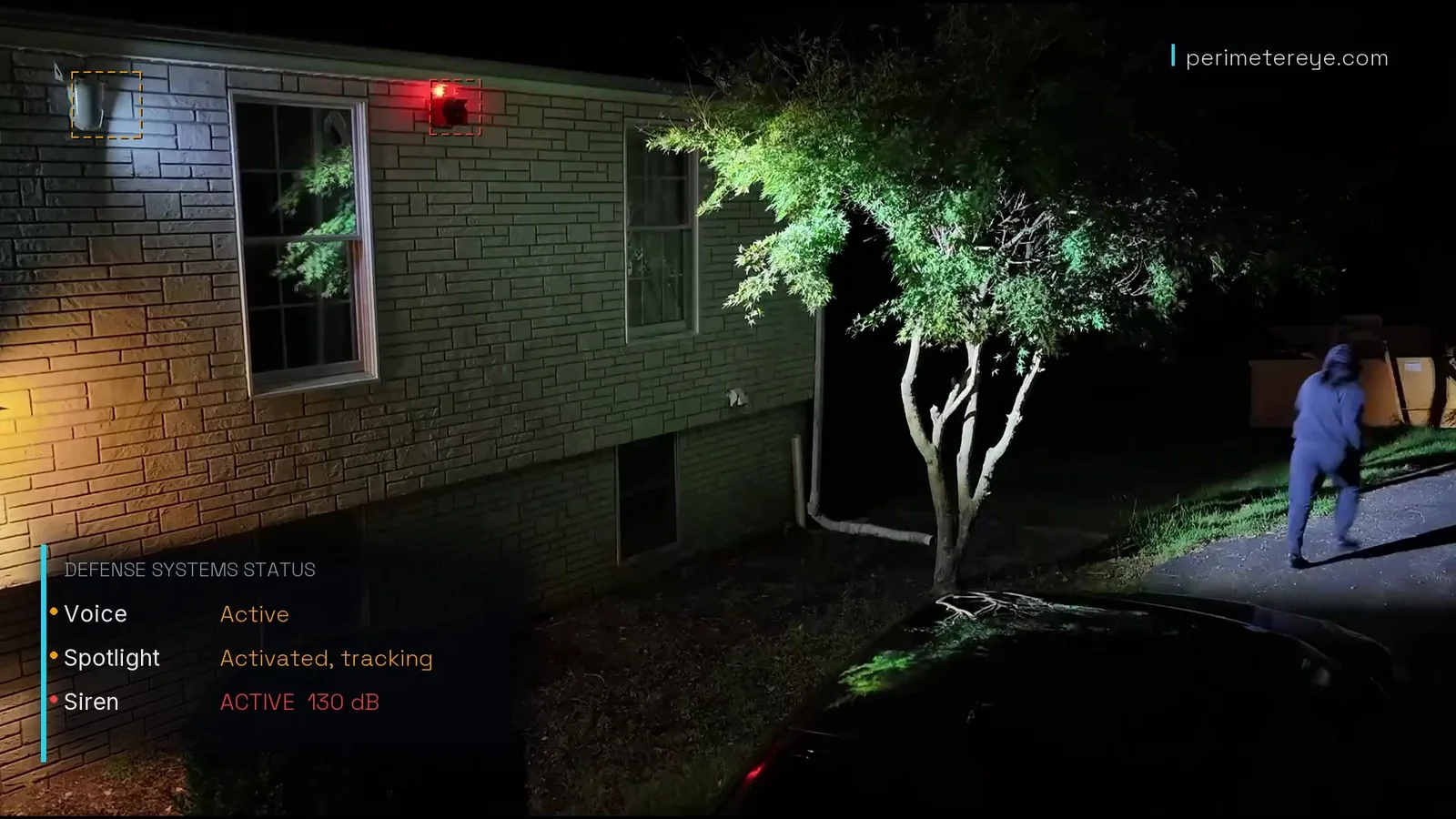
Stills from the demonstration with the system’s status on screen. Each part of the response switches on as the person keeps going, automatically.
1 of 4 · VoiceView full size
A warning with their description
The first response is spoken, and it is about them: “You, black hoodie, get away from the car now.” The searchlight and siren are on standby.
2 of 4 · SearchlightView full size
Then the light finds them
The person stays at the car, so the searchlight activates and tracks. They are lit up where they stand.
3 of 4 · SirenView full size
Then the 130 dB siren
The siren joins the voice and the light, and the person runs from the car.
4 of 4 · FollowedView full size
Followed as they go
The beam stays on them as they run past the tree, with every part of the response still active.
Filmed on a real property. The attempt was staged for filming; the system’s response was automatic, with no operator.
What the surveys actually found
The academic source is Kuhns and colleagues' 2013 UNC Charlotte study, "Understanding Decisions to Burglarize from the Offender's Perspective" — a survey of 422 incarcerated burglars, funded by AIREF, an alarm-industry research foundation (a bias worth noting, though dogs are not the funder's product). When burglars described how they selected targets, the top factors were the proximity of other people, escape routes, and signs of security — and inside that last bundle, dogs inside the home sat alongside alarm signs and outdoor cameras as a leading reason to move on.
The journalistic source is KGW-TV's 2017 project, in which reporter Kyle Iboshi surveyed 86 incarcerated burglars in Oregon. It is not peer-reviewed, but its findings converge: the strongest avoid signals were a car in the driveway, sound inside the house, and big, loud dogs. The same inmates reported that essentially all of them knocked or rang the doorbell first to test occupancy — which matters for dogs, as we will see.
Two different populations, two different methods, two different funders, one shared conclusion. In a literature this thin, that kind of convergence is rare, and it is the main reason dog deterrence deserves more credence than most of what circulates about signs and stickers.
Why dogs work: the mechanism, not the teeth
Watch what a dog actually does when a stranger approaches. It detects early — hearing and smell put it on alert before any human in the house knows anything is happening. It announces instantly: barking is noise, attention, and alarm rolled into one, audible to the intruder, the household, and the neighbors at the same moment. It positions, moving to the door or window nearest the threat. And it escalates — the longer the stranger stays, the louder and more agitated the response gets. There is no window where probing it produces silence.
Notice what is missing from that list: biting. The deterrent value is not primarily the prospect of injury — it is the certainty of being detected and confronted, loudly and immediately, with attention drawn from exactly the people a burglar least wants involved. Recall one of the UNC study's top target-selection factors: the proximity of other people. A barking dog manufactures that factor on demand. It converts a quiet empty house into a loud, watched one.
The UNC data has a second finding that rhymes with this. Over half of the surveyed burglars said that discovering an alarm mid-burglary would make them abort. Real-time confrontation interrupts crimes in progress — and a dog is real-time confrontation on four legs, running before any human decision gets made.
The honest limits of the dog evidence
Now the caveats, because this literature earns fewer decimal points than it usually gets. Both surveys are self-reports from burglars who were caught — the unsuccessful ones, by definition. The UNC study is industry-funded. The KGW sample is 86 people in one state, gathered by a newsroom. No randomized study of dog ownership and burglary exists, and probably never will. What we have is two consistent self-report surveys, not a measured effect size.
The qualifier in the Oregon data also matters: big and loud. A small, quiet dog produces little of the mechanism — less noise, less threat, less manufactured occupancy. And dogs can be defeated: distracted with food, soothed by calm familiarity, shut behind an interior door, or simply risked by someone determined enough. The surveys show dogs shift the odds meaningfully. They do not show dogs make a house untouchable.
What a dog cannot do
A dog's mechanism runs entirely at the property, which is also its ceiling. While you are away, it cannot tell you anything. It records nothing, describes no one, and produces no evidence a detective or an insurer can use. FBI data for 2024 shows daytime residential burglaries (216,601) outnumbering nighttime ones (174,053) — burglars work your work hours — so the most common scenario is a dog handling an intruder alone, with you learning about it from a mess hours later rather than a message in the moment.
The other scenario is worse. Bureau of Justice Statistics data found a household member was present in roughly 28% of burglaries. A confrontation between an intruder and your dog, with your family home, is not a plan — it is a gamble with stakes on both ends of the leash. Dogs also sleep, age, get sick, and travel with you, and the mechanism goes wherever they go.
Should you get a dog for deterrence?
No — get a dog because you want a dog. It is a ten-to-fifteen-year commitment of care, cost, training, and attention, and an animal acquired primarily as equipment tends to be shortchanged on all four. The deterrence is a real side effect of a well-kept dog, not a reason to acquire one.
But the surveys leave behind something useful either way: a specification. The thing that deters is not fur or teeth — it is an on-site responder that detects early, confronts immediately, and escalates for as long as the intruder stays. Write the mechanism down like that and an obvious question follows: can it be automated?
Automating the mechanism
That is precisely what an Automatic Property Defense System is engineered to do — reproduce the detect-confront-escalate loop without asking an animal to hold the line. Monitoring products watch and notify; the dog's whole lesson is that deterrence lives in what responds at the scene, in the moment.
PerimeterEye runs the loop in seconds. It verifies a person on the property, then a motorized searchlight locks onto them and physically follows them — 355 degrees of rotation, 90 of tilt, the effect homeowners compare to a police-helicopter beam. Then it speaks: live, targeted words describing the specific person in frame — "You, in the dark hoodie — you are not authorized to be on this property" — not a recording on a loop. If they stay, a 130 dB siren sounds and priority alerts with live video go to your phone, where you can watch, talk live, or take manual control. Detection, confrontation, escalation — the dog's mechanism, minus the nap schedule.
It even has the good dog's other trait: it knows the household. Family arrivals and the mail carrier never trigger deterrence, the same way your dog does not bark at your own kids. No security system can guarantee prevention of every incident — but the mechanism both burglar surveys point to can now run on watts instead of kibble.
Common questions
Do burglars really avoid houses with dogs?
The two best offender surveys say yes. Incarcerated burglars in the 2013 UNC Charlotte study ranked dogs inside among their top reasons to skip a target, and Oregon inmates surveyed by KGW-TV in 2017 named big, loud dogs one of the strongest avoid signals — alongside occupancy cues like cars and noise.
Does the dog's size or breed matter?
The Oregon inmates were specific: big and loud was the signal, not merely canine. A small quiet dog announces less and threatens nothing. That detail supports the mechanism theory — what deters is credible real-time detection and confrontation, so the more clearly a dog can detect and confront, the stronger the effect.
Is a beware-of-dog sign as good as a dog?
No. A sign is a claim, and offender surveys show burglars test claims — nearly all of KGW's Oregon inmates knocked or rang first. A knock that produces no barking answers the question the sign raised. Widely shared statistics about beware-of-dog signs have no locatable primary source, so treat them as folklore.
Can burglars get past a dog?
Yes. Dogs can be distracted with food, won over by calm familiarity, shut behind an interior door, or simply risked by someone determined enough. Dogs also sleep, age, and travel with the family. The surveys show dogs shift odds meaningfully — they do not show dogs make a home untouchable.
Should I get a dog for home protection?
Get a dog because you want a dog. It is a ten-to-fifteen-year commitment of care, cost, and attention, and using one primarily as equipment shortchanges both of you. If what you actually want is the deterrence mechanism — detect, confront, escalate in real time — that can now be automated.
What it costs
See what a system costs for your property.
Essential system
As low as$146/mo*Essential covers a driveway and the approaches to the house. Larger properties usually suit Advanced or Estate; a specialist can size it with you before you order.
What’s included
- 5 ultra-HD 4K cameras
- 1 tracking spotlight
- 1 speaker/siren unit
- PerimeterEye Access intercom, included with every complete system
- 1 PerimeterEye control panel
- 1 PerimeterEye AI processor
*Essential system, $0 down: 36 monthly payments of $145.17 at 10% APR on the hardware price before sales tax, shown rounded up to the dollar. Affirm rates 0–36% APR; Klarna terms are shown at checkout. Subject to eligibility and lender approval; your rate, term and down payment may differ. US only; not available in all states. Software is billed separately: first 6 months included, then $99/month.
The mechanism, without the dog
PerimeterEye detects, confronts, and escalates in seconds — a searchlight that follows, a live targeted voice, a 130 dB siren — while alerts and live video go straight to you.