Does Ring prevent break-ins?
There is no solid evidence that Ring or any video doorbell prevents break-ins. The widely repeated claim that Ring cut burglaries 55% in a Los Angeles pilot came from Ring's own 2016 announcement; Ring never released the data behind it, and the one independent test MIT Technology Review found showed no benefit. The mechanical reason is simple: a notification is not an intervention.
None of that makes a video doorbell a bad purchase — it makes it a mislabeled one. Doorbells are genuinely good at packages, visitors, and evidence, and this article gives them full credit for all three. What they are not is a break-in prevention device, and the gap between those two jobs is best seen by walking a burglary past one, second by second.
Along the way: where the famous 55% number came from and why you should never repeat it, what researchers find when they go looking, and what the industry's own product roadmap quietly admits.
What this looks like on a real property
Same camera. A different outcome.
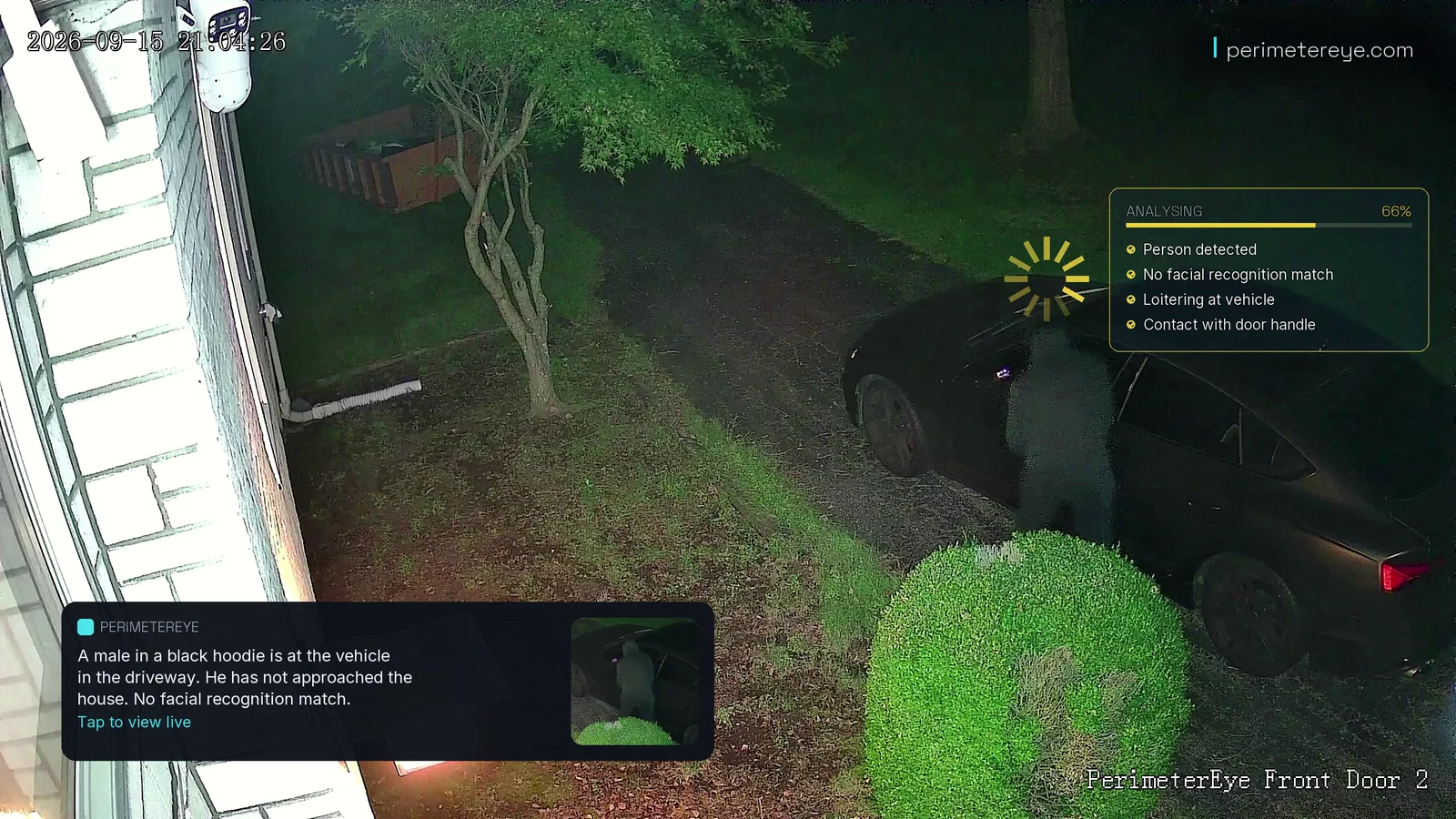
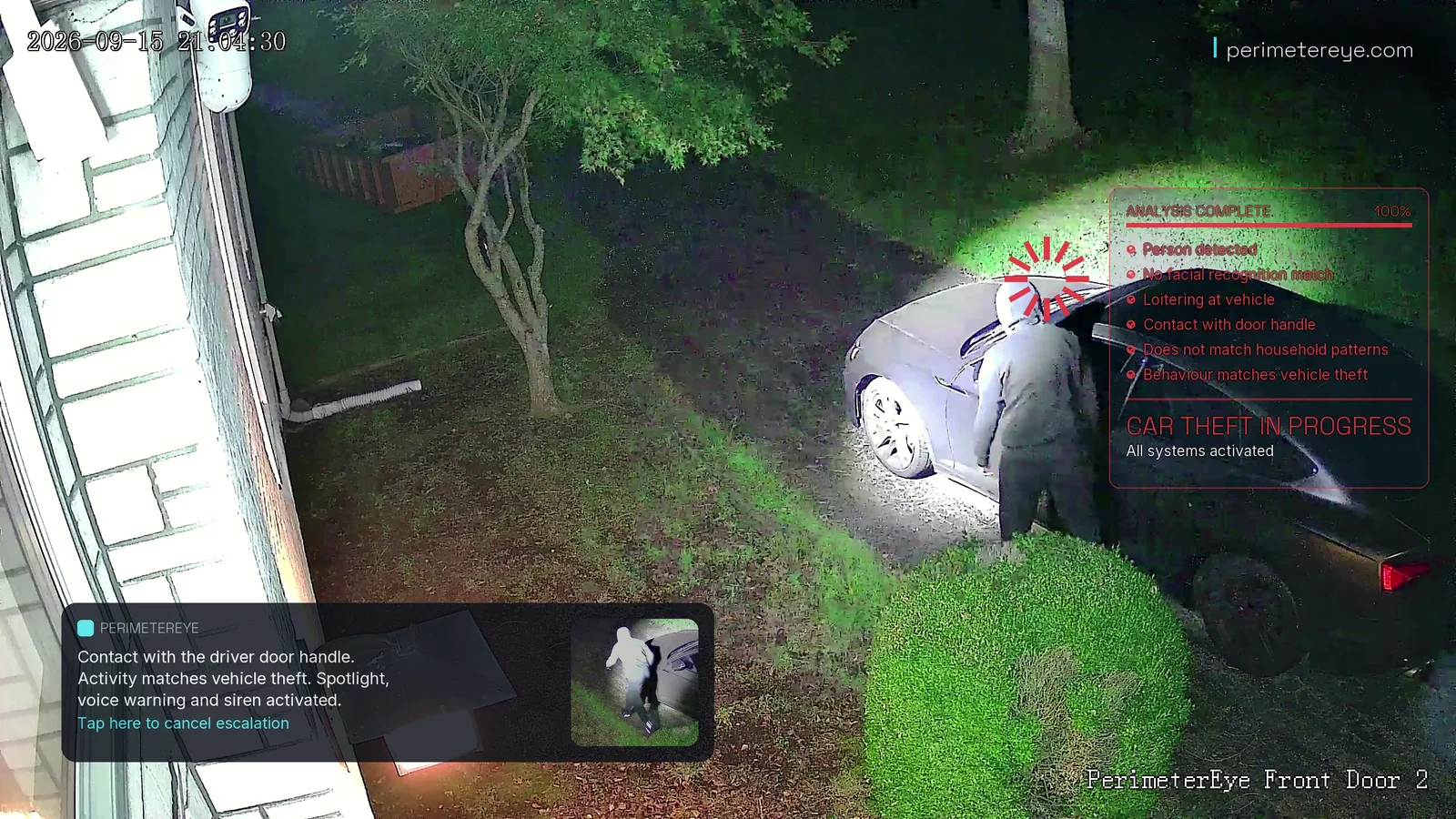
One camera and one staged break-in, shown three ways: the view on its own, with PerimeterEye’s analysis, and with its response hardware.
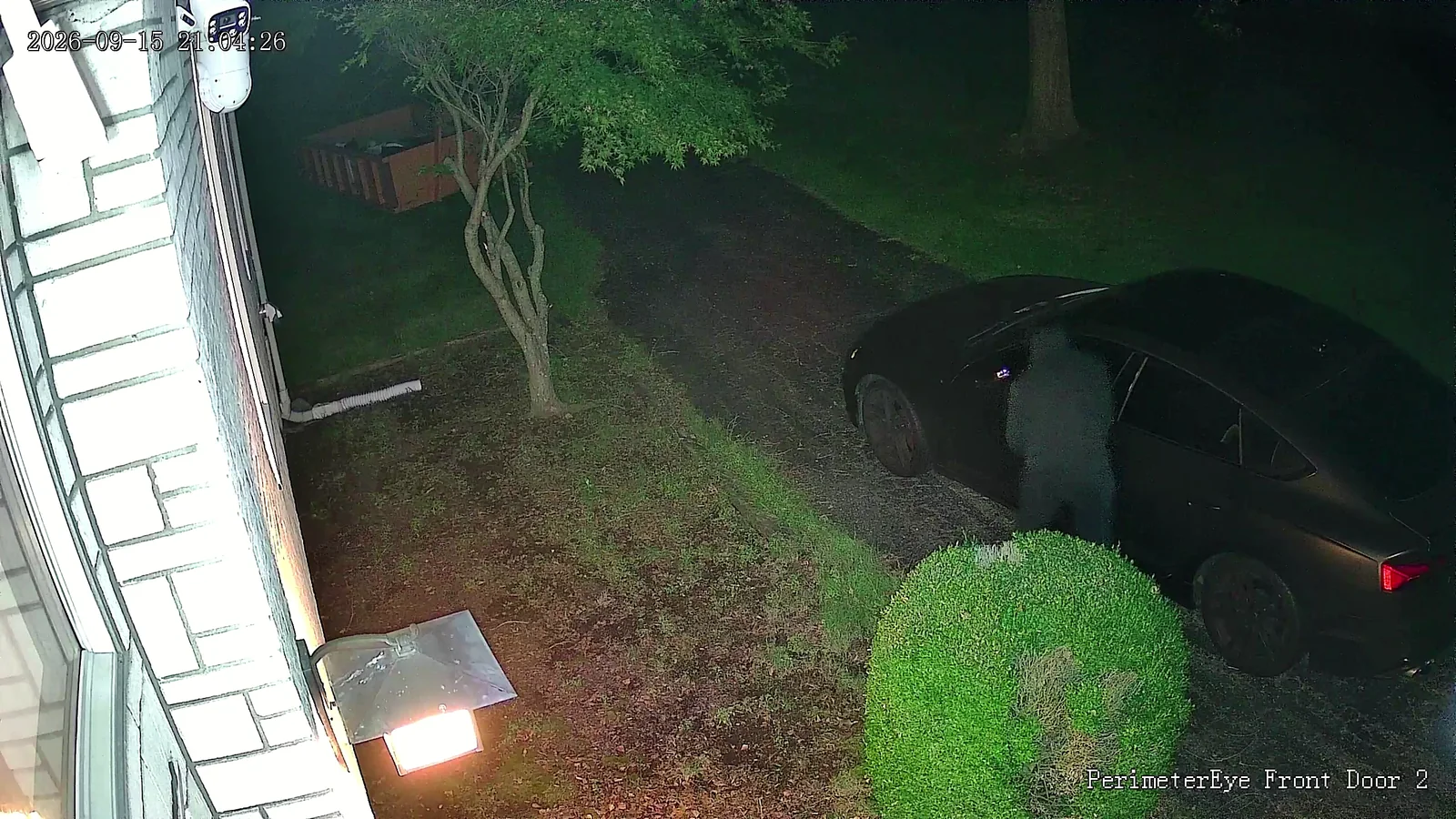
1 of 3 · A camera aloneView full size
It records
A person at the driver’s door, on a camera that records. Unless someone opens the clip in time, nothing else happens.
2 of 3 · UnderstoodView full size
The same view, understood
PerimeterEye reads the same moment: a person, no match to anyone it knows, loitering at the vehicle, contact with the door handle. The alert describes them in plain language.
3 of 3 · AnsweredView full size
The same view, answered
With a tracking searchlight, a siren, and AI voice warnings, the camera’s view directs a response. Four seconds later, the searchlight is on the person at the driver’s door.
Stills from a vehicle break-in staged for filming on a real property, on the Front Door 2 camera’s clock (21:04:26 and 21:04:30). The system’s response was automatic, with no operator.
The 55% claim, and why it cannot be verified
For years, the most quoted statistic in the video-doorbell world was that Ring cameras cut burglaries 55% in a Los Angeles neighborhood pilot. Ring installed about 40 doorbells in the Wilshire Park neighborhood starting in 2015 and announced the result in March 2016, at a joint press event with the LAPD. The number traveled from there into news coverage and a thousand blog posts. But Ring never released the data or methodology behind it; when MIT Technology Review asked in 2018, the company would not supply any.
The LAPD's own follow-up analysis, covering ten months from July 2015, found a 21% year-over-year decline — 42% after adjusting for the surrounding area — and in 2017 Wilshire Park had more burglaries than in any of the previous seven years. The only test MIT Technology Review found that was run independently of Ring, in West Valley City, Utah, found the neighborhood without the doorbells fared better. If the effect were large, someone should have been able to point at it.
So retire the 55% number entirely. It is not a weak statistic; it is an unverifiable one, and any article still citing it as fact has told you something useful about its sourcing standards.
What researchers find when they go looking
The independent picture is thin: the few attempts to link video doorbells to measurable reductions in break-ins have come up empty or inconclusive. Honest hedges apply — crime studies are genuinely hard, adoption is uneven across neighborhoods, and absence of evidence is not proof of no effect. But after years of mass deployment, the burden of proof sits squarely on the claim, and the claim keeps failing to meet it.
The verified offender research assigns cameras a modest, mixed role rather than a protective one. In the 2013 UNC Charlotte survey of 422 incarcerated burglars (industry-funded, and disclosed as such), outdoor cameras appear inside the broader "signs of security" bundle that burglars weigh — real, but well below occupancy and escape routes. And in KGW-TV's 2017 interviews with 86 Oregon inmates, cameras cut both ways: a deterrent to some, a hint of valuables inside to others.
In other words: even the most camera-favorable data treats a camera as one cue among many, not a wall. The doorbell's specific problem is what it does after the cue fails.
The mechanical problem: a notification is not an intervention
Strip the branding and a video doorbell does three things: watches one narrow approach to the house, records what crosses it, and sends a push notification. Everything beyond that routes through a distant human — you — noticing the notification, judging it correctly, and doing something useful about it, remotely, in time to matter.
Each link in that chain is weak at exactly the wrong moment. FBI data for 2024 shows daytime residential burglaries (216,601) outnumbering nighttime ones (174,053): burglars work your work hours, which means the notification lands where you are — a meeting, a commute, a phone on silent — not where the burglary is. The doorbell's output is information. The break-in is a physical event. Nothing in the product converts one into the other.
A break-in, second by second, against a doorbell
Run the standard residential burglary past a doorbell and watch what it contributes at each step:
Nothing malfunctioned in that timeline. That is the point. The product did its job at every step — and its job was documentation and messaging, not intervention. The chime rang, the clip saved, the notification sent. The burglary proceeded.
- 0:00 — The knock. Essentially all of KGW's Oregon inmates knocked or rang first to test occupancy. This is the doorbell's best moment: if you notice the alert within seconds and answer, the house reads occupied
- 0:40 — No answer. He steps off the porch and around the side of the house. The doorbell's field of view ends at the porch; so does its participation
- 1:30 — Side door or window. Most of KGW's inmates entered through unlocked doors and windows. If other cameras exist, more notifications queue on a phone that is in a meeting with you
- 2:30 — Inside. If anyone is home — BJS found a household member present in roughly 28% of burglaries — a notification buzzing in your pocket at work does nothing for them
- 5:00 — You see your phone. You are now watching a recording of someone who has been inside for minutes. You can call 911 and narrate footage. The doorbell has done everything it was designed to do
What video doorbells are genuinely good at
Fairness requires the other column, because it is real. Package theft is the doorbell's home turf: SafeWise's 2025 survey of 7,500 US adults found 31% had a package stolen in the past twelve months, with a median loss of $143, and the USPS Office of Inspector General's May 2025 whitepaper stands as the strongest federal source on the problem. A doorbell documents porch theft, guides deliveries, and occasionally identifies a repeat offender for an entire street.
The occupancy knock is the other genuine win. Since burglars overwhelmingly ring first, a doorbell you answer quickly — from anywhere — lets the house pass the test it is actually being given. Add everyday visitor screening and evidence quality that police reports and insurance claims can actually use, and the verdict writes itself: a video doorbell is worth having for what it does. Just be precise about what that is.
The industry's own answer: add humans, monthly
The clearest evidence that notifications alone fall short comes from the notification vendors themselves, all of whom now sell response as an upgrade. As of mid-2026: Ring offers Virtual Security Guard, a professional-agent add-on around $99 a month; SimpliSafe's Active Guard tier, around $80 a month for 24/7 coverage, adds human agents who can intervene through up to three outdoor cameras; Deep Sentinel builds its entire product on live guards in a surveillance center, from roughly $100 a month; Alarm.com introduced an automated AI deterrence service, AID, at CES 2025; and RAD launched its RADCam talking camera in 2024.
These are competent monitoring companies making a rational admission: watching and notifying was never the whole job, so they are renting you the missing piece — a human, or lately an AI, that can act while the event is happening. The market has priced the gap this article describes at roughly eighty to a hundred dollars a month, indefinitely.
Acting at the property, in seconds
If you typed "does Ring prevent break-ins" into a search bar, you were probably shopping the home security aisle for something that goes beyond notifying you. Everything in that aisle — Ring, Nest, ADT, SimpliSafe, and the rest — watches, records, and notifies, and does it competently; the premium tiers add a person who responds from somewhere else. PerimeterEye belongs to a different category: an Automatic Property Defense System, which acts on the property itself, in seconds, automatically, while you watch live. PerimeterEye is not an alarm-monitoring service — alerts and control go directly to you.
Replay the timeline. The knock still happens — but the system has already verified the person, and it knows the household, so a delivery or a family arrival passes quietly. A stranger who steps off the approved path gets a different property: a motorized searchlight locks onto them and physically follows them, a live targeted voice describes them specifically — the person, the clothing, the location — and if they stay, a 130 dB siren sounds while priority alerts with live video reach your phone. You can watch, talk live, or take manual control at any point, and there is nothing to arm or disarm.
No security system can guarantee prevention of every incident. The claim here is narrower and checkable: during those first two minutes — the only minutes that matter — something happens at the scene, in light and voice and sound, instead of only in your pocket.
Common questions
Did Ring really cut burglaries 55% in Los Angeles?
Not verifiably. Ring announced the figure in 2016 after a small pilot in LA's Wilshire Park, but never released the data or methodology behind it. The LAPD's own analysis of a longer period found a 21% year-over-year decline, and an independent test in West Valley City, Utah found no benefit (MIT Technology Review, 2018).
Do video doorbells deter burglars at all?
Possibly at the margin. Incarcerated burglars in the 2013 UNC Charlotte survey counted visible cameras among the security signs they weighed, but Oregon inmates in KGW's 2017 reporting also read cameras as a hint of valuables inside. We know of no independent study showing that video doorbells measurably prevent break-ins.
Is a video doorbell still worth having?
Yes, for what it actually does. It documents package theft — which 31% of Americans experienced in the past year per SafeWise's 2025 survey — lets you answer the door from anywhere, screens visitors, and produces evidence police and insurers can use. Just don't buy it expecting it to prevent break-ins.
What is the difference between notification and intervention?
A notification tells a distant human something happened and hopes they respond in time. An intervention changes conditions at the scene during the event — light on the person, a voice addressing them, a siren. In the UNC Charlotte survey, over half of burglars said discovering an alarm mid-burglary would make them abort.
Can answering the doorbell remotely stop a break-in?
Sometimes, if the timing works. Nearly all burglars in KGW's Oregon survey knocked or rang first to test occupancy, so answering quickly can make a house read occupied. But that depends on you noticing the alert within seconds, and it does nothing once someone moves past the door to a side entry.
Sources
- KGW-TV, "We asked 86 burglars" (Kyle Iboshi, 2017)
- Kuhns et al., Understanding Decisions to Burglarize from the Offender's Perspective (UNC Charlotte, 2013, AIREF-funded)
- FBI Crime in the Nation 2024, FBI Crime Data Explorer
- BJS, Victimization During Household Burglary (2010)
- SafeWise 2025 Package Theft Report
- USPS Office of Inspector General, whitepaper RISC-WP-25-002 (May 2025)
- MIT Technology Review, "Video doorbell firm Ring says its devices slash crime—but the evidence looks flimsy" (October 2018)
What it costs
See what a system costs for your property.
Essential system
As low as$146/mo*Essential covers a driveway and the approaches to the house. Larger properties usually suit Advanced or Estate; a specialist can size it with you before you order.
What’s included
- 5 ultra-HD 4K cameras
- 1 tracking spotlight
- 1 speaker/siren unit
- PerimeterEye Access intercom, included with every complete system
- 1 PerimeterEye control panel
- 1 PerimeterEye AI processor
*Essential system, $0 down: 36 monthly payments of $145.17 at 10% APR on the hardware price before sales tax, shown rounded up to the dollar. Affirm rates 0–36% APR; Klarna terms are shown at checkout. Subject to eligibility and lender approval; your rate, term and down payment may differ. US only; not available in all states. Software is billed separately: first 6 months included, then $99/month.
From notification to intervention
See how PerimeterEye replays that same timeline — a searchlight locked on at the first verified stranger, a live voice calling them out, a 130 dB siren behind it — while you watch live from anywhere.