Signs Someone Is Casing Your House — and What to Do About It
The classic signs someone is casing your house: the same unfamiliar car passing slowly at odd hours, a stranger knocking with a flimsy excuse, someone photographing homes or lingering on foot, and tested door handles or gate latches. Respond by documenting plates, times, and descriptions, calling the police non-emergency line, and removing every signal that the house sits unwatched.
Casing is reconnaissance. Before many residential burglaries, someone checks the target — sometimes for thirty seconds from a slow-rolling car, sometimes over days of walking a dog past your fence. It works for one simple reason: almost no property reacts. The scout learns your schedule, your sightlines, and your habits at zero risk, because nothing about the house tells them they have been noticed.
This is a playbook, not a lecture: what to do right now, tonight, and this week — in that order.
What this looks like on a real property
Three seconds from the alert to the searchlight.
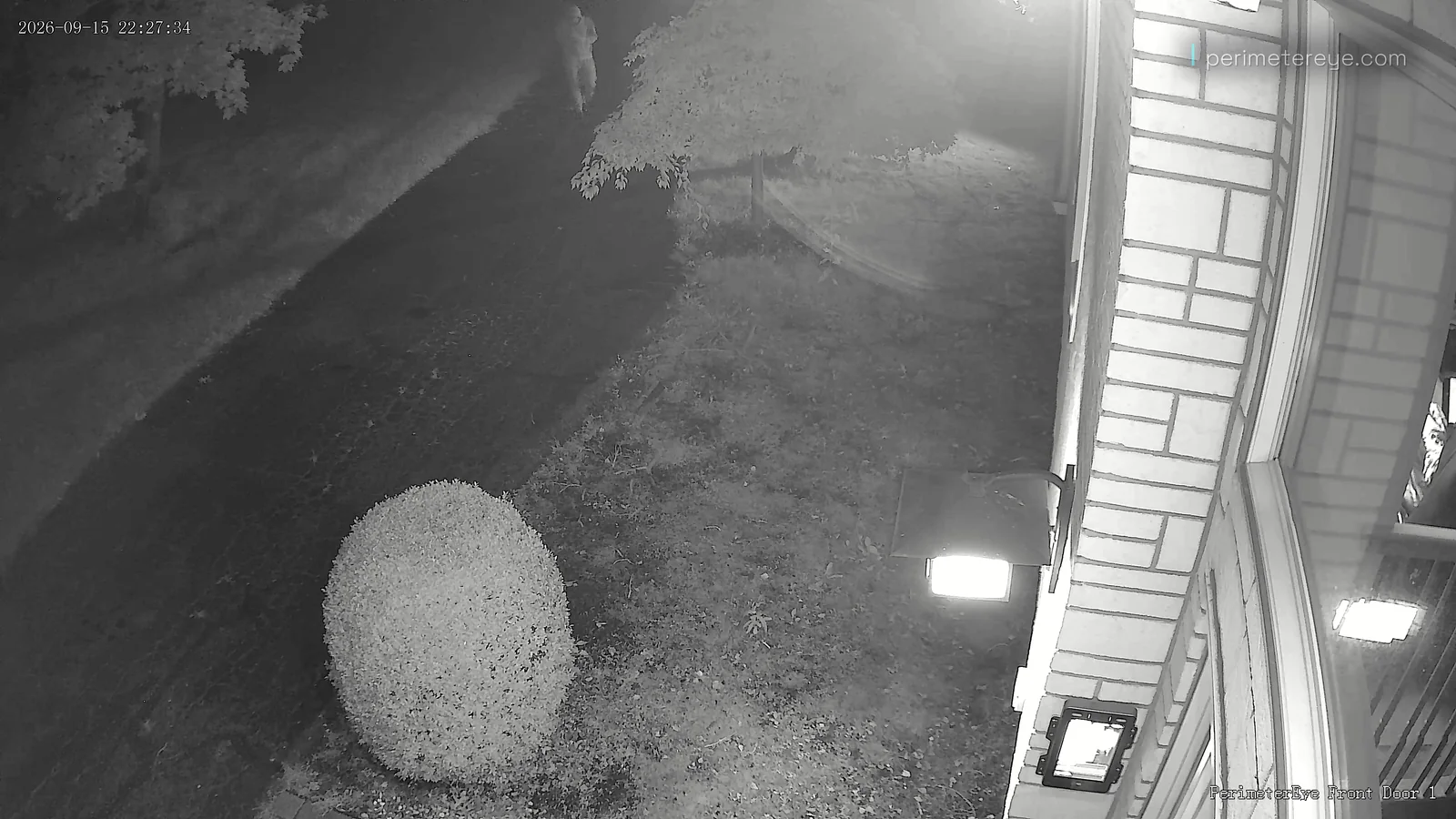
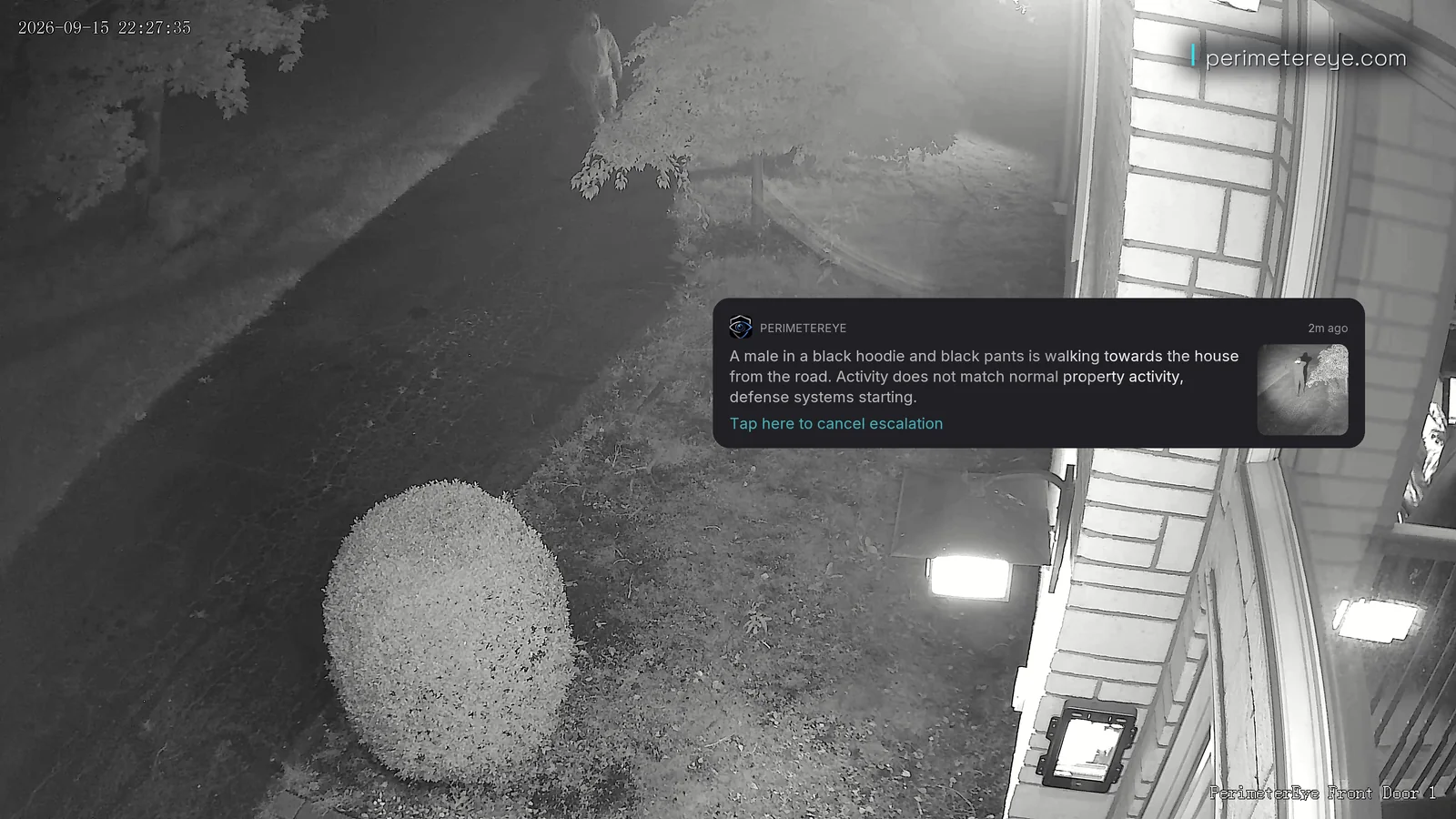
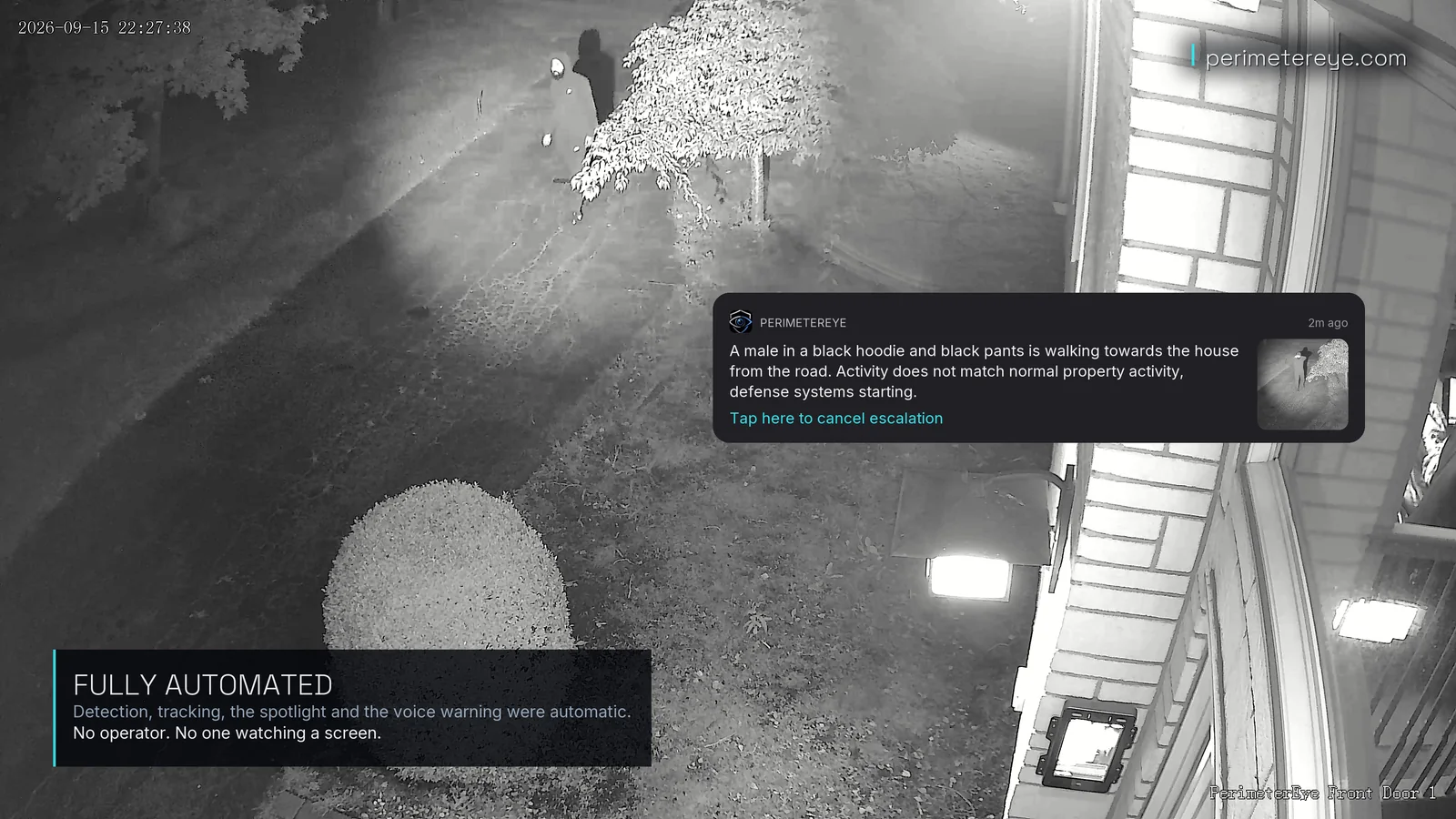
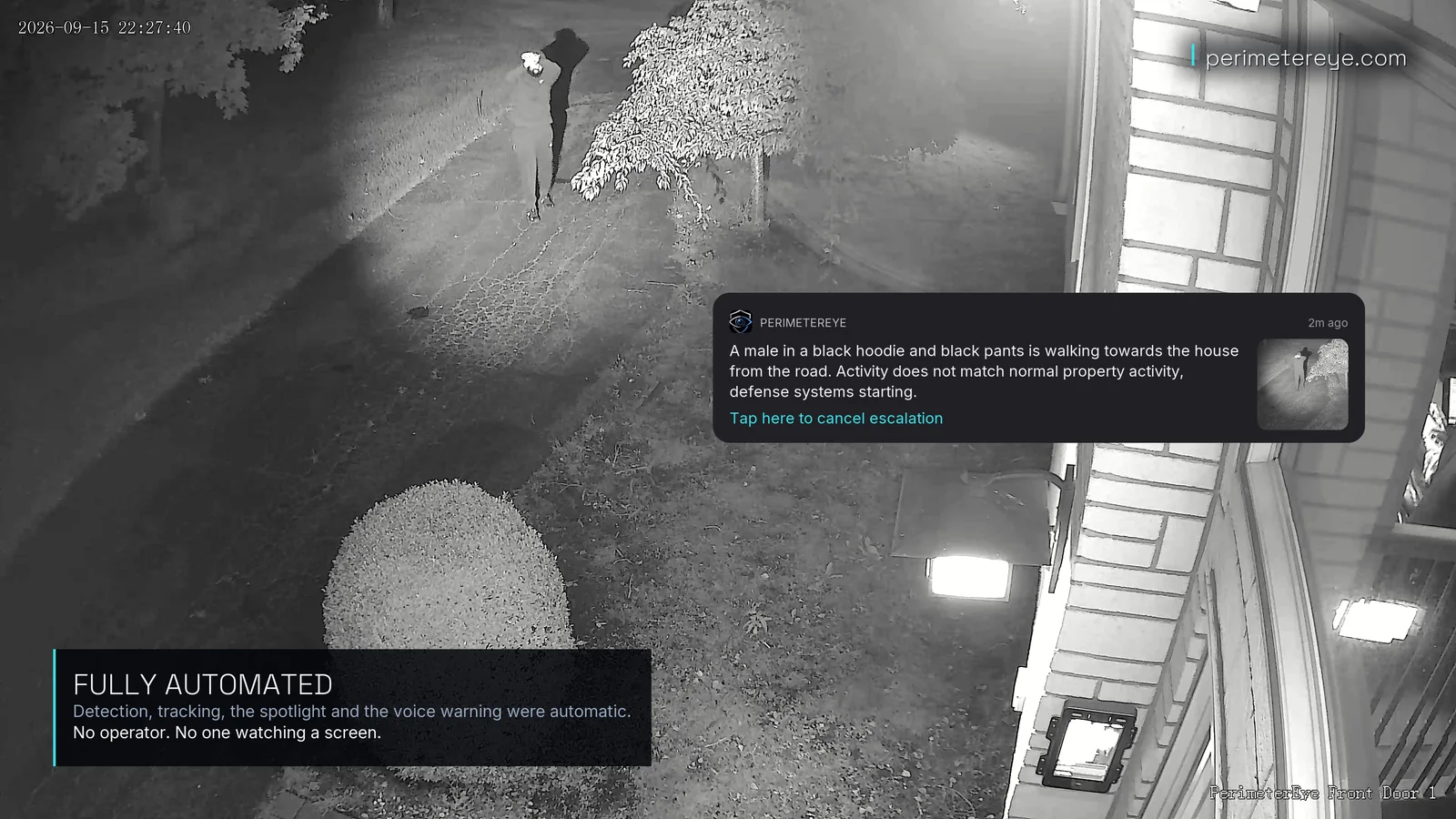
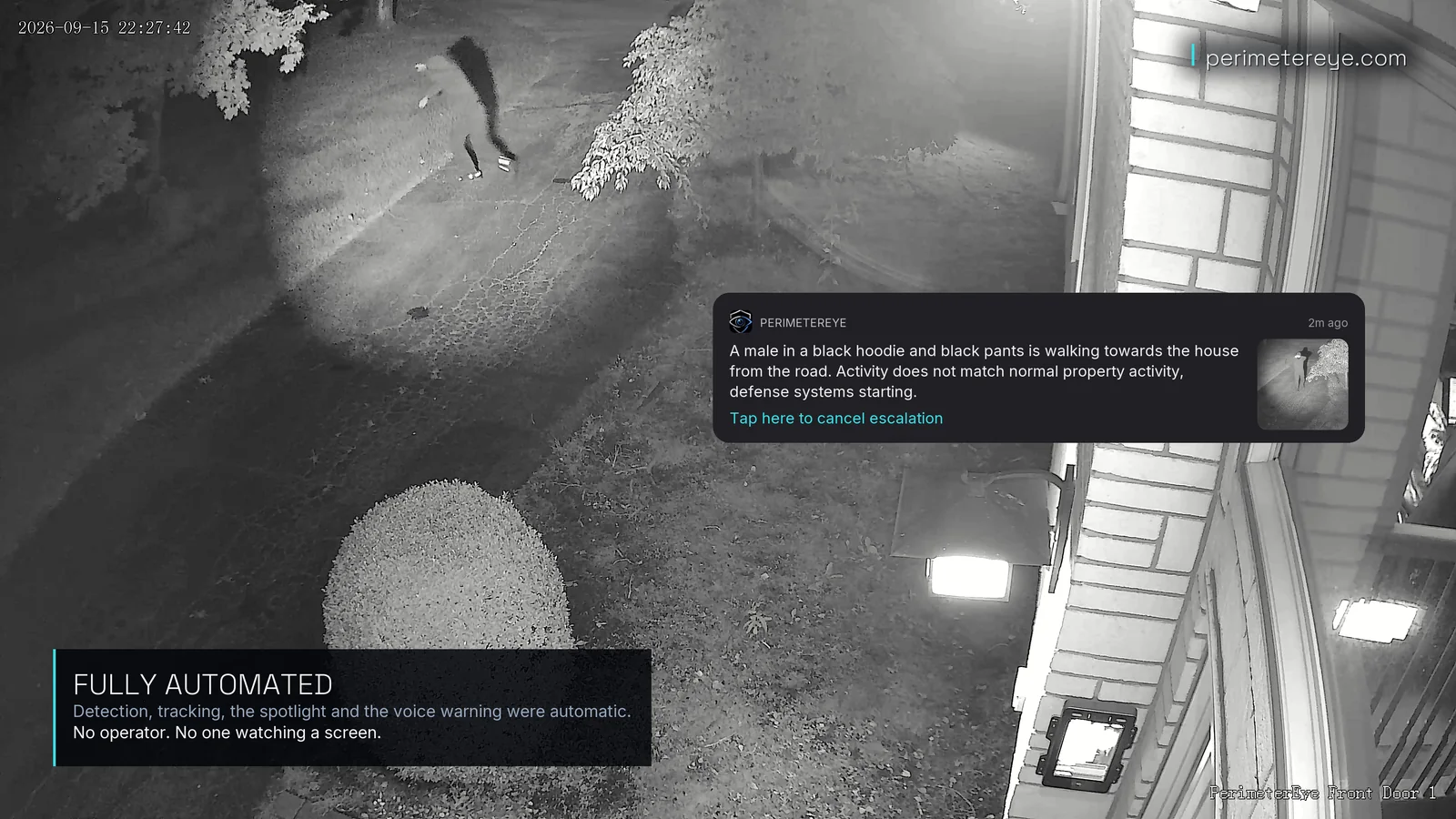
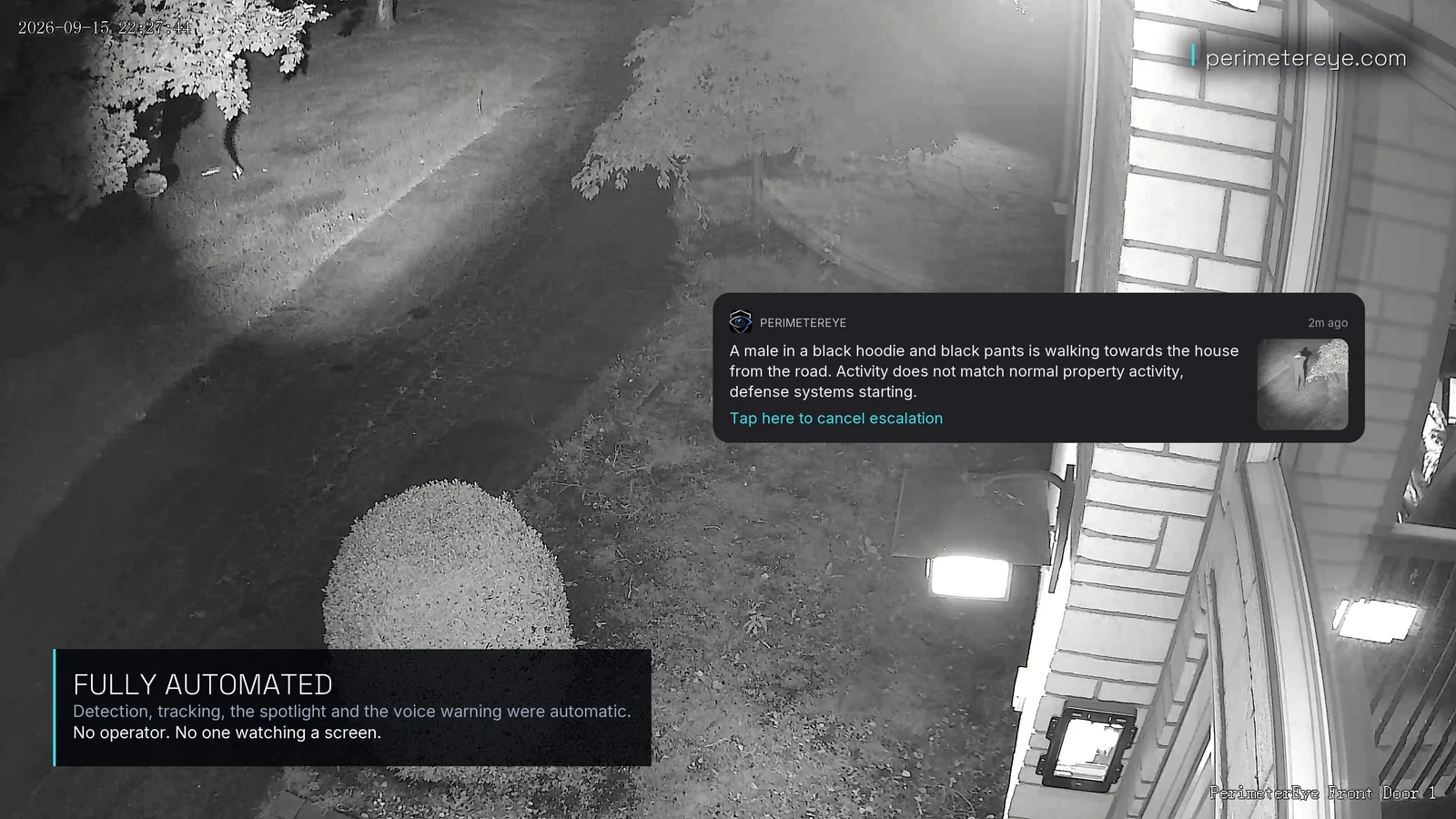
Front Door 1, on the camera’s own clock. The person is visible at the road end at 22:27:34, the alert describes them at 22:27:35, and the searchlight is on them at 22:27:38. By 22:27:42 they are turning away.
1 of 6 · 22:27:34View full size
Walking in from the road
At the far end of the driveway, in the dark, the person is already in view of the camera.
2 of 6 · 22:27:35View full size
The alert
The alert reads: walking towards the house from the road; activity does not match normal property activity; defense systems starting.
3 of 6 · 22:27:38View full size
In the searchlight
Three seconds after the alert, the searchlight is on the person by the tree. Detection, tracking, the light, and the voice warning were all automatic.
5 of 6 · 22:27:42View full size
Turning away
Four seconds in the light, and the person turns away from the house. The beam goes with them.
6 of 6 · 22:27:44View full size
Followed off the lawn
The searchlight stays on them to the edge of the camera’s view.
Filmed September 15, 2026, on a real property with PerimeterEye cameras and a searchlight. The approach was staged for filming; the system’s response was automatic, with no operator.
What casing actually looks like
No single sighting proves anything. Casing is a pattern, and the pattern is what you should watch for. A lost driver passes once; a scout passes three times in a week, always slowly, always looking at houses instead of the road.
Trust the pattern, not your embarrassment. Most people talk themselves out of reporting because each individual sighting seems innocent on its own. Write everything down and let the accumulated pattern speak for itself.
- The same unfamiliar vehicle passing slowly at odd hours, pausing near driveways, or parked with the engine running and nobody getting out
- A knock or doorbell ring from a stranger with a thin story — wrong address, vague survey, a lost pet with no flyer, an unsolicited contractor quote
- Someone on foot who studies windows, side gates, and garage doors instead of the sidewalk ahead of them
- A person photographing homes or lingering on a phone directly in front of yours
- A side gate found open that you know you latched, or a door handle that has clearly been tried
- New faces — workers, canvassers, movers next door — who ask about your schedule, your travel plans, or who else lives in the house
The knock is the tell
In 2017, KGW-TV journalist Kyle Iboshi surveyed 86 incarcerated burglars in Oregon. It was journalism, not peer-reviewed research, but one finding was nearly unanimous: essentially all of them knocked or rang the doorbell first to test whether anyone was home. If someone answered, they had an excuse ready and walked away. If nobody answered, they went around back.
So the strange knock deserves far more weight than most people give it. Someone who seems startled that you answered, whose story dissolves under one follow-up question, or who cranes to look past you into the house has just run the cheapest test in burglary. Note the time, what they said, what they wore, and which direction they left.
Right now: write it down
Start a log today, even if you feel silly doing it. For vehicles: the plate (even partial), make, model, color, dents or stickers, direction of travel, and the exact time and date of every sighting. For people: height, build, clothing, and precisely what they did — knocked, paused at the gate, walked the fence line, photographed the house.
Photos and video taken from inside your home are fine and useful. Do not confront anyone, and do not follow the car. A confrontation risks escalation and teaches the scout exactly what you have noticed; a quiet, dated log turns a vague feeling into something police can act on, and it lets your neighbors' sightings link to yours.
Tonight: call the non-emergency line
If someone is actively trying doors or windows, entering your yard at night, or refusing to leave — that is 911, right now. A pattern of suspicious passes and knocks is a call to the police non-emergency line: report the pattern, offer your log, and ask them to note your address for extra patrol. Departments genuinely use these reports to connect burglary crews to neighborhoods, and your call may be the third one about the same sedan.
Post to the neighborhood group too, but keep it factual: plate, vehicle, times, behavior. Skip the accusations and theories — descriptions age well, speculation doesn't. Ask whether anyone else has the same vehicle in their doorbell footage. Casing rarely targets a single house.
This week: remove the giveaway signals
A scout is reading your property for one message: nobody is paying attention. The research on how burglars choose targets backs this up. Kuhns et al. (2013), a UNC Charlotte survey of 422 incarcerated burglars funded by the industry-backed Alarm Industry Research and Educational Foundation, found the top target-selection factors were the proximity of other people, escape routes, and visible signs of security — and roughly 83% said they would try to determine whether an alarm was present before proceeding.
None of this is exotic. It is simply removing the free information the scout came to collect.
- Stop the pile-ups: mail, packages, and bins left at the curb days after pickup all announce absence
- Put interior lights on a varied schedule instead of leaving a dark house at the same hour every evening
- Close the garage door; put ladders and tools away where they can't be seen or borrowed
- Don't post travel plans publicly while you're still away
- Keep a car in the driveway when you can — in the KGW survey, a car in the driveway was one of the strongest avoid signals burglars named
Tighten what's visible
Visible layers change the scout's risk calculation: exterior lighting on the approaches, locked side gates, trimmed shrubs that eliminate hiding spots near windows, and cameras the scout can see. Be honest about the limits, though. Signs and stickers alone are weak — easily discounted as bluff — and a camera that only records interrupts nothing. It documents.
The Kuhns survey is instructive here too: about 60% of burglars said they would seek another target if they discovered an alarm, and over half said they would abort a burglary already in progress. The finding underneath the numbers is that burglars respond to what a property does — and the earlier the response arrives, the cheaper the outcome for you.
How a property fails the casing test on purpose
Everything above raises the cost of casing. A property-defense system breaks the method itself. PerimeterEye — an Automatic Property Defense System, not a camera kit — writes a plain-language analysis of every event on every camera, so the white sedan's third slow pass this week exists as a documented, time-stamped pattern with 4K stills you can hand straight to the non-emergency line.
And when that vehicle noses into the driveway, or its passenger steps onto the property, the property reacts in seconds: a motorized searchlight locks on and physically follows them, and a live AI voice addresses them specifically — describing that person, out loud, in the moment. The scout's entire method depends on the property staying silent. Measured against the burglar's own checklist — signs of security, proximity of other people — a house that names the loiterer and tracks him with a light reads as the most expensive target on the street. It knows the household, so family arrivals and the mail carrier never trigger any of it. No security system can guarantee prevention of every incident, but casing only works on properties that don't react.
Common questions
Should I call 911 or the non-emergency line about someone casing my house?
Call 911 if anything is happening right now — someone trying doors or windows, entering your yard at night, or refusing to leave. Use the non-emergency line for patterns: repeated slow drive-bys, suspicious knocks, a loitering vehicle. Bring dates, times, plate numbers, and descriptions, and ask them to log your address for extra patrol.
Is casing a house illegal?
Driving past a house or knocking on a door is not a crime by itself, which is exactly why scouts do it. But trespassing, prowling at night, and peering into windows are offenses in most places, and a documented pattern gives police grounds to make contact. Report the pattern and let officers decide the rest.
What details do police actually need?
License plates, even partial ones, are the most valuable single detail. After that: vehicle make, model, color, and distinguishing marks; the date and time of every sighting; person descriptions covering height, build, and clothing; and exactly what each person did. Camera clips help. A written log covering a week beats a vague single phone call.
Should I confront someone I think is casing my house?
No. Confrontation risks escalation and teaches the scout precisely what you have noticed and what you haven't. Observe from inside, photograph or film through the window, and write everything down. If they come to the door, you can answer through an intercom or the closed door. Beyond that, let the police make contact.
How long do burglars case a house before breaking in?
There is no reliable published number — it ranges from a single slow drive-by minutes before entry to weeks of learning a neighborhood's rhythms. In the KGW survey of 86 burglars, nearly all tested occupancy with a knock immediately beforehand, so the casing can be seconds long. Treat any pattern as current and act the same week.
Related reading
What it costs
See what a system costs for your property.
Essential system
As low as$146/mo*Essential covers a driveway and the approaches to the house. Larger properties usually suit Advanced or Estate; a specialist can size it with you before you order.
What’s included
- 5 ultra-HD 4K cameras
- 1 tracking spotlight
- 1 speaker/siren unit
- PerimeterEye Access intercom, included with every complete system
- 1 PerimeterEye control panel
- 1 PerimeterEye AI processor
*Essential system, $0 down: 36 monthly payments of $145.17 at 10% APR on the hardware price before sales tax, shown rounded up to the dollar. Affirm rates 0–36% APR; Klarna terms are shown at checkout. Subject to eligibility and lender approval; your rate, term and down payment may differ. US only; not available in all states. Software is billed separately: first 6 months included, then $99/month.
Make your property fail the casing test
PerimeterEye acknowledges the scout out loud — a tracking searchlight and a live, targeted voice — and hands you a documented pattern for police while you watch live from anywhere. Casing depends on silence; take the silence away.