Car Broken Into in Your Driveway? Here's How to Stop It
Most driveway car break-ins are handle-pulls: someone walks the street at 2 a.m. lifting door handles and taking whatever unlocked cars offer. Lock every door every night, leave nothing visible inside, light the driveway, and report every incident — then make your driveway the one that reacts instead of just recording.
It rarely feels worth reporting — a rifled glovebox, some change, maybe a bag — but driveway car prowls are a volume crime, and volume crimes are pattern crimes. The crew that pulled your handle worked the rest of the block the same night, and the streets that change nothing get visited again.
What this looks like on a real property
Five seconds from the door handle to running away.
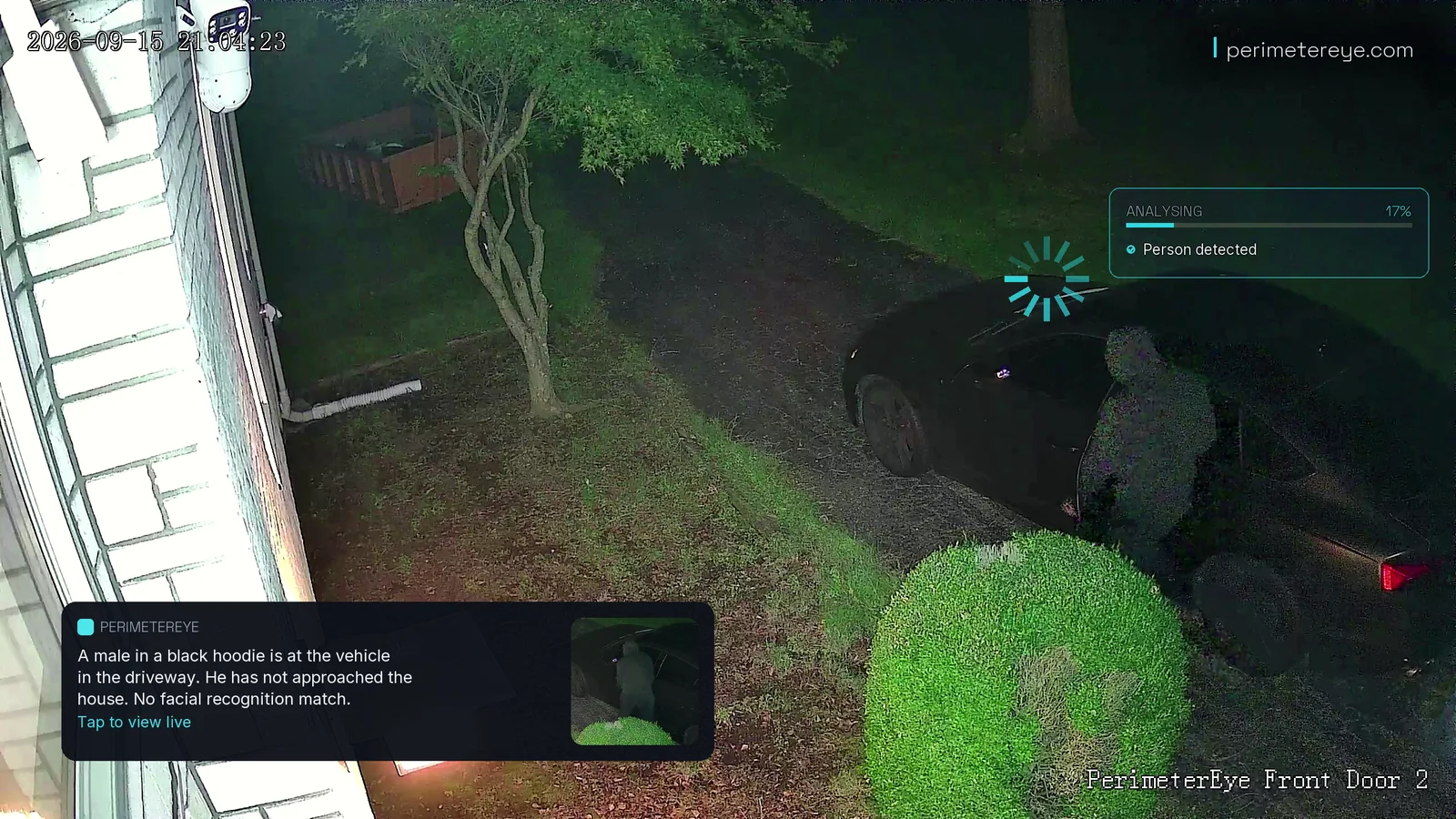
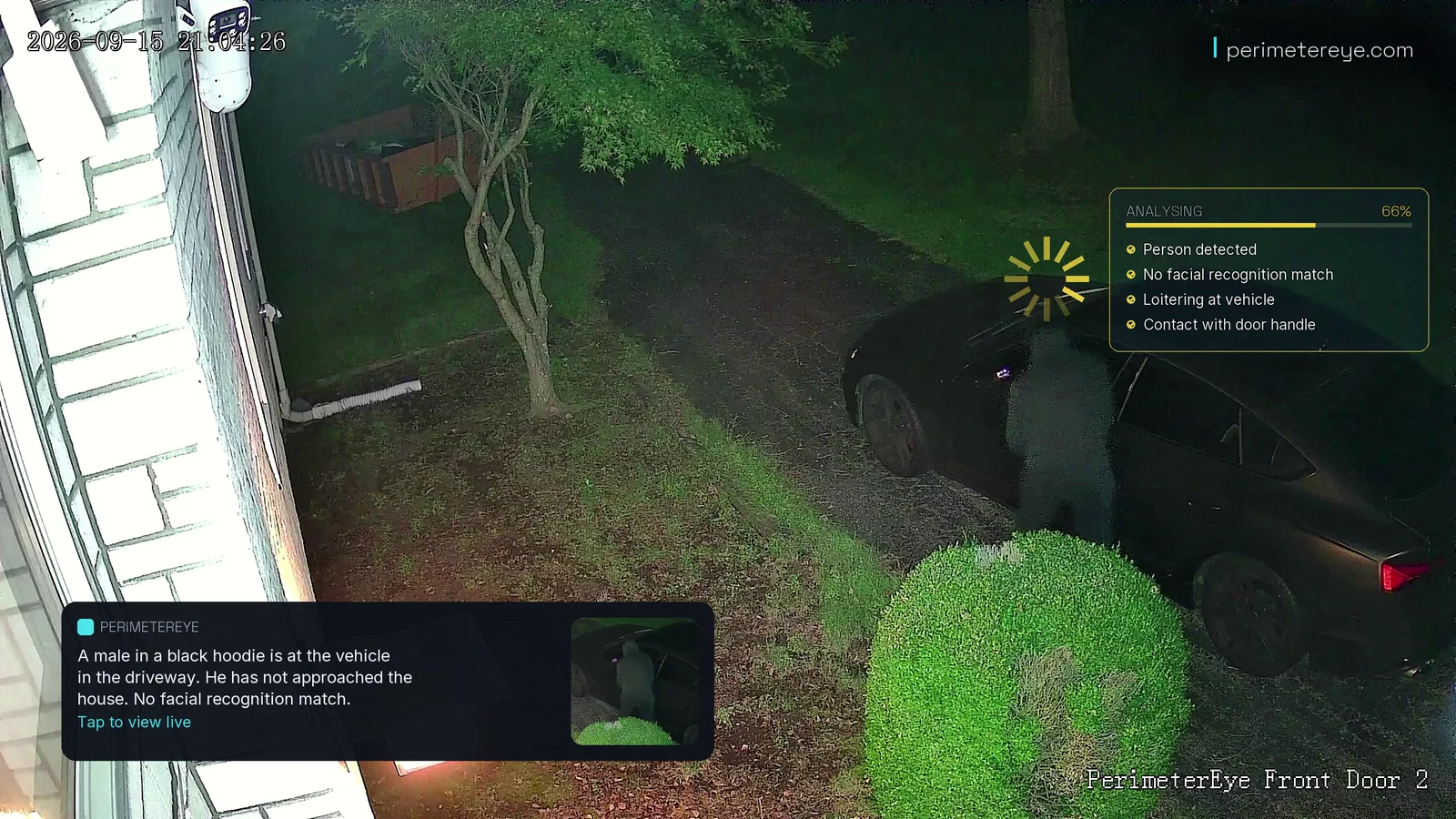
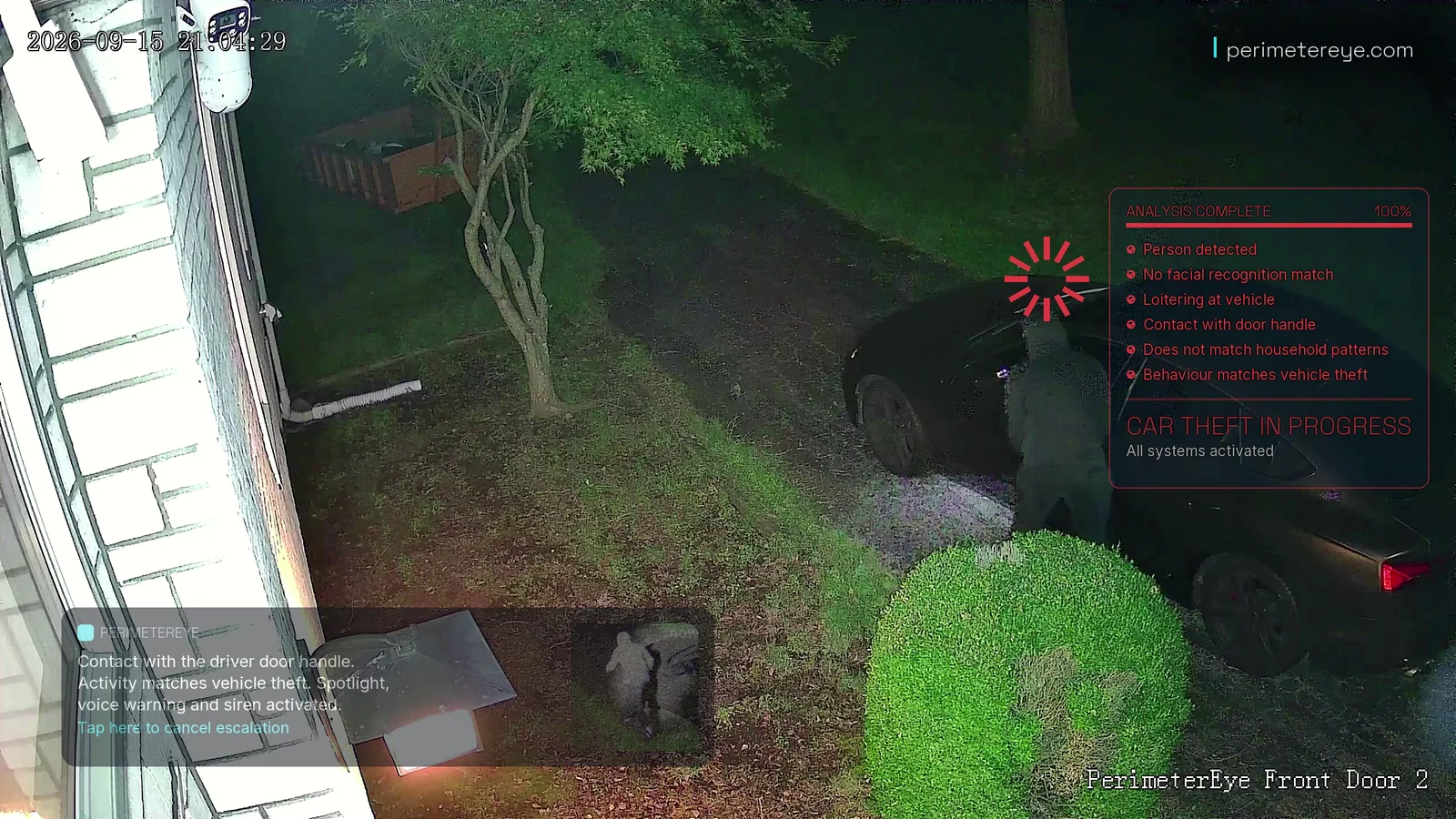
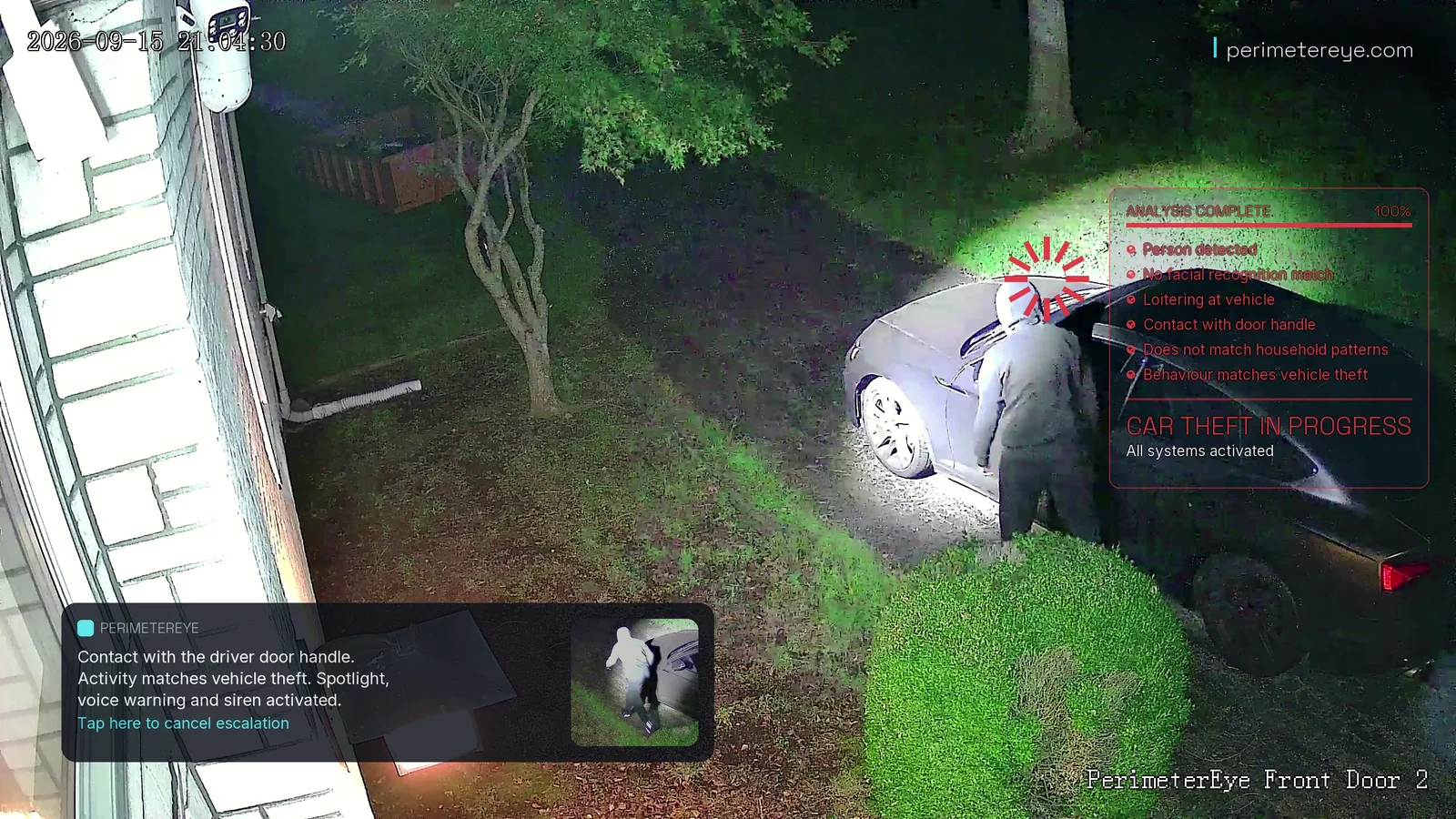
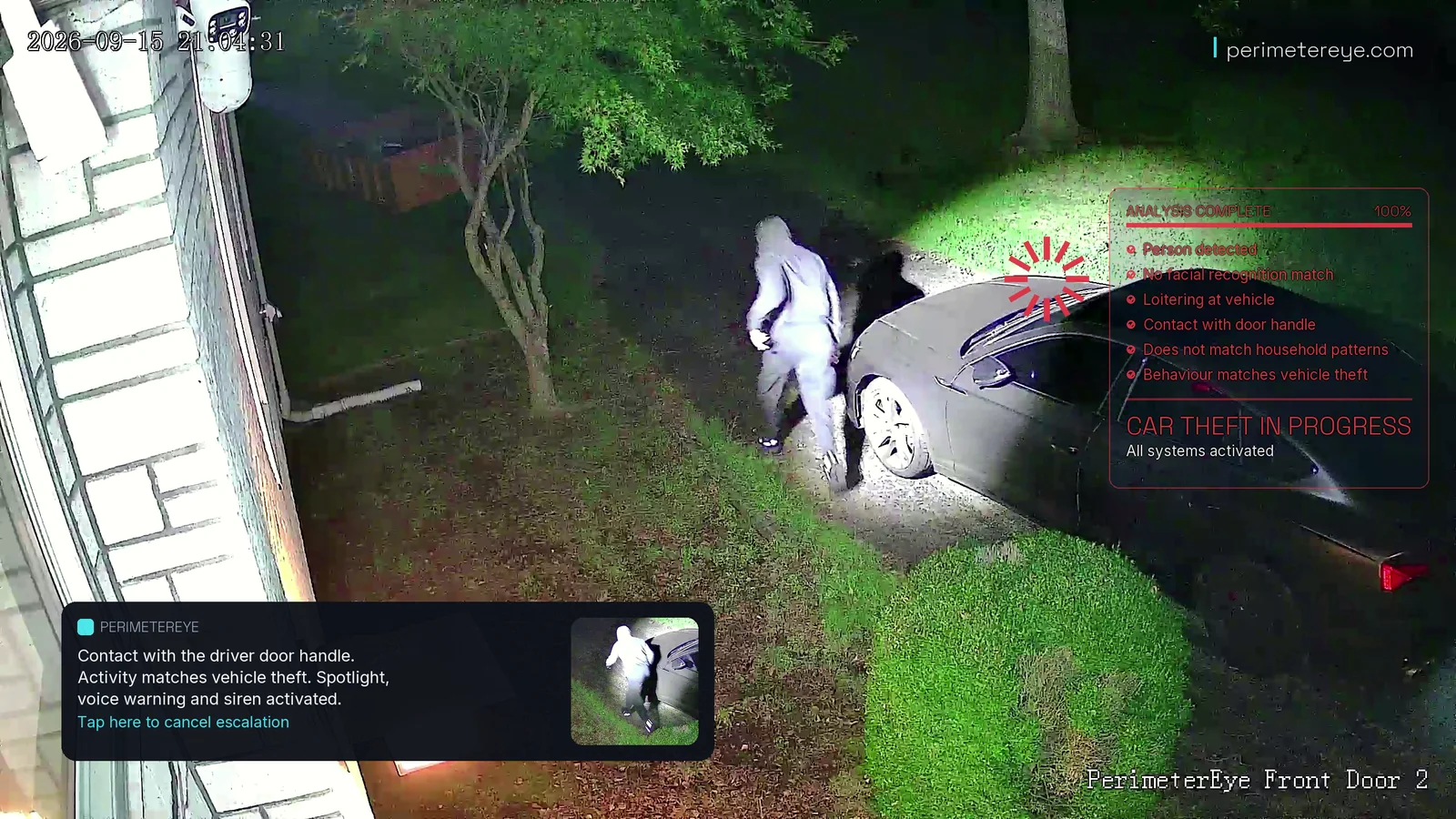
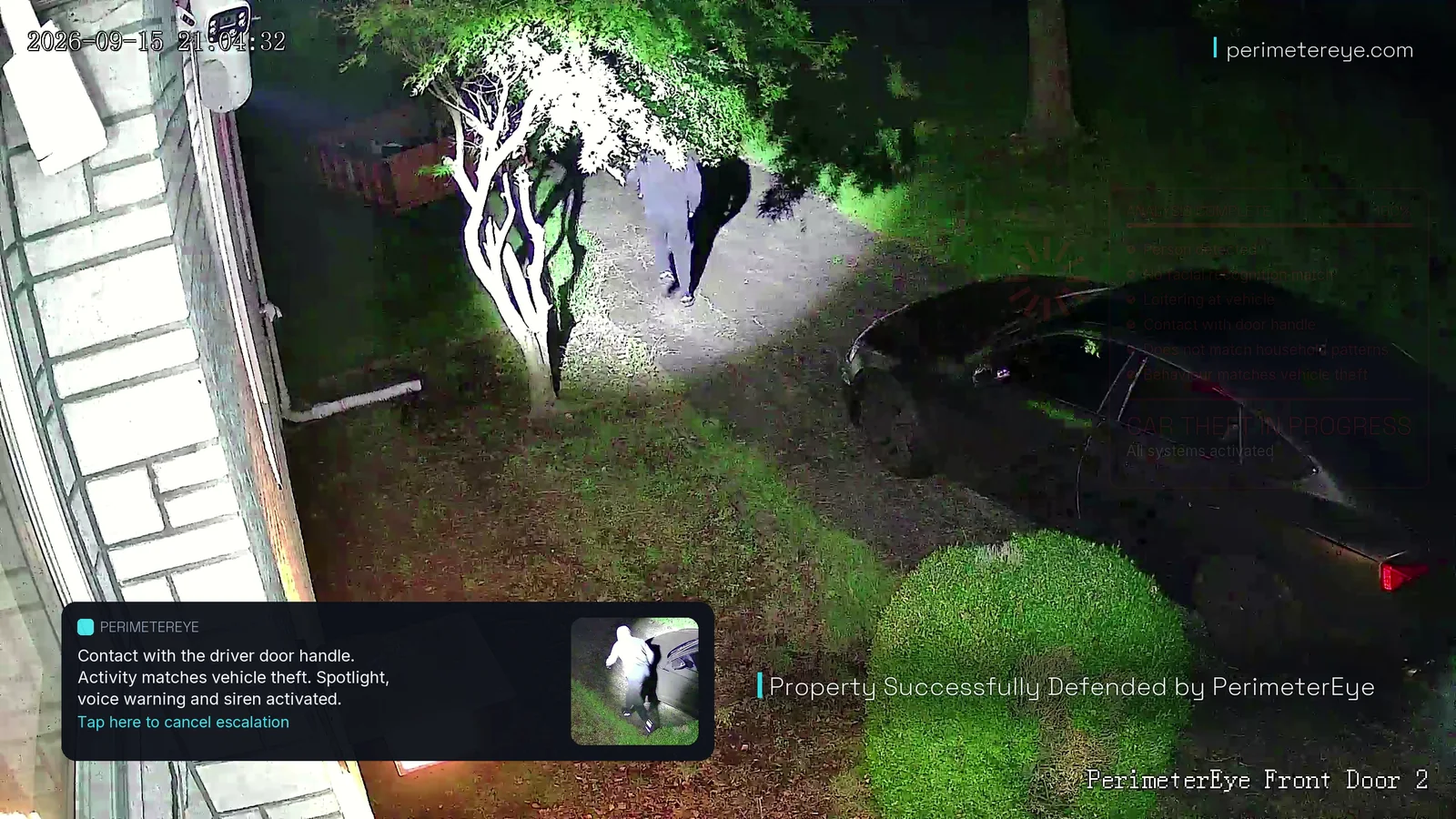
Stills from the film with its on-screen analysis and phone alert, on the Front Door 2 camera’s own clock. The door handle registers at 21:04:26. By 21:04:29 all systems are activated, and at 21:04:31 the person is running.
1 of 6 · 21:04:23View full size
The first alert
The person in the black hoodie is at the car, and the first alert already describes them: at the vehicle in the driveway, and has not approached the house.
2 of 6 · 21:04:26View full size
Contact with the door handle
The person reaches for the driver’s door. The analysis builds second by second: a person, no match to anyone it knows, loitering at the vehicle, and now contact with the door handle.
3 of 6 · 21:04:29View full size
Car theft in progress
Three seconds after the door handle, the analysis is complete: the activity doesn’t match the household’s patterns and matches vehicle theft. All systems activate.
4 of 6 · 21:04:30View full size
The searchlight lands
The searchlight hits the person at the driver’s door. The alert reads: spotlight, voice warning and siren activated, with a tap to cancel the escalation.
5 of 6 · 21:04:31View full size
Running, and the beam follows
Five seconds after touching the door handle, the person is running down the drive, and the searchlight has moved with them, away from the car.
6 of 6 · 21:04:32View full size
Followed away from the car
The searchlight follows the person past the tree and along the drive. The car hasn’t moved.
Filmed September 15, 2026, on a real property. The break-in was staged for filming; the system’s response was automatic, with no operator.
How handle-pullers actually work
The method is almost embarrassingly simple: walk the street late at night, lift every car door handle, take from the unlocked ones, skip the locked ones. Breaking glass is noisy, slow, and raises the legal stakes, so most prowlers never bother — the unlocked minority of cars supplies plenty. Often a drop-off car idles at the corner while the walker works both sides of the street, and the whole block is done in minutes.
The logic mirrors house burglary. In KGW-TV's 2017 survey of 86 incarcerated burglars — journalism, not peer-reviewed research — most said they entered homes through unlocked doors and windows. The unlocked entry is the entire business model; car prowlers just run the same playbook a few steps closer to the street.
The other pillar is silence. Nothing on a normal driveway reacts to a person cupping their hands against your car window at 2 a.m. The prowler learns in one quiet minute that this property does not respond, and works accordingly — tonight and next month.
If your car was just broken into
Before touching anything, photograph the car, the contents, and the surroundings. Then inventory what's missing — and think beyond valuables. A garage-door remote is a house key. Registration and insurance cards carry your home address. If a remote or any key is gone, reset the garage code and rekey what needs rekeying today, and treat the event as a lost-house-key situation, not a car annoyance.
Report it on the non-emergency line even if the loss is trivial: the time window, any vehicle you or your cameras saw, and your footage. Prowl reports are how police map a crew's route across a neighborhood. Cancel any taken cards, ask neighbors to check their overnight footage, and if the house itself now feels exposed, the same-day securing sequence in our break-in guide applies here too.
The basics that remove the easy win
None of this is glamorous, which is exactly why it works — the standard prowl depends on someone skipping it.
Unlocked-and-full is the entire target profile. Locked-and-visibly-empty removes the reward and raises the cost, and most prowlers move to the next handle rather than break glass over a maybe.
- Lock every door, every night — including the quick evening stop when the car is only out front for an hour
- Empty the car completely, not just of valuables: cords, sunglasses, coins, and a gym bag all read as maybe-more-inside
- Take the garage remote inside, and never keep a spare key anywhere in the vehicle
- Park in the garage when you can; the driveway spot nearest the street is the most-pulled handle on the property
- Never leave the car running unattended to warm up or cool down
Light the approach
The strongest causal evidence on lighting and crime is a randomized experiment: Chalfin, Hansen, Lerner, and Parker (NBER Working Paper 25798, 2019, with a 2022 follow-up in Criminology & Public Policy) assigned new lighting across 77 New York City public-housing developments and measured a roughly 36% drop in nighttime outdoor index crimes, with effects persisting about three years.
Honest transfer caveat: those were high-output lights over public streetscapes, not a fixture above your garage, so don't expect the same percentage in a driveway. But the direction of the finding is what matters — darkness is the prowler's working condition, and removing it changes behavior. Light the driveway and its approach, with motion-activated fixtures as the minimum.
Why the whole street gets hit — and keeps getting hit
Handle-pulling economics only work because the entire street is passive. Overnight footage of a hooded figure rarely identifies anyone; a stolen forty dollars in change will never get a detective assigned; so the route repeats weekly or monthly until something on the street changes the math.
Watch for the overlap with bigger problems, too. A prowler learning your street is learning your street — which cars leave at what hour, which houses stay dark, which side gates are open. If the car break-in coincides with repeat slow drive-bys or the same unfamiliar vehicle appearing on the block, treat that as its own problem and work the casing playbook the same week.
The driveway they skip
Every house on the street records. One house reacts. PerimeterEye — an Automatic Property Defense System — verifies the person at your car in seconds and then does what no doorbell camera does: a motorized searchlight snaps on, locks onto them, and physically follows as they move, the way homeowners describe a police-helicopter light, while a live AI voice addresses them specifically — the hoodie, the position, the car they're standing beside. If they press on, a 130 dB siren sounds and a priority alert with live video reaches your phone, where you can watch, talk, or take control.
Two details matter for prowls specifically. It knows the household, so your own 1 a.m. return from the airport triggers none of it. And the drop-off car idling at the curb is captured in 4K — detail that turns your non-emergency report from a-guy-in-a-hoodie into something police can work with. No security system can guarantee prevention of every incident, but a crew working a street of quiet driveways has no reason to stand in the one that lights them up and calls them out.
Common questions
Should I report a car break-in if nothing was stolen?
Yes. A tried handle or rifled glovebox with nothing taken is still evidence that a prowl crew worked your street, and police map crew routes from exactly such reports. Call the non-emergency line with the time window and any footage. Your five-minute report may be the third pin on a map that gets a patrol assigned.
Does insurance cover things stolen from my car?
Usually it splits: comprehensive auto coverage handles damage to the vehicle itself — glass and locks — while personal items inside typically fall under homeowners or renters insurance, subject to your deductible. For a small loss, claiming may cost more than it returns. Document everything anyway; a pattern of incidents strengthens any later claim.
Do car alarms stop driveway break-ins?
Mostly no, for a simple reason: the standard prowl opens unlocked doors, which often never triggers the factory alarm at all. And when alarms do sound, bystanders overwhelmingly ignore them. Reliably locking the car and leaving nothing visible does more than any alarm, because it removes the easy version of the theft entirely.
Why do people check car door handles at night?
Because it's a nearly zero-risk search for unlocked cars. Pulling a handle is silent, takes a second, and looks innocuous from any distance; a locked door costs the prowler nothing, and they move on. One person can check a full street in minutes. The defense is symmetrical: make every handle-pull cost something — a lock, a light, a voice.
What should I never leave in my car overnight?
The garage-door remote and any spare key top the list — combined with the address on your registration, they amount to a house kit. Then anything visible: bags, cords, coins, sunglasses. Firearms and medications should never sleep in a parked car. If documents must stay, keep them in the console rather than in view.
Related reading
What it costs
See what a system costs for your property.
Essential system
As low as$146/mo*Essential covers a driveway and the approaches to the house. Larger properties usually suit Advanced or Estate; a specialist can size it with you before you order.
What’s included
- 5 ultra-HD 4K cameras
- 1 tracking spotlight
- 1 speaker/siren unit
- PerimeterEye Access intercom, included with every complete system
- 1 PerimeterEye control panel
- 1 PerimeterEye AI processor
*Essential system, $0 down: 36 monthly payments of $145.17 at 10% APR on the hardware price before sales tax, shown rounded up to the dollar. Affirm rates 0–36% APR; Klarna terms are shown at checkout. Subject to eligibility and lender approval; your rate, term and down payment may differ. US only; not available in all states. Software is billed separately: first 6 months included, then $99/month.
Be the one driveway that reacts
A searchlight that locks on, a live voice that describes them, and a 4K capture of the drop-off car at the curb — PerimeterEye turns your driveway from a quiet stop on the route into the reason the route changes.