What to Do After a Break-In: A Calm, Step-by-Step Plan
After a break-in: get everyone somewhere safe and call 911 if there is any chance the intruder is still inside. Then file a police report, photograph everything before you clean, list stolen items for insurance, and secure the entry point the same day. The last job — rebuilding your household's sense of safety — deserves as much attention as the locks.
A burglary is disorienting in a way people don't expect. The financial loss is usually smaller than the sense of violation, and both hit at a moment when nobody thinks clearly. A sequence helps. Work down this list in order and you will cover safety, evidence, money, and recovery without having to improvise any of it.
What this looks like on a real property
Same camera. A different outcome.
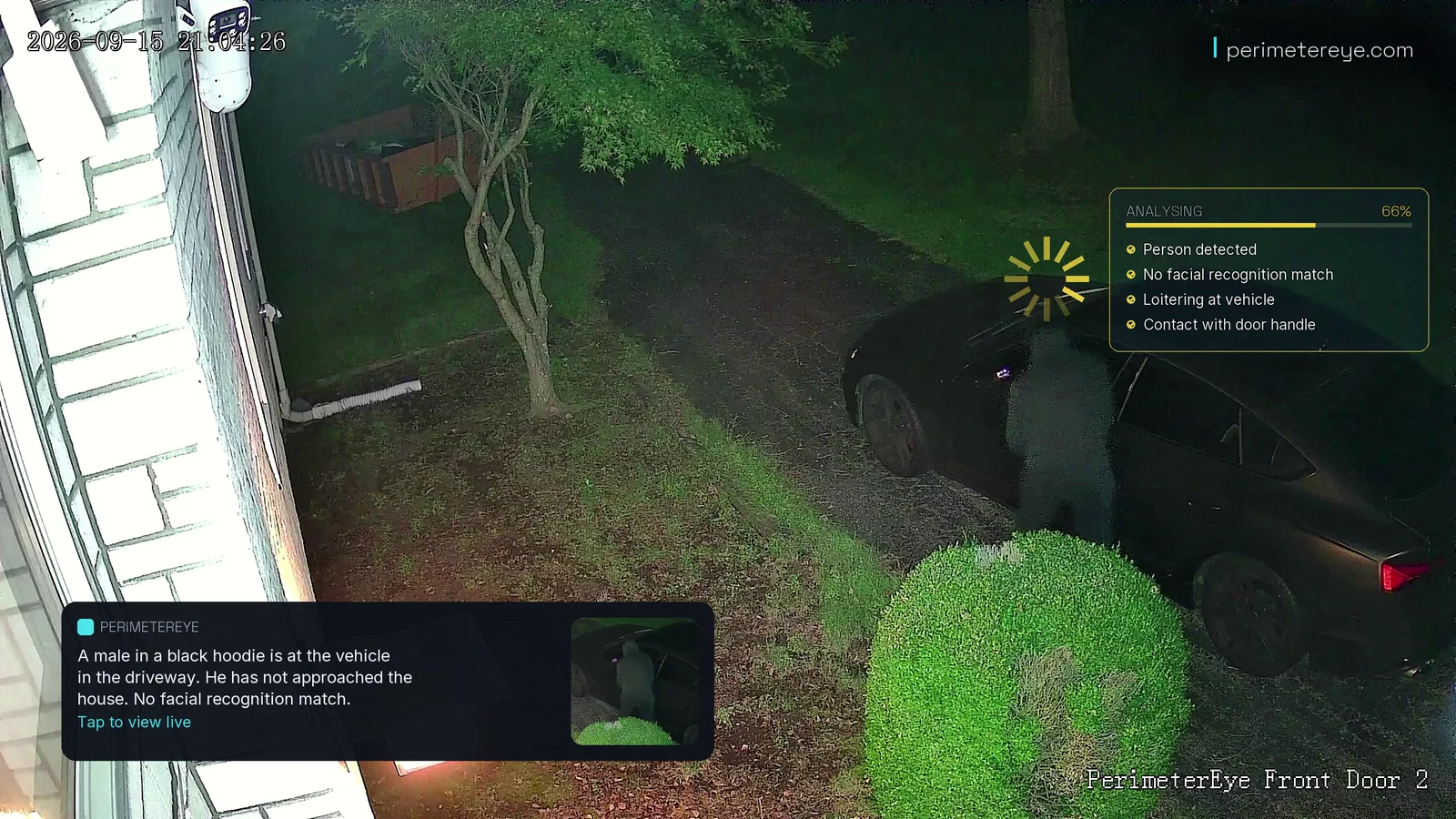
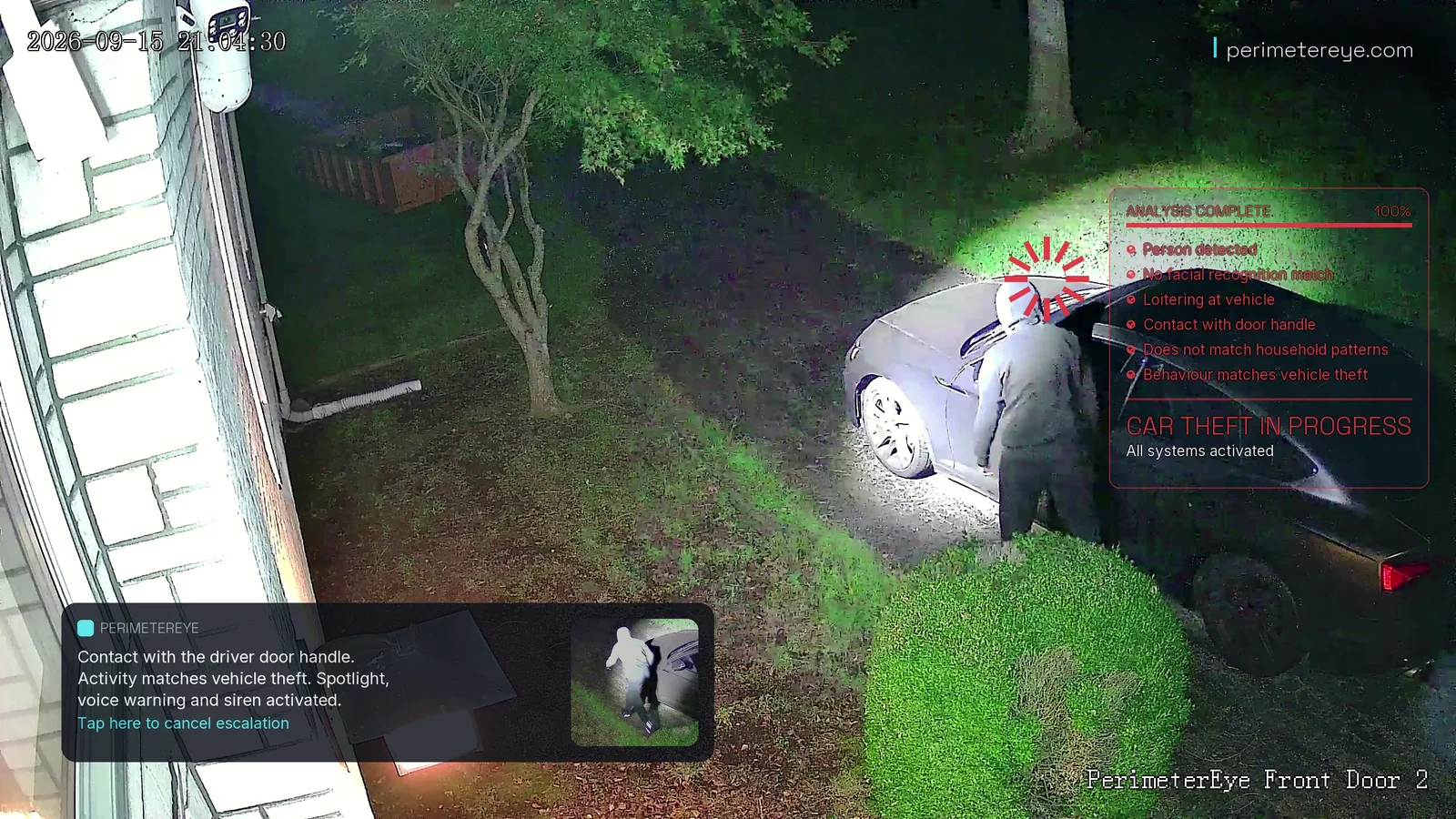
One camera and one staged break-in, shown three ways: the view on its own, with PerimeterEye’s analysis, and with its response hardware.
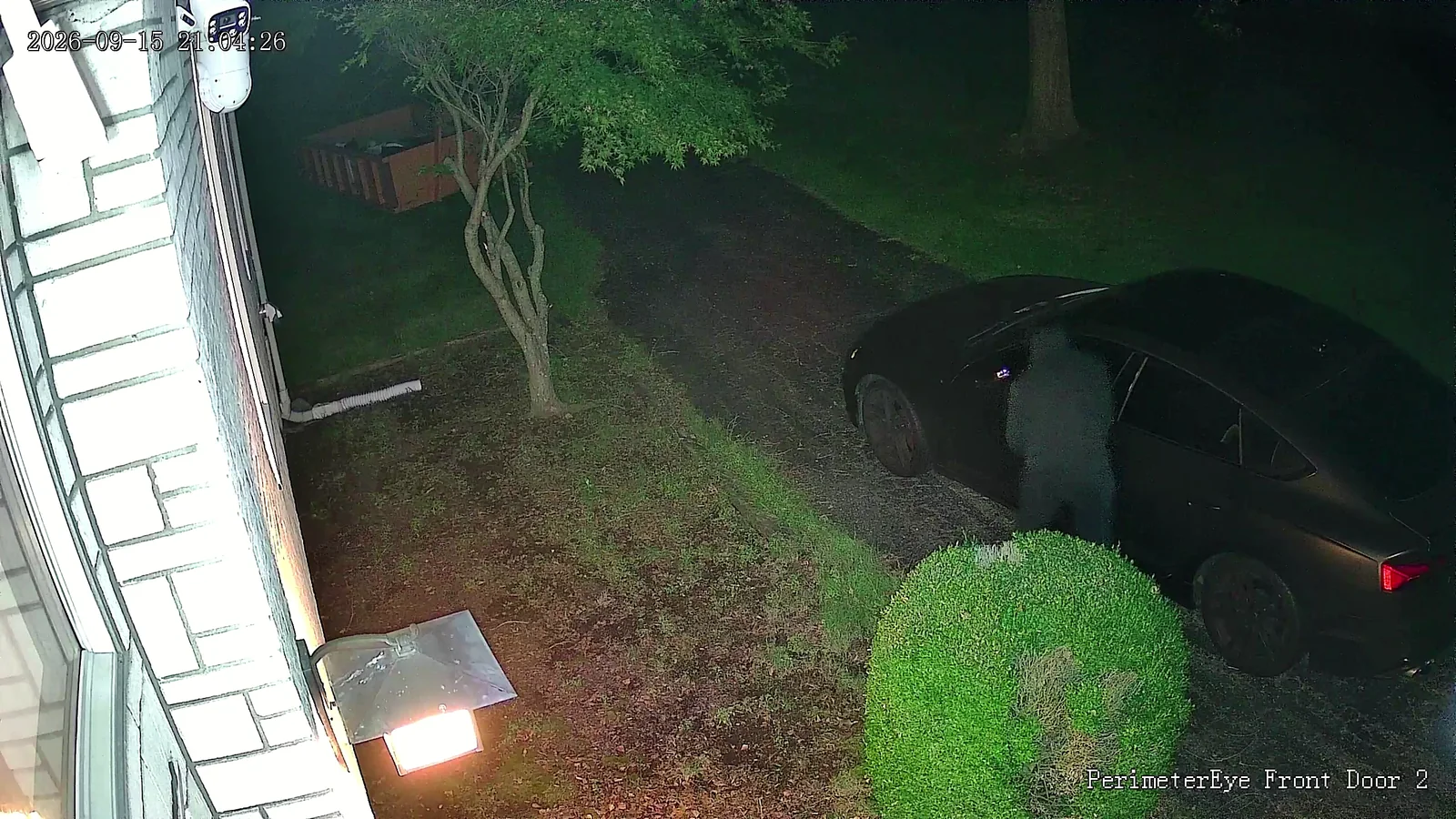
1 of 3 · A camera aloneView full size
It records
A person at the driver’s door, on a camera that records. Unless someone opens the clip in time, nothing else happens.
2 of 3 · UnderstoodView full size
The same view, understood
PerimeterEye reads the same moment: a person, no match to anyone it knows, loitering at the vehicle, contact with the door handle. The alert describes them in plain language.
3 of 3 · AnsweredView full size
The same view, answered
With a tracking searchlight, a siren, and AI voice warnings, the camera’s view directs a response. Four seconds later, the searchlight is on the person at the driver’s door.
Stills from a vehicle break-in staged for filming on a real property, on the Front Door 2 camera’s clock (21:04:26 and 21:04:30). The system’s response was automatic, with no operator.
First: make sure everyone is out and safe
If you arrive home to a forced door or broken window, do not go inside. Go to a neighbor's house or your car, call 911, and let officers clear the house. This feels excessive to almost everyone, and it isn't: the Bureau of Justice Statistics found a household member was present during roughly 28% of burglaries. Never assume the house is empty just because it should be.
If you were home when it happened, get everyone into one room or out of the house entirely, then call. Property can be replaced on any timeline. This step cannot be redone.
File the police report — even for a small loss
Report every burglary, even when little was taken. You need the report number for any insurance claim; stolen serial numbers go into databases that pawn shops and resellers check; and your report may be the data point that links a crew working your neighborhood. Skipping the report helps exactly one party, and it isn't you.
Some context while you wait for the officer: the FBI's Crime in the Nation 2024 release put the national burglary rate at 229.2 per 100,000 — a record low — with roughly 52% of burglaries residential, and daytime residential burglaries (216,601) outnumbering nighttime ones (174,053). Two takeaways: this is less common than fear suggests, and it happens while people are at work more often than while they sleep.
Document everything before you clean
Photograph and video every affected room and the entry point before touching anything, and ask the responding officers whether they intend to process for fingerprints first. The mess itself is evidence, and your insurer will want to see it.
Then build the list of what's gone. Serial numbers, receipts, card and bank statements, order-confirmation emails, product-registration records, and old photos that happen to show items in the background all count as documentation. Get the report number and the officer's name — your insurer will ask for both — file the claim promptly, and photograph repair invoices as they come in.
Secure the entry point the same day
Same day — not this weekend. Board or replace broken glass, repair the door frame, and if a door was kicked, upgrade while you're there: most kicked doors fail at the strike plate, and a reinforced strike with three-inch screws into the stud is a cheap fix. Rekey or replace locks if any key was taken, and reset garage codes. KGW-TV's 2017 journalistic survey of 86 burglars (not peer-reviewed research) found most entered through unlocked doors and windows, so lock discipline starts tonight, not after the repairs.
Then walk the perimeter the way the burglar did and ask: where would I get in now? Fix the second-easiest entry too. You just learned where the easiest one was the hard way.
Will they come back? Repeat victimization is real
The uncomfortable, honest answer: sometimes, yes. The burglar now knows your layout, your locks, and exactly how the entry went — a burglarized home can face elevated risk for a while afterward, for reasons that are practical rather than personal. They know what they left behind, and they know insurance tends to replace electronics with newer ones.
That is why same-day securing matters, and why the weeks after a burglary are precisely the wrong time to relax. It is also why anything that changes what a returning burglar encounters — new locks, lighting, visible layers, a system that reacts — pays off most right now.
Rebuilding the household's sense of safety
This is the part checklists usually skip. Trouble sleeping, jumpiness at ordinary noises, kids refusing their own rooms — all normal after a burglary, and usually fading over a few weeks. Name it out loud rather than dismissing it; the goal is a household that talks about the plan, not one that quietly rehearses the fear.
Practical steps help more than reassurance. Walk the house together and show everyone exactly what changed — the new locks, the lighting, the reinforced door. Give an anxious child a small nightly job, like checking the back door with you, if that gives them a sense of control. Keep routines identical. If anxiety still disrupts sleep after a month or two, a few sessions with a counselor is a reasonable, ordinary step, not an overreaction.
The second visit can meet a different property
Here is the strategic frame for whatever you upgrade: the first visit succeeded because the property did nothing while it happened. Cameras may have recorded. Nothing interrupted. If a returning burglar meets the same silence, the second visit runs like the first — same entry, same timeline, same result.
A property-defense system changes what that second visit meets. PerimeterEye verifies a person on the property in seconds, then escalates: a motorized searchlight locks on and physically follows them, a live AI voice addresses them specifically — what they're wearing, where they're standing — and if they press on, a 130 dB siren sounds while priority alerts with live video reach your phone, where you can watch, talk, or take control. In the Kuhns survey of 422 incarcerated burglars (industry-funded, worth noting), over half said they would abort a burglary in progress on discovering an alarm; a property that reacts mid-approach applies that pressure before the door, not after it. No security system can guarantee prevention of every incident — but the burglar who knew your house now has to learn a new one.
Common questions
Should I clean up right away after a break-in?
No. Photograph and video everything first — every room, the entry point, the mess — and ask the responding officers whether they want to process for fingerprints before you touch surfaces. Your insurer will want the images, and cleanup destroys both evidence and documentation. Clean once the report is filed and the photos are backed up.
Will burglars come back to the same house?
Sometimes. A burglarized home can face elevated risk for a while afterward, because the burglar now knows the layout, the entry, and what was left behind — and that insurance replaces electronics. Secure the entry point the same day, and change what a second visit would actually encounter.
Do police actually investigate residential burglaries?
They take the report, sometimes process for prints, and add your case to pattern files — but honestly, many residential burglaries are never solved and recovered property is uncommon. File anyway. The report is required for insurance, feeds serial-number databases, and can be the data point that ties a crew to your neighborhood.
What if I don't have receipts for what was stolen?
You can still claim. Use card and bank statements, order-confirmation emails, product-registration records, manuals, and old photos or videos that show items in the background. Insurers accept reasonable documentation, not only receipts. Going forward, a ten-minute phone video of every room, stored off-site, is the cheapest insurance preparation there is.
How do I help my kids feel safe after a burglary?
Tell the truth in simple terms, then show them what changed: walk the house together, demonstrate the new locks and lighting, and keep bedtime routines identical. Give an anxious child a small nightly job, like checking the back door with you. If fear still disrupts sleep after several weeks, a few counseling sessions genuinely help.
Sources
What it costs
See what a system costs for your property.
Essential system
As low as$146/mo*Essential covers a driveway and the approaches to the house. Larger properties usually suit Advanced or Estate; a specialist can size it with you before you order.
What’s included
- 5 ultra-HD 4K cameras
- 1 tracking spotlight
- 1 speaker/siren unit
- PerimeterEye Access intercom, included with every complete system
- 1 PerimeterEye control panel
- 1 PerimeterEye AI processor
*Essential system, $0 down: 36 monthly payments of $145.17 at 10% APR on the hardware price before sales tax, shown rounded up to the dollar. Affirm rates 0–36% APR; Klarna terms are shown at checkout. Subject to eligibility and lender approval; your rate, term and down payment may differ. US only; not available in all states. Software is billed separately: first 6 months included, then $99/month.
Give the second visit a different answer
PerimeterEye meets a returning burglar with a tracking searchlight, a live targeted voice, and a 130 dB siren — while you watch live and decide. The house they knew is gone.