How to Secure a Detached Garage
To secure a detached garage, reinforce the side door with a quality deadbolt and long strike screws, disable or lock the overhead track when away, frost or bar the windows, anchor valuables, and light the approach. Then close the real gap: detached structures fail quietly when nobody sees the alert.
A detached garage has a different risk profile from the house it belongs to. It holds concentrated value — tools, bikes, vehicles, often a spare house key — behind the weakest doors on the property, far enough from bedrooms that nobody hears anything. This guide covers the physical fundamentals first, because they are cheap and they work, and then the failure mode most owners only discover after a break-in.
What this looks like on a real property
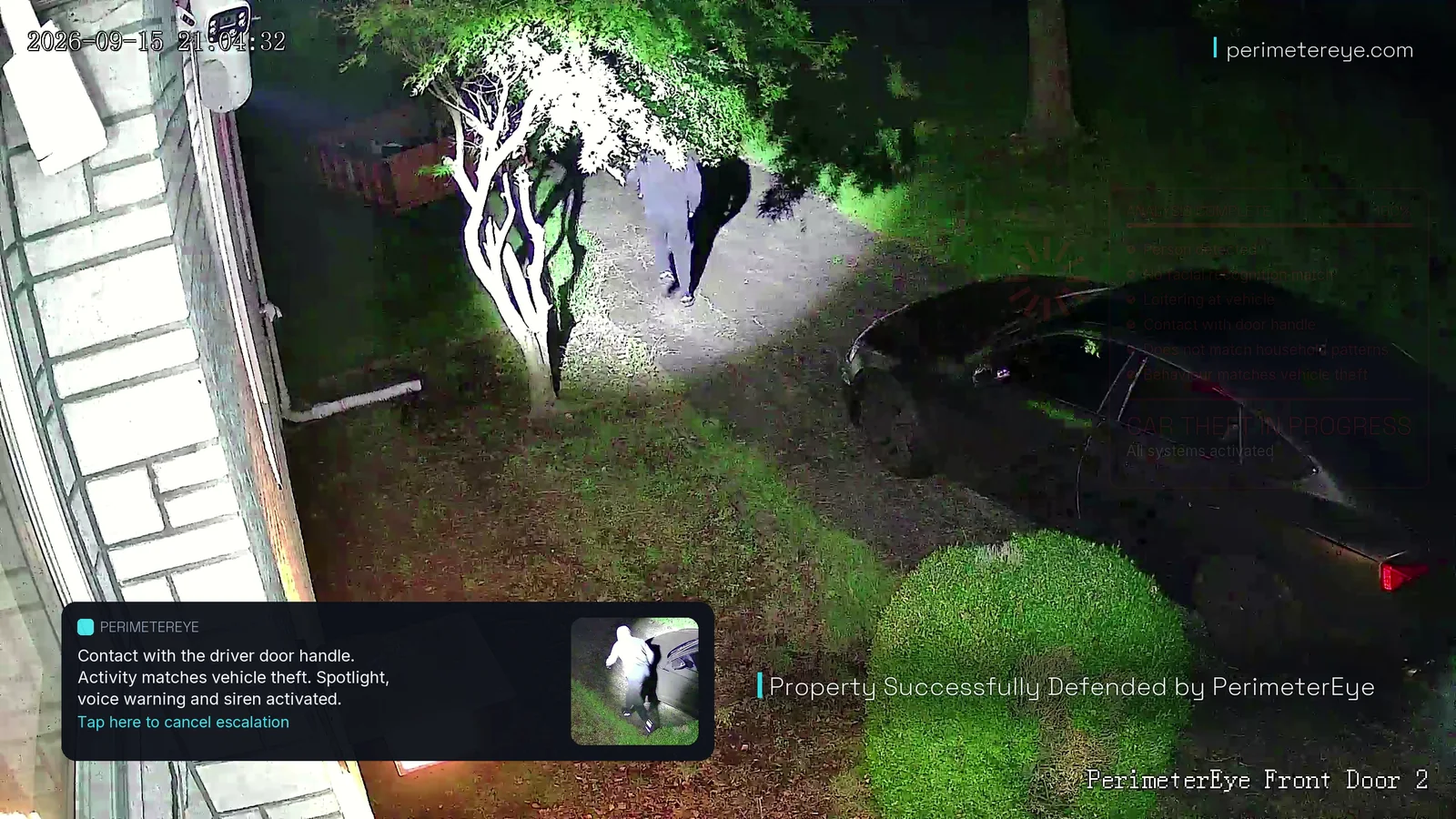
Five seconds from the door handle to running away.
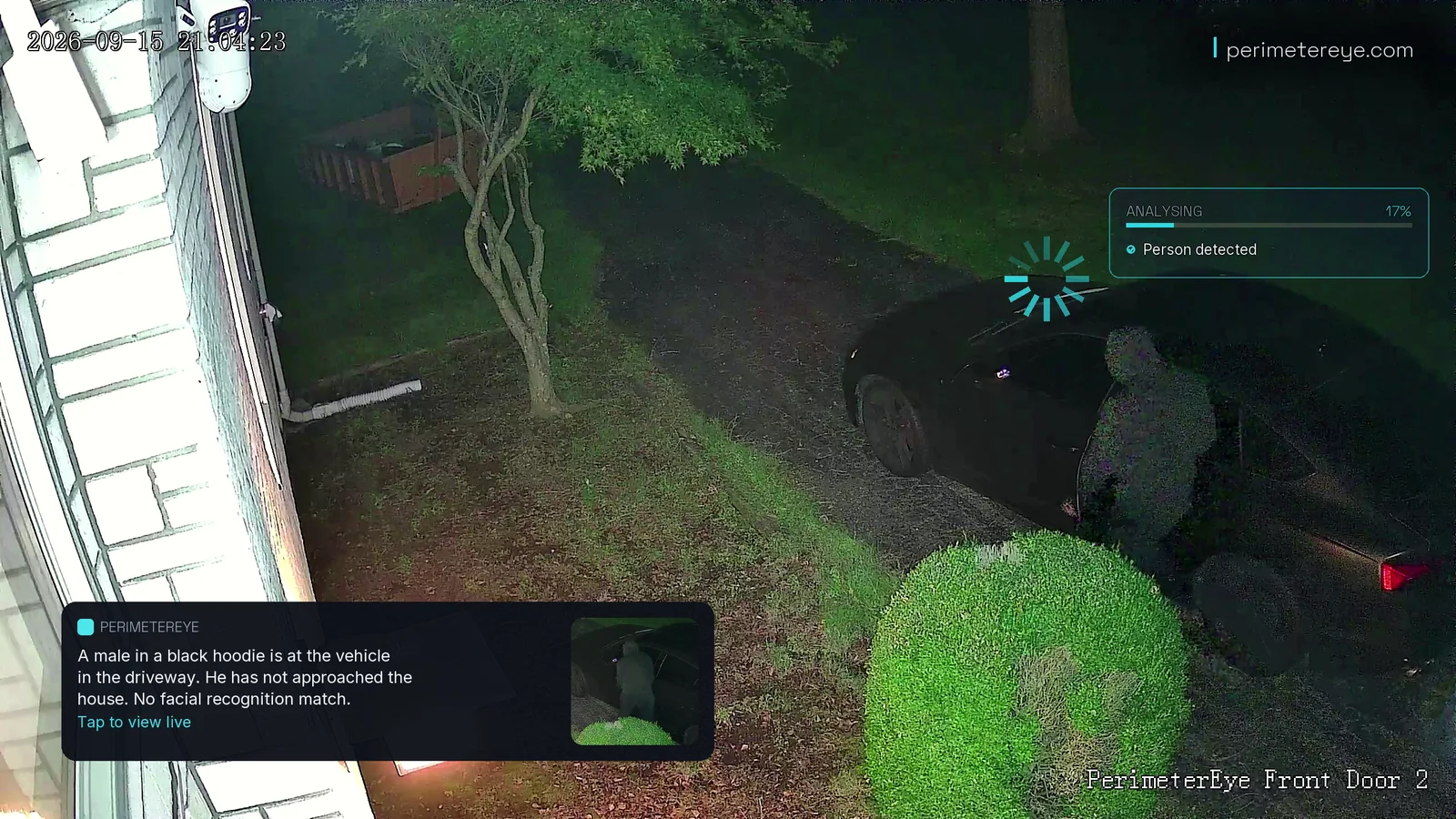
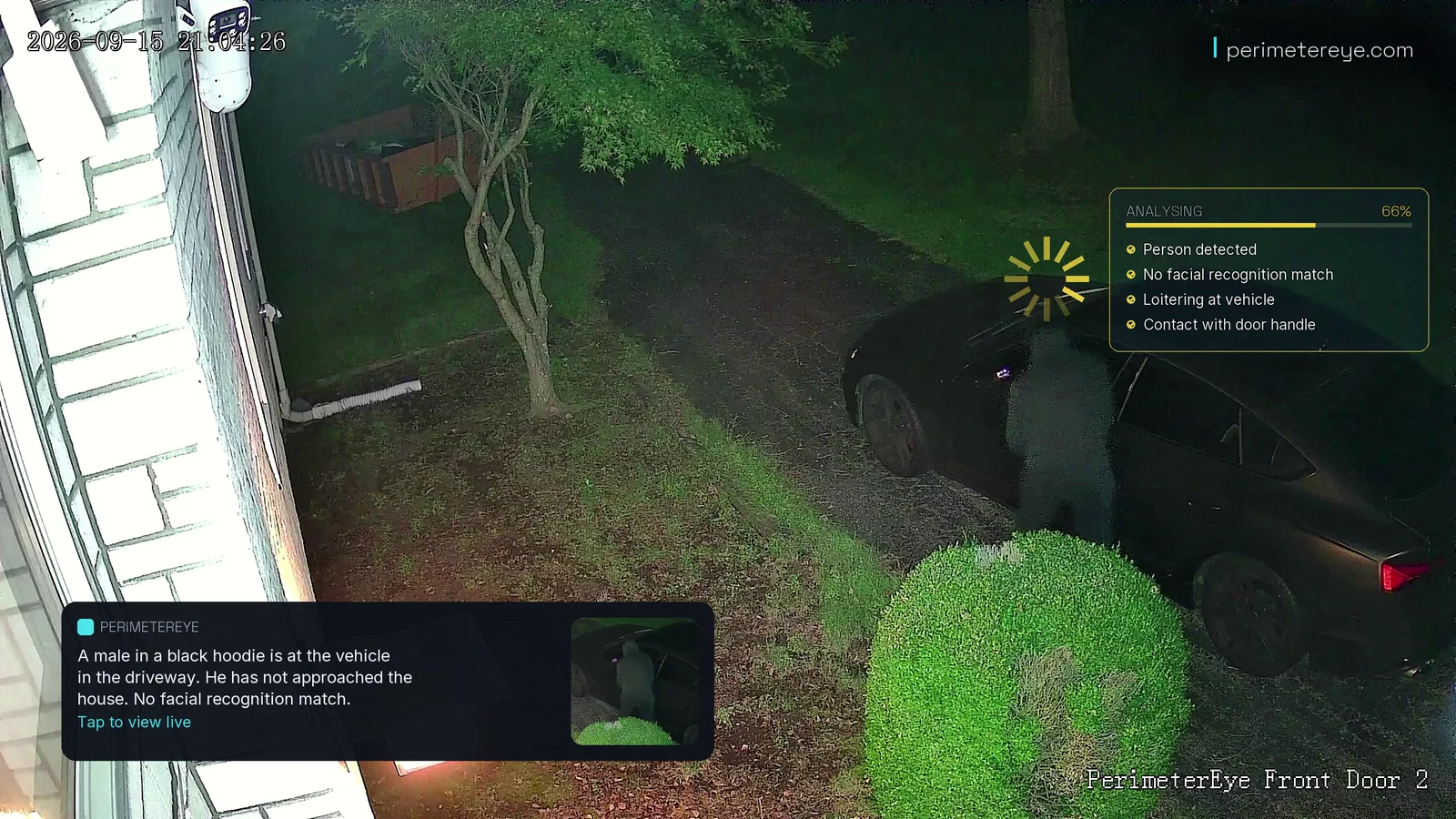
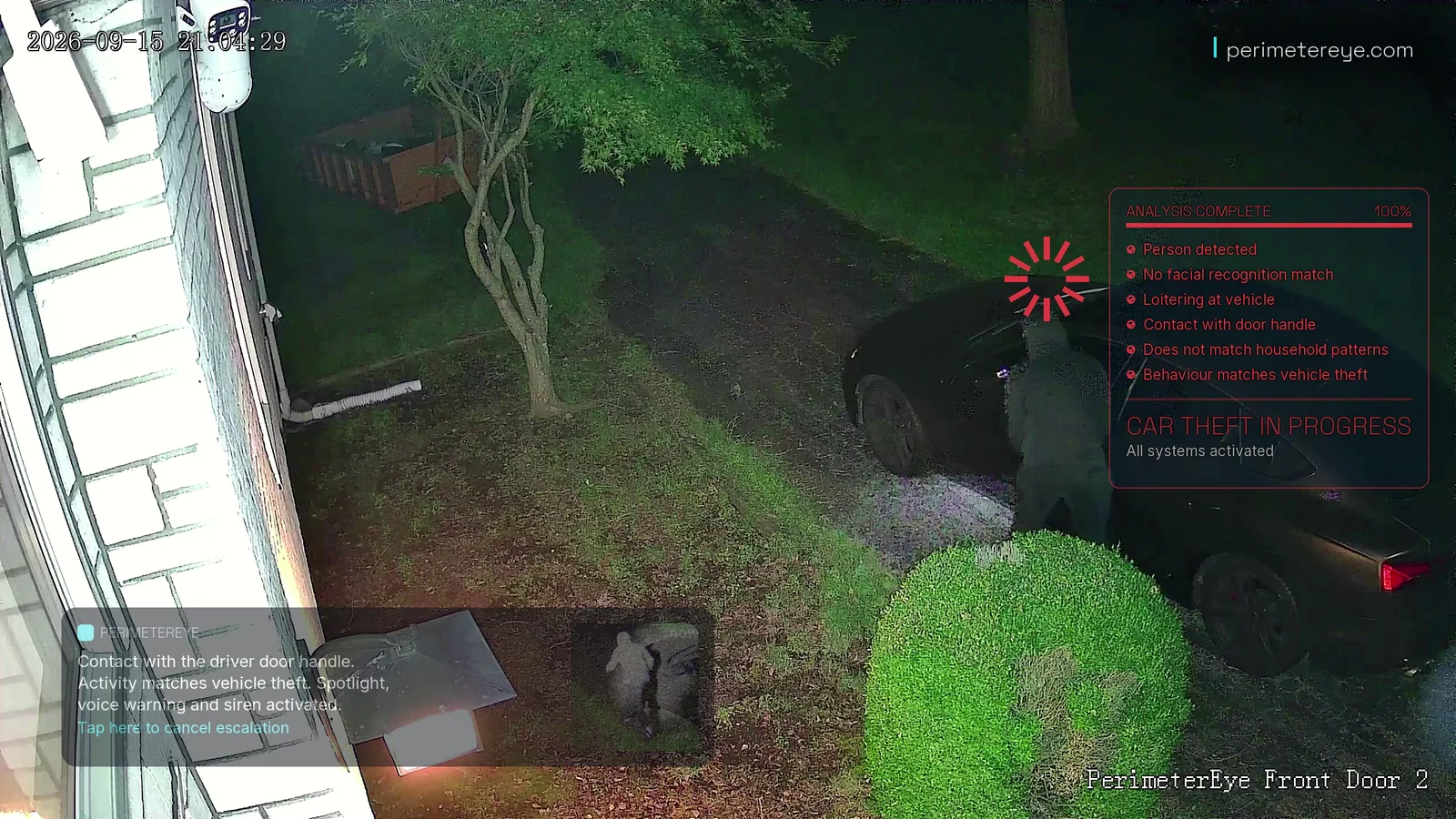
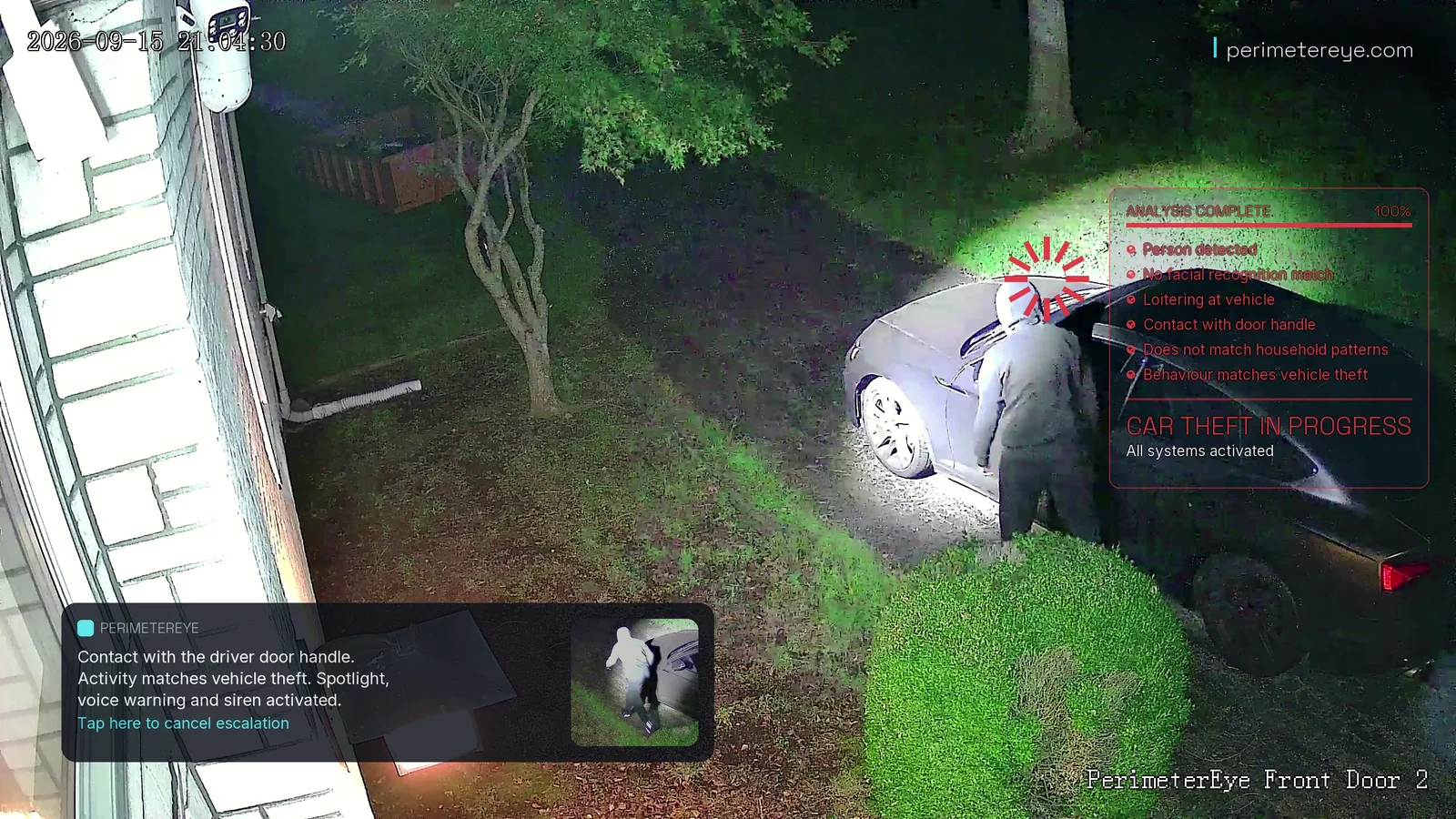
Stills from the film with its on-screen analysis and phone alert, on the Front Door 2 camera’s own clock. The door handle registers at 21:04:26. By 21:04:29 all systems are activated, and at 21:04:31 the person is running.
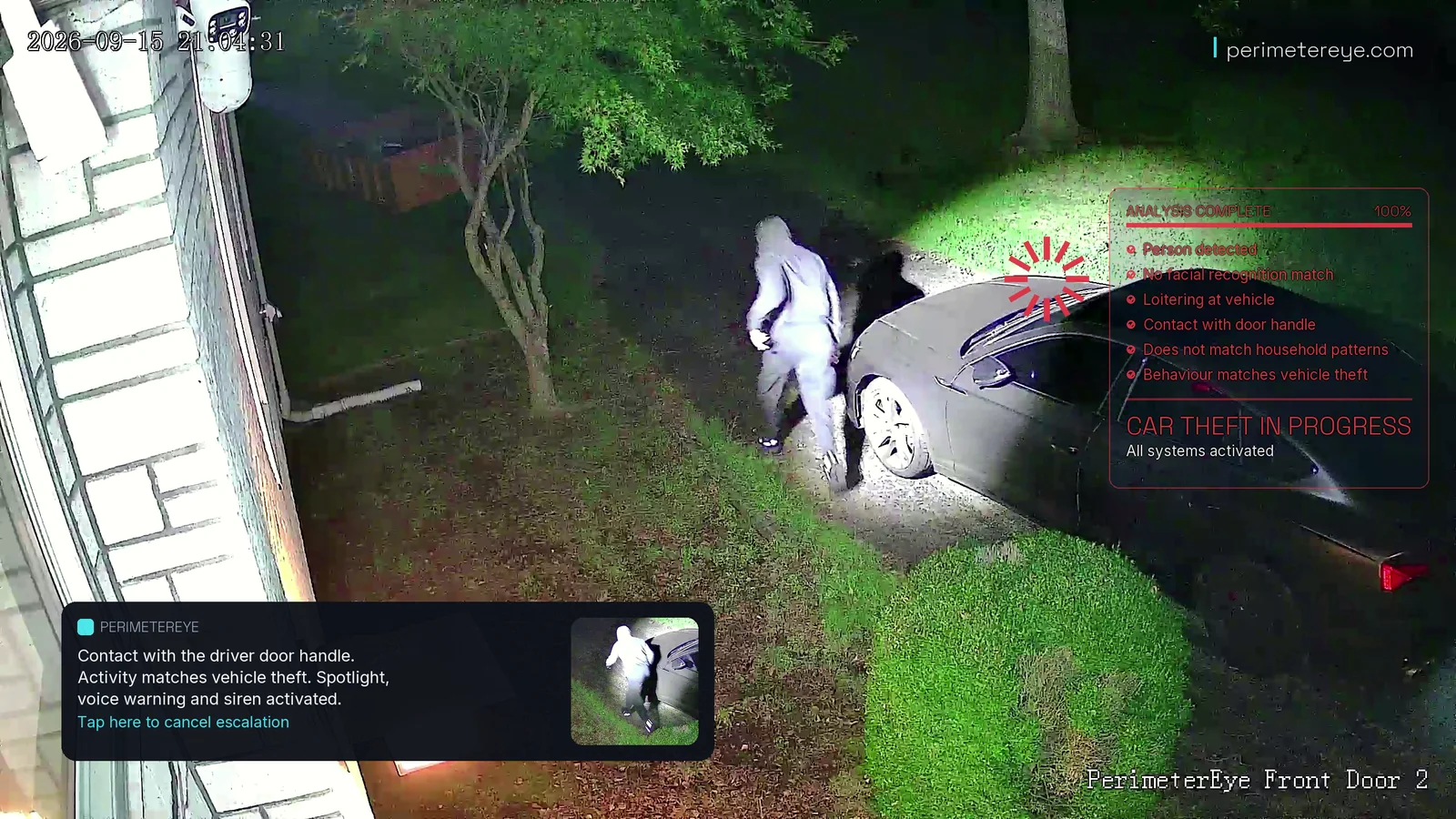
1 of 6 · 21:04:23View full size
The first alert
The person in the black hoodie is at the car, and the first alert already describes them: at the vehicle in the driveway, and has not approached the house.
2 of 6 · 21:04:26View full size
Contact with the door handle
The person reaches for the driver’s door. The analysis builds second by second: a person, no match to anyone it knows, loitering at the vehicle, and now contact with the door handle.
3 of 6 · 21:04:29View full size
Car theft in progress
Three seconds after the door handle, the analysis is complete: the activity doesn’t match the household’s patterns and matches vehicle theft. All systems activate.
4 of 6 · 21:04:30View full size
The searchlight lands
The searchlight hits the person at the driver’s door. The alert reads: spotlight, voice warning and siren activated, with a tap to cancel the escalation.
5 of 6 · 21:04:31View full size
Running, and the beam follows
Five seconds after touching the door handle, the person is running down the drive, and the searchlight has moved with them, away from the car.
6 of 6 · 21:04:32View full size
Followed away from the car
The searchlight follows the person past the tree and along the drive. The car hasn’t moved.
Filmed September 15, 2026, on a real property. The break-in was staged for filming; the system’s response was automatic, with no operator.
Why detached garages get hit
A detached garage solves several problems for a burglar at once. It sits away from where people sleep, so sound carries poorly. It shows no interior life — no flickering TV, no lights on a schedule — and it never answers a knock. Its contents are high-value, generic, and easy to sell: power tools, bicycles, compressors, mowers, sometimes the car itself.
It also tends to get the property's worst hardware. Builders hang hollow or half-glass doors on garages that would never pass for a front entry, and homeowners who lock the house religiously walk away from the garage side door every day. In the KGW-TV survey of 86 incarcerated Oregon burglars, most said they entered through unlocked doors and windows — the plainest finding in the entire literature, and the one detached structures fail most often.
Harden the side door first
The pedestrian door is the most common human entry point, and most garage versions are weaker than any exterior house door. Fit a solid-core or steel door, a deadbolt with a full one-inch throw, and — the highest-value five minutes of the whole project — replace the strike plate's stubby screws with three-inch screws that bite into the framing. A kick-in attack defeats the frame, not the lock — which is why the strike screws matter more than the deadbolt brand.
If the door has glass panes, or a window sits within arm's reach of the thumb turn, apply security film over the glass or use a double-cylinder deadbolt where local code permits one. If the door opens outward with exposed hinges, add hinge-side protection: set screws or safety studs that keep the door in place even with the pins pulled.
Control the overhead door
Overhead doors fail two ways: fishing and force. The fishing attack — a stiff wire slipped through the top gap to hook the opener's emergency release cord — opens many unprotected doors in seconds. A zip tie through the release lever's hole or a small shield plate over the mechanism blocks the reach-in while leaving the release fully usable from inside.
For longer absences, go mechanical: slide the track's bolt lock, or drop a padlock through a track hole just above a roller, and unplug the opener entirely. And keep remotes out of parked vehicles — especially vehicles parked in the driveway. A visor remote stolen from an unlocked car is a key to the structure, with the address printed on the registration beside it.
Windows: end the shopping trip
Garage windows sell the burglary before it happens. A clear pane facing the yard is an inventory display — the scout can price the job from outside the fence. Frost the glass with film, hang simple curtains, or apply translucent security film that obscures the view and slows a smash entry. If the windows never need to open, pin or screw them shut.
Then make the inventory itself hard to move: a concrete-anchored ground anchor and hardened chain for bikes and tool chests, lockable cabinets for hand tools, and no spare house key anywhere in the structure. Photograph everything and record serial numbers — both recovery and insurance claims run on documentation, not memory.
Light the approach
Lighting is the deterrence measure with the strongest evidence behind it. A randomized experiment (NBER Working Paper 25798, with a 2022 follow-up in Criminology & Public Policy) added lighting across 77 New York City public-housing developments and measured a roughly 36% drop in nighttime outdoor index crimes, with effects persisting about three years. Public housing is not a backyard, so treat the number as directional — but randomized designs of that size are rare in this field, and this one points firmly toward light.
For a detached structure, position lighting to cover the approach paths and the doors, not just the driveway apron. Motion activation keeps the neighbors happy and makes the light itself an event — a sudden change that the person notices, and that anyone glancing out a window notices too.
Where camera-and-phone setups quietly fail
Here is the failure mode the hardware aisle does not mention. You mount a camera on the garage, connect it to your phone, and feel covered. At 2 AM, someone walks to the structure. The camera performs exactly as designed: it detects, records, and sends a push notification — to a phone that is face-down, silenced, on a nightstand, forty feet and two walls away from a building that cannot respond on its own.
By morning the clip is not a warning; it is evidence. This is the structural gap of every notify-only setup on a detached building: detection happens at the garage, but the response depends on a human being awake, noticing, deciding, and walking outside toward an unknown person in the dark — a chain that breaks at every link during exactly the hours that matter. The alert model works when a person is available to act. A detached structure at night needs a response that happens at the structure.
A response that happens at the structure
This is the specific problem an Automatic Property Defense System is built for. When PerimeterEye verifies an unknown person at a detached garage, the response executes on the spot, in seconds, without waiting for anyone to wake up: a motorized searchlight locks onto the person and physically follows them, a live AI voice addresses them directly — describing the actual person standing at your garage door — and if they stay, a 130 dB siren fires at the structure while a priority alert with live video reaches your phone.
Because the system knows the household, your own late trip to the garage triggers no deterrence — no light, no voice, no siren. Because everything runs on the on-site Brain, the core response keeps working even when the internet is out. And when you do pick up your phone, you are not deciding whether to walk outside — you are watching a lit, warned, documented event, with the option to speak live or take manual control. No security system can guarantee prevention of every incident, but a structure that lights up, calls out, and sounds off on its own has a categorically different night than one that sends a silent notification.
Common questions
What is the most common way burglars get into a garage?
Through doors and windows that were never locked. In the KGW-TV survey of 86 incarcerated Oregon burglars, most said they entered through unlocked doors or windows. Detached garages are especially prone to lapses because owners walk away from them all day. Lock discipline — every door, every window, every time — beats any hardware upgrade.
Can someone open my garage door using the emergency release?
Yes — a wire slipped through the top gap can hook the emergency release cord and pop many overhead doors open in seconds. A zip tie through the release lever's hole or a simple shield plate defeats the trick without disabling the release for you inside. Treat the side door as a second lock line regardless.
Do motion lights actually protect a detached garage?
The best evidence on outdoor lighting is a randomized NBER experiment across 77 New York City public-housing developments, where added lighting cut nighttime outdoor index crimes by roughly 36%, with effects lasting about three years. That setting differs from a backyard garage, but it is the strongest sign that lighting genuinely changes offender behavior.
Should a detached garage have its own siren?
Sound at the structure matters because sound at the house may be too far away to register. In the UNC Charlotte survey of 422 incarcerated burglars (an industry-funded but widely referenced study), more than half said they would abandon a burglary in progress on discovering an alarm. A siren that fires where the entry is happening applies that finding directly.
Will securing my garage reduce my home insurance premium?
It may help you qualify for a discount — ask your carrier. Insurers set their own rules about which devices and documentation count, and discounts vary widely by state and policy. Keep receipts, photographs, and serial numbers for garage contents either way; they matter far more than the discount if you ever file a claim.
Sources
- KGW-TV, "We Asked 86 Burglars" (2017, Kyle Iboshi; journalistic survey of Oregon inmates)
- Chalfin, Hansen, Lerner & Parker, NBER Working Paper 25798 (2019); follow-up in Criminology & Public Policy (2022)
- Kuhns et al., Understanding Decisions to Burglarize from the Offender's Perspective (2013, UNC Charlotte; AIREF industry-funded survey)
What it costs
See what a system costs for your property.
Essential system
As low as$146/mo*Essential covers a driveway and the approaches to the house. Larger properties usually suit Advanced or Estate; a specialist can size it with you before you order.
What’s included
- 5 ultra-HD 4K cameras
- 1 tracking spotlight
- 1 speaker/siren unit
- PerimeterEye Access intercom, included with every complete system
- 1 PerimeterEye control panel
- 1 PerimeterEye AI processor
*Essential system, $0 down: 36 monthly payments of $145.17 at 10% APR on the hardware price before sales tax, shown rounded up to the dollar. Affirm rates 0–36% APR; Klarna terms are shown at checkout. Subject to eligibility and lender approval; your rate, term and down payment may differ. US only; not available in all states. Software is billed separately: first 6 months included, then $99/month.
Give the structure its own response
A detached garage cannot depend on someone in the house waking up. PerimeterEye puts verification, a tracking searchlight, live targeted voice, and a siren at the structure itself — and lets you watch from anywhere.