Local AI Security System? The Intelligence Should Live Where You Do
If you want a local AI security system, you want the intelligence living on your property — not in someone else's data center. PerimeterEye runs on the Brain, a true edge computer with its own CPU, GPU, RAM, and SSD. It watches, records, and rewinds locally, and it commands every spotlight and siren on site. That is the real distinction: local processing that acts is property defense, not monitoring.
 View photo
What PerimeterEye adds
Same camera. A different outcome.
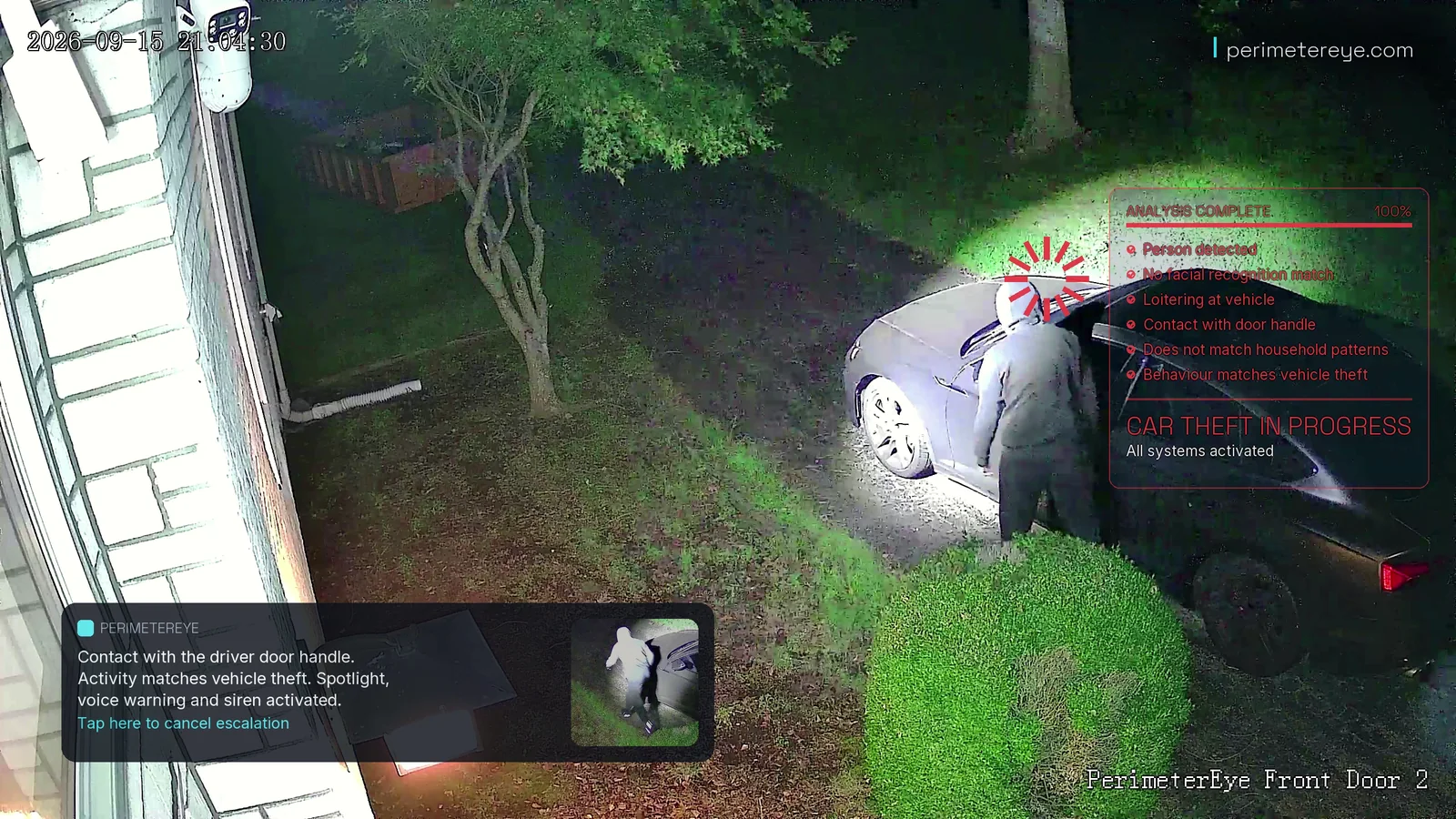
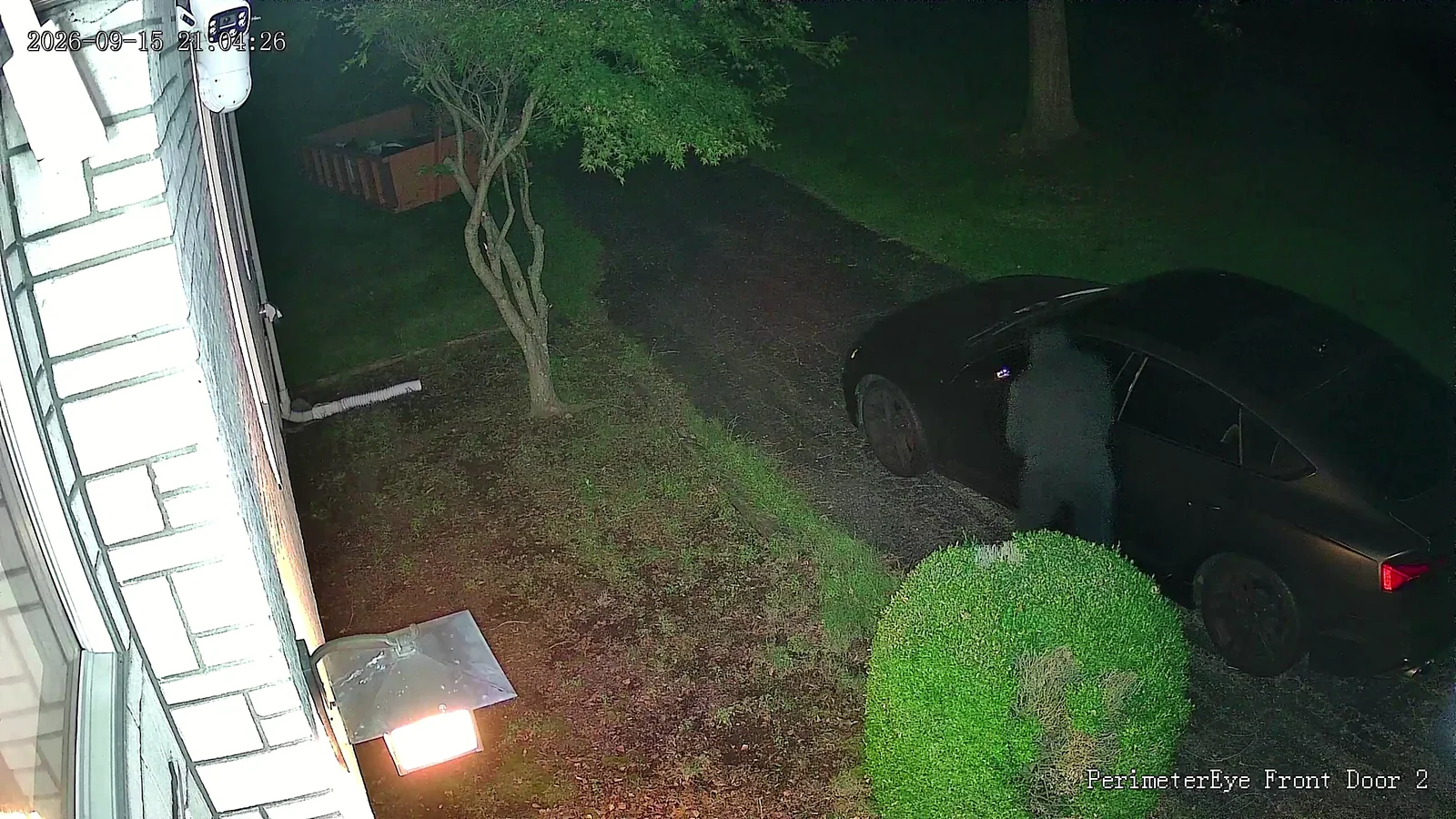
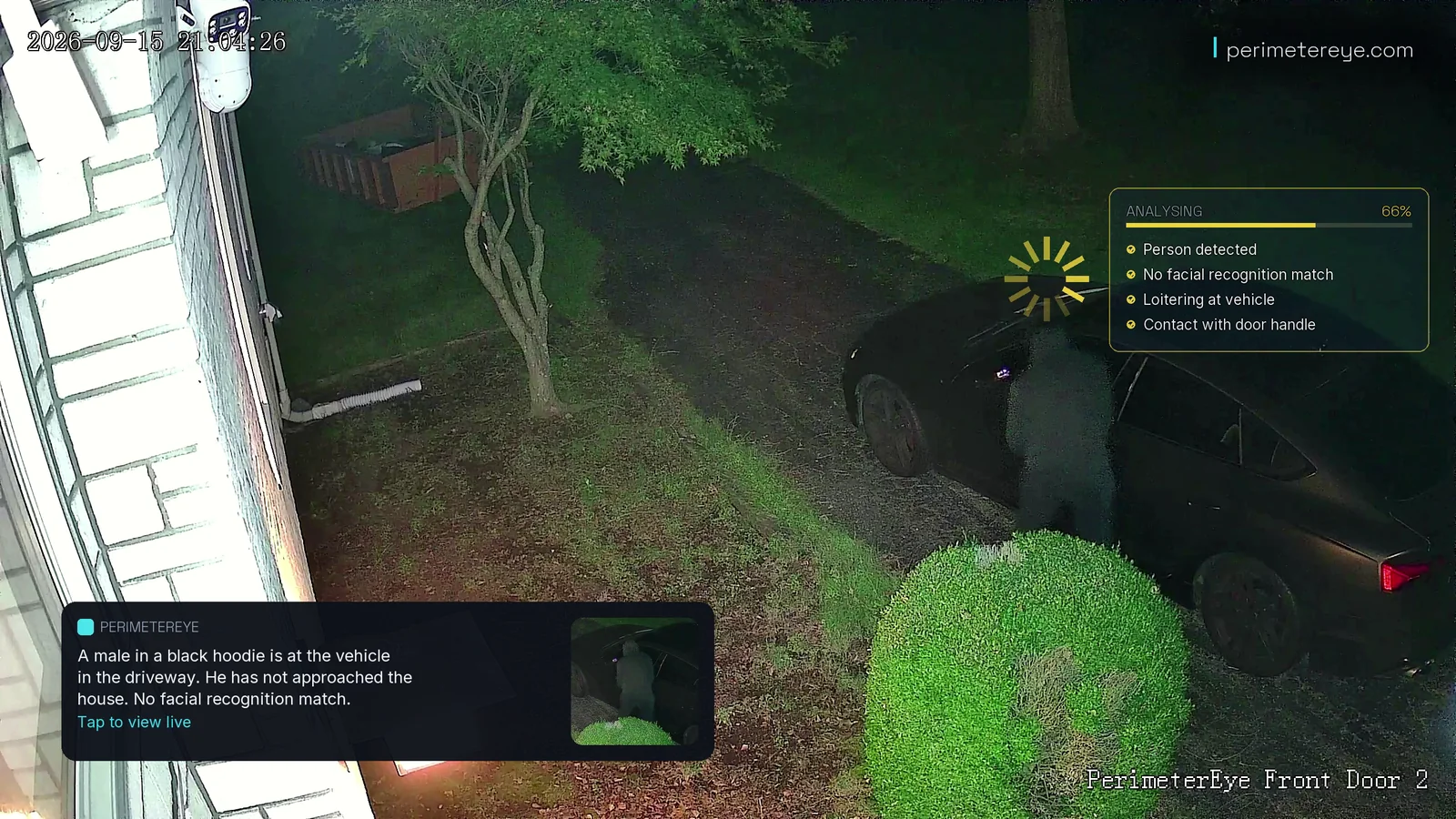
One camera and one staged break-in, shown three ways: the view on its own, with PerimeterEye’s analysis, and with its response hardware.
1 of 3 · A camera aloneView full size
It records
A person at the driver’s door, on a camera that records. Unless someone opens the clip in time, nothing else happens.
2 of 3 · UnderstoodView full size
The same view, understood
PerimeterEye reads the same moment: a person, no match to anyone it knows, loitering at the vehicle, contact with the door handle. The alert describes them in plain language.
3 of 3 · AnsweredView full size
The same view, answered
With a tracking searchlight, a siren, and AI voice warnings, the camera’s view directs a response. Four seconds later, the searchlight is on the person at the driver’s door.
Stills from a vehicle break-in staged for filming on a real property, on the Front Door 2 camera’s clock (21:04:26 and 21:04:30). The system’s response was automatic, with no operator.
What changes
Intelligence that lives where your property lives
- A true edge computer — dedicated CPU, GPU, RAM, and SSD — runs the entire property from the property.
- Local intelligence that acts: tracking searchlight, live targeted voice, and siren, not just a notification.
- Core defense keeps working through internet outages, and no monitoring center ever sees your feeds.
Every camera feed, every recorded second, and every deterrence decision routes through the Brain inside your home. That is why response happens in seconds, why rewind is instant, and why an internet outage does not blind the property. The intelligence is not a service you rent access to — it is a computer you own, running an operating system built for exactly one job.
It changes the privacy math too. There is no monitoring center, no human review, and no stranger with a login to your cameras. Alerts and control go directly to you, the household is known so routine life never trips deterrence, and the plain-language record of everything that happens on your property stays yours.
What every system includes
- On-site edge computer (the Brain)
- 4K AI cameras
- Tracking searchlights
- Live targeted AI voice
- 130 dB siren escalation
- Doorbell video intercom
- Wall panel command center
- iOS app with live 4K video
01
What people really mean by "local AI"
Search for a local AI security system and you are really asking for three things: your video should not have to leave your property to be useful, the system should keep working when the internet does not, and no company — and none of its employees — should be watching your cameras. Those are reasonable demands. Most products fail at least one of them.
The usual compromise is a camera that does basic detection on-device, then leans on distant servers for everything that matters. When the connection drops, the intelligence drops with it. You end up owning hardware that is only smart when it phones home.
02
The Brain: a true edge computer, not a recording box
Every PerimeterEye system is built around the Brain — a dedicated edge computer with its own CPU, GPU, RAM, and SSD, running PerimeterEye OS. It is not a video recorder with a marketing name. It runs the property: live 4K video from every camera, continuous recording, instant DVR rewind, and direct command of every tracking searchlight, siren, and the doorbell intercom.
Because the Brain sits on your property, the response does not wait on a round trip to somebody else's infrastructure. When something crosses the boundary, the system acts on the property itself, in seconds — verifying, lighting, speaking, sounding — while priority alerts with live video reach your phone.
03
Local that only records is still a monitoring box
Here is the frame worth converting: on-device processing, by itself, just makes a better monitoring product. A camera that classifies people locally and then sends you a notification has improved the plumbing, not the outcome. You are still the entire response plan. Local AI that only watches is a private diary of things that happened to your property.
PerimeterEye's intelligence commands physical devices. A verified intruder gets a motorized searchlight locked on and following them, then a live, targeted AI voice describing exactly who it is addressing — "You, in the dark hoodie" — then a 130 dB siren, while alerts with live video reach your phone. That is the difference between local processing and local defense.
04
When the internet goes down, the defense does not
Core defense — live view, recording, instant rewind, the siren, and the tracking spotlights — keeps working during an internet outage, because all of it runs on the on-site Brain. A cut line or a regional outage does not turn your property dark. Recording continues, the rewind buffer keeps filling, and every deterrence device stays under command.
Compare that with cloud-first cameras, where the features that matter most — alerts, AI classification, remote view, often recording itself — thin out or stop the moment the connection drops, often precisely when you would most want them working. With PerimeterEye, remote alerts resume when connectivity does, and everything that happened in between is on the Brain, recorded and waiting for you.
05
Privacy is the default, not a tier
There is no monitoring center, no human review desk, and no stranger with a login to your feeds. PerimeterEye is not an alarm-monitoring service — alerts and control go directly to you. The only people who see your cameras are the people you put on the account.
The system knows the household — family arrivals and the regular mail carrier never trigger deterrence — and it writes a plain-language analysis of every event, so you can search your own history in ordinary English. Your property's record belongs to you, on hardware you own outright.
06
What it costs to own the intelligence
Packages are sized to the property, each including the Brain, 4K AI cameras, motorized tracking searchlights, siren, the PerimeterEye Access doorbell intercom, and the wall panel command center. You own the hardware with no contract, paid monthly, as low as $145.17/mo for Essential (36 monthly payments at 10% APR, $0 down, through Affirm or Klarna, subject to approval), or in full at checkout.
A $99/mo software and AI subscription after six included months from activation for launch system orders keeps the intelligence current and improving. There is no professional-monitoring fee, because there is no monitoring middleman to pay for. What you are buying is a computer that runs your property, plus the software that keeps it sharp. Full package details are at /pricing.
What separates PerimeterEye
Where the intelligence lives.
Cloud cameras send video away to be understood. PerimeterEye understands it at your property.
| Option | Where the AI runs | When the internet drops |
|---|---|---|
| Cloud cameras | In the vendor’s data center, after the video uploads. | Alerts and smart features stop until the connection returns. |
| Cameras with a recorder | Mostly on the recorder: motion or person detection. | Recording continues; remote alerts stop. |
| PerimeterEye | On the Brain, a computer at your property running PerimeterEye OS. | Live view, recording, rewind, searchlights, and siren keep working on the property. |
Watch it at full speed
The same response, on film.
Real footage of the working system. Play it with sound to hear the voice warning and the siren.
A staged vehicle break-in on a real property. Voice warning, tracking searchlight and a 130 dB siren — automatic, on-site, no operator. The scenario was staged for filming; the system's responses were not.
Play with sound to hear the voice warning and siren.What it costs
See what a system costs for your property.
Essential system
As low as$146/mo*Essential covers a driveway and the approaches to the house. Larger properties usually suit Advanced or Estate; a specialist can size it with you before you order.
What’s included
- 5 ultra-HD 4K cameras
- 1 tracking spotlight
- 1 speaker/siren unit
- PerimeterEye Access intercom, included with every complete system
- 1 PerimeterEye control panel
- 1 PerimeterEye AI processor
*Essential system, $0 down: 36 monthly payments of $145.17 at 10% APR on the hardware price before sales tax, shown rounded up to the dollar. Affirm rates 0–36% APR; Klarna terms are shown at checkout. Subject to eligibility and lender approval; your rate, term and down payment may differ. US only; not available in all states. Software is billed separately: first 6 months included, then $99/month.
Before you choose
Common questions
Does PerimeterEye work without internet?
Core defense keeps working through an outage: live view, recording, instant rewind, the 130 dB siren, and the tracking searchlights all run on the on-site Brain. Remote app alerts and remote live viewing need a connection, and they resume automatically the moment yours comes back.
Where does my video live?
On your property. The Brain records continuously to its own SSD, which is why rewind is instant and internet outages do not create gaps. You can pull up live 4K, scrub back through the DVR, and export clips from the iOS app whenever you need a record of an event.
Is the Brain just an NVR with better branding?
No. A network video recorder stores footage; the Brain runs the property. It is a true edge computer — dedicated CPU, GPU, RAM, and SSD, running PerimeterEye OS — that identifies what it sees, decides whether it belongs, and commands the searchlights, siren, voice, and doorbell intercom in real time.
Do humans ever review my footage?
No. PerimeterEye is not an alarm-monitoring service — alerts and control go directly to you. There is no monitoring center, no human agents, and no managed review of your cameras. Access belongs to the people you add to your account, and the hardware holding your history is yours.
If it runs locally, why is there a $99/mo subscription?
The subscription covers the software and AI that keep the system sharp — plain-language event analysis, daily briefing reports, classification improvements, and app services. You own the hardware outright either way, there is no contract, and there is no monitoring fee hiding anywhere inside the price.
What does running locally actually protect?
The response itself. Detection, recording, light, voice, and siren run on the Brain at your property, so they never depend on your internet connection or on a distant server being awake. The defense runs where the property is.
Keep exploring
Related reading
Put a response behind your property.
Tell a specialist about your property, your driveway, and where people approach. They’ll size the cameras, searchlights, and sirens with you, or book a call first if you’d rather talk it through.
Explore an upgrade for your existing camerasSystem launch offer
Your first 6 months
of service included.
First 6 months included from activation. Then $99/month.
Compare system packages